
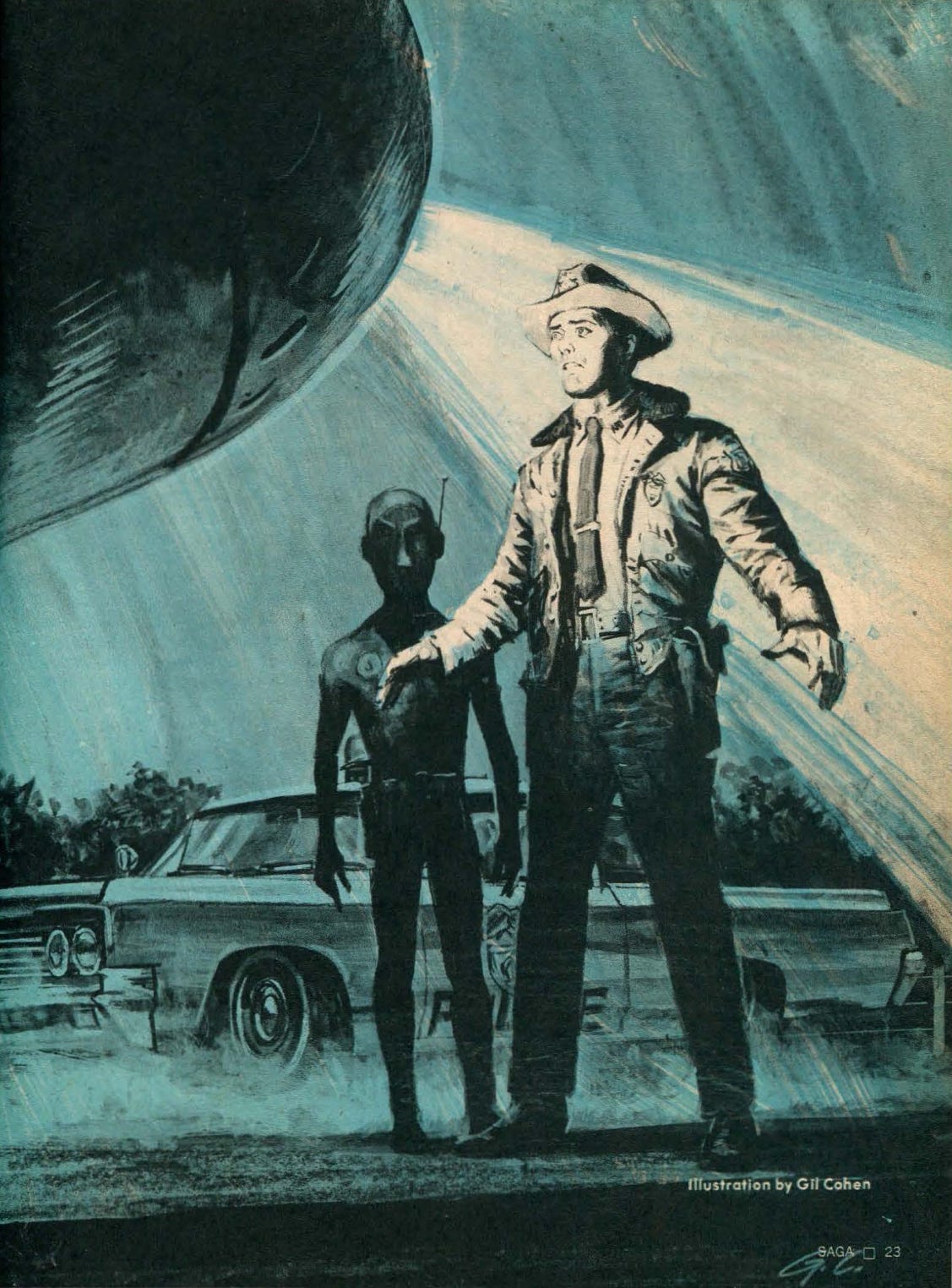
I. INTRODUCTION AND SCOPE OF INQUIRY
In the long and often turbulent history of American UFO investigation, relatively few cases have achieved the peculiar distinction of being simultaneously endorsed by a government–funded scientific committee as meriting serious investigation, subjected to institutional dismissal by that same body’s ultimate published conclusions, and yet preserved against the gravitational pull of official skepticism as a matter of enduring significance in the literature of anomalous phenomena. The encounter reported by Police Sergeant Herbert Schirmer of Ashland, Nebraska, in the early morning hours of December 3, 1967, is precisely such a case. It sits at the intersection of multiple streams of investigative and analytical concern: the official institutional response to the UFO phenomenon, the emerging category of the alien abduction report, the epistemological difficulties surrounding hypnotically recovered memory, the problem of physical evidence and its analysis, and the deeper question of what interpretive framework is adequate to an experience that, whatever its ultimate nature, demonstrably altered the life of a credible witness and left behind a documentary record that cannot be dismissed without cost to intellectual honesty.
At its most elemental level, the Schirmer case presents a straightforward set of facts. A young patrol officer, alone on the quiet intersecting highways of a small Nebraska agricultural community well past midnight, observed a metallic, luminous object hovering above the road surface, watched it ascend and disappear into the night sky, returned to the police station to record what he had seen in his duty log within minutes of the event, and subsequently discovered that approximately twenty minutes of time had gone unaccounted for in his conscious memory. These bare facts were documented in Schirmer’s own handwriting in his official duty log within hours of the event and were investigated by the University of Colorado’s Condon Committee—the most prominent government–sponsored UFO study in American history. The committee found no easy conventional explanation. That much is uncontested in the publicly available record.
What followed transformed what might have remained a notable but unexceptional close–encounter sighting into one of the seminal cases in the history of the alien abduction phenomenon. Under hypnotic regression conducted in February 1968 by Dr. R. Leo Sprinkle of the University of Wyoming—employed by the Condon Committee as a specialist in hypnotic investigation—Schirmer produced a detailed account of being removed from his patrol car, escorted aboard the craft by humanoid occupants of distinctive physical appearance, and subjected to a conducted tour of the vessel during which the entities communicated with him both verbally and through a form of mental telepathy. They explained their mission on Earth, their propulsion technology, their claimed origin in a galaxy adjacent to our own, and their concern for the trajectory of human civilization. These details were initially incomplete as recovered in the committee’s own sessions and subsequently expanded through additional hypnotic regression with hypnotist Loring G. Williams in June 1968—conducted in the presence of writers Warren Smith and Brad Steiger—and became the basis for two books published under Smith’s pseudonym Eric Norman, entering the permanent literature of UFO contact reports where they have remained subjects of ongoing analysis.
As a young man, I had the privilege of speaking with Officer Schirmer in mid– December 1967, and he was gracious enough to answer my questions concerning his experience (this prior to the recovered memories of his “abduction”). The present study undertakes an exhaustive examination of the Schirmer case in all its dimensions: the historical and biographical context that shaped both the witness and the investigative response; the detailed phenomenology of the encounter itself, reconstructed from the best available contemporaneous documentary sources; the immediate response of the Ashland Police Department and the subsequent engagement of the Condon Committee; the hypnotic regression sessions and their implications for the evidential record and the epistemology of memory recovery; the physical evidence examined and the analytical inadequacy of its treatment; the psychological assessment conducted by committee investigators and its proper interpretation; the devastating personal and professional aftermath of the case for Schirmer; the comparative context within the broader abduction literature and the tradition of law enforcement UFO witnesses; the major interpretive frameworks through which the case can be assessed; the theological questions raised by the entities’ communications and the specific symbolism of the winged serpent emblem; and the legacy of the case in both the research literature and the broader culture. Throughout, the Condon Report—formally titled Scientific Study of Unidentified Flying Objects (1969)—functions as a primary documentary source, and its handling of the Schirmer case is subjected to the same critical scrutiny applied to all other evidence.1
This analysis proceeds from a conviction that the Schirmer case demands to be taken with full seriousness not because its ultimate explanation is obvious but precisely because it is not. The case presents genuine evidentiary complexity, a credible and consistent primary witness, documentary corroboration in the form of the contemporaneous patrol log, physical sequelae consistent with a substantial body of comparable cases across multiple countries and decades, and a history of investigation that—whatever its institutional shortcomings—generated a substantial body of material worthy of sustained scholarly attention. The question of how to interpret cases of this type—and, more fundamentally, what framework of understanding is adequate to the phenomena they report—is not reducible to a simple binary between literal acceptance and outright dismissal. The available interpretive frameworks span from the extraterrestrial hypothesis through various psychological and neurological models to the demonic–deception hypothesis that situates the close–encounter phenomenon within the framework of Christian theological anthropology and biblical demonology. Each is examined in the pages that follow, and each is found to illuminate aspects of the Schirmer case while leaving others in darkness.
A note on method: the citation protocol throughout this document treats secondary sources as paraphrase rendered with appropriate signal phrases, reserving direct quotation for primary documents—the Condon Report, Schirmer’s own patrol log entry, and the directly quoted statements of investigators reporting their findings. Endnotes follow the Chicago Manual of Style (17th edition) format in strict ascending sequential order with no gaps or duplicates.
II. HISTORICAL CONTEXT: THE UFO LANDSCAPE OF 1967
A. The Postwar UFO Era and Its Institutional Architecture
To understand the significance of what occurred on a rural Nebraska highway in December 1967, one must situate the event within the broader arc of postwar American UFO history. That history shaped both the investigative response to Schirmer’s report and the interpretive vocabulary available to everyone involved. The modern UFO era is conventionally dated from June 24, 1947, when experienced civilian pilot Kenneth Arnold reported observing nine crescent–shaped objects moving at extraordinary speed near Mount Rainier, Washington. Arnold’s description of their motion as resembling a saucer skipped across water generated, through a process of journalistic condensation, the lasting idiom of the “flying saucer,” and within weeks the Air Force’s Technical Intelligence Command at Wright–Patterson Air Force Base was receiving hundreds of similar reports from across the country.
The timing was not coincidental. The summer of 1947 was a moment of profound Cold War anxiety: the Soviet Union had demonstrated technological capability for surprise, and when unidentified aerial phenomena began appearing in American skies in unprecedented numbers, the question of whether they represented Soviet technology was a legitimate operational concern. This security dimension would remain an important element in the institutional management of the UFO question throughout the period culminating in the Schirmer case. The Air Force’s response was a succession of investigative programs spanning more than two decades: Project Sign (1947–1948), whose internal “Estimate of the Situation” reportedly concluding extraterrestrial origin was ordered destroyed by Air Force Chief of Staff General Hoyt Vandenberg; Project Grudge (1949–1951), with a mandate effectively reversed from investigation to debunking; and Project Blue Book (1952–1969), the longest–running and best–documented program, accumulating over twelve thousand case reports under the scientific consultancy of astronomer Dr. J. Allen Hynek.
Hynek’s engagement with Blue Book began in 1948 as a committed skeptic and evolved, through decades of exposure to cases that resisted easy explanation, into genuine advocacy for serious scientific investigation. His 1966 “swamp gas” attribution for the Dexter–Hillsdale, Michigan, sightings—offered under institutional pressure and received with nationwide derision—became a touchstone of public cynicism about official explanations and directly precipitated the congressional attention that led to the Condon Committee. By the time of his 1972 book The UFO Experience, Hynek had become one of the most influential voices for treating the phenomenon as a genuine scientific problem rather than a sociological curiosity, developing in that work the close–encounter classification system (CE–I through CE–III) that remains the standard analytical vocabulary of the field.2
The civilian research infrastructure developed in parallel. The National Investigations Committee on Aerial Phenomena (NICAP), led for most of its active period by Donald Keyhoe, championed a rigorous evidence–based approach and maintained field investigators across the country. The Aerial Phenomena Research Organization (APRO), founded in Tucson by Coral and Jim Lorenzen, offered broader theoretical tolerance, engaging more readily with entity reports and contact cases. Together these organizations constituted the institutional memory of the phenomenon across administrations, building the comparative databases on which later analytical work depended. By 1967, both had accumulated substantial case files; both would be consulted by the Condon Committee.
B. The 1966 UFO Wave and the Congressional Response
The years immediately preceding the Schirmer encounter were among the most intense in American UFO reporting history. The spring 1966 wave produced sightings that, because of the “swamp gas” episode and the subsequent congressional hearings before the House Armed Services Committee, forced a more substantive Air Force response. The committee pressed the Air Force for an independent scientific study; after negotiations with several institutions wary of the reputational risk, the contract went to the University of Colorado. The project was placed under the direction of Dr. Edward U. Condon—a physicist of genuine distinction who had served as director of the National Bureau of Standards, had been central to the Manhattan Project’s scientific infrastructure, and was a member of the National Academy of Sciences. His selection was meant to confer credibility; it also brought to the project a man who, by his own subsequent behavior, appeared to regard the study as essentially complete before it began.3
The project’s administrative coordinator Robert Low wrote a memorandum on August 9, 1966—before the project had formally commenced—suggesting that the study could be structured to “look like a balanced, objective study” while actually approaching the subject from the perspective of people who believed in flying saucers rather than of the saucers themselves. This memorandum, which became known as the “trick memo,” remained internal until being leaked to Look magazine in 1968 by two of the committee’s own investigators. The resulting controversy was severe. Dr. David Saunders, a psychologist and principal investigator who had conducted substantial fieldwork and developed genuine interest in the phenomenon, was dismissed along with Norman Levine for their role in distributing the document. Saunders subsequently published UFOs? Yes! Where the Condon Committee Went Wrong (1968)—a book that appeared before the Condon Report itself—providing the first documented critique of the project’s institutional integrity.4
C. The Abduction Phenomenon Prior to 1967
The concept of the alien abduction—the unwilling physical removal of a human being by non–human entities, typically involving missing time, physical sequelae, and memory recovered through hypnotic regression—did not exist as a recognizable cultural type in 1947. By December 1967 it was nascent but defined, shaped primarily by two cases: the 1957 encounter of Brazilian farmer Antonio Villas–Boas, and the 1961 encounter of Betty and Barney Hill in New Hampshire. Villas–Boas claimed to have been taken aboard a landed craft and subjected to sexual encounter with a humanoid female entity, subsequently suffering radiation–consistent symptoms including nausea, skin lesions, and weakness. The case established the template of physical contact and bodily aftermath, though its geographical remoteness and unusual content limited its impact on Anglo–American discourse until the mid–1960s.
Of far greater significance for the American investigative context was the Hill encounter of September 19–20, 1961. Betty Hill was a social worker employed in child welfare; Barney Hill was a postal worker active in the NAACP and United Church of Christ. Both were, by all available accounts, credible members of their community with no profile suggesting attention–seeking behavior. Returning from a brief vacation in Montreal, they observed a bright light that paced their car, eventually resolving at close range into a structured craft with figures visible in lighted windows. They arrived home with unexplained physical marks, stopped watches, and a two–hour gap in their recollection. Through hypnotic regression sessions beginning in January 1964 with Boston psychiatrist Dr. Benjamin Simon—a specialist in wartime trauma and hypnotherapy—both independently produced detailed accounts of being taken aboard the craft, separated, and subjected to medical examination by humanoid beings with large, almond–shaped eyes. Betty Hill also described a star map shown to her by the entities.5
John G. Fuller’s account of the Hills’ experience, The Interrupted Journey (1966), became a national bestseller and established in American popular consciousness the basic vocabulary and phenomenological structure of the alien abduction experience: missing time, physical evidence, medical examination, humanoid entities, star map, communication with a leader entity, and hypnotic recovery of memories. Dr. Simon himself carefully distinguished between the psychological reality of the Hills’ experiences and their literal physical actuality, a distinction that would prove relevant to the assessment of Schirmer’s own hypnotically recovered account. By December 1967 the abduction framework was culturally available as an interpretive lens; investigators approaching Schirmer’s case brought it to Boulder with them, a fact with epistemological implications that the analysis must take seriously.6
D. Contemporaneous 1967 Cases
The Schirmer encounter did not occur in isolation. The Portage County, Ohio, police pursuit of April 17, 1966—in which multiple law enforcement officers from several jurisdictions pursued a large structured craft for over eighty miles across county lines—had sensitized both investigators and the public to the particular credibility weight of law enforcement officer reports. The Falcon Lake encounter of May 20, 1967, in which Canadian prospector Stefan Michalak suffered severe radiation burns and grid–pattern lesions on his chest after a close approach to a landed craft, provided a contemporaneous case of extreme physical sequelae documented by multiple examining physicians. Both cases contributed to the investigative context in which the Schirmer report arrived at the Condon Committee, and both demonstrated that physical effects consistent with genuine environmental insult could accompany close–encounter reports from credible witnesses.7
E. The Scientific Standing of UFO Research in 1967
The standing of UFO research within the mainstream scientific community in 1967 was marginal at best and derisory at worst. The American Association for the Advancement of Science did not treat the phenomenon as a legitimate scientific question; Nature and Science, the two most prestigious English–language scientific journals, did not publish papers on UFO evidence; and researchers who expressed serious interest in the subject risked professional damage that could end careers still in their developmental stages. This institutional climate was not incidental to the Condon Committee’s operation but directly relevant to it: the committee’s investigators, recruited from university departments that were embedded in this professional environment, faced personal incentives against reaching conclusions that would be regarded as scientifically embarrassing by their colleagues. The institutional pressure toward negative conclusions that the Low memorandum documented explicitly was therefore not merely an administrative policy decision but a reflection of the professional sociology of American science in the late 1960s.
The one prominent exception to the pattern of scientific dismissiveness was Dr. James McDonald, whose training and institutional position as a senior atmospheric physicist at the University of Arizona’s Institute of Atmospheric Physics gave him both the scientific credibility and the professional security to engage publicly and rigorously with the UFO evidence base. McDonald conducted his own independent investigation of hundreds of cases, traveled extensively to interview witnesses, and appeared before congressional committees and scientific audiences to argue that the phenomenon deserved serious scientific attention. His presentation to the American Association for the Advancement of Science in 1969—“Science in Default: Twenty–Two Years of Inadequate UFO Investigations”—remains the most rigorous scientific critique of the Condon Report ever published in a mainstream scientific venue. McDonald’s tragic death in 1971 removed from the field its most scientifically credible voice and contributed to the two–decade period of institutional inattention that followed.67
The sociological analysis of why the mainstream scientific community failed to engage seriously with the UFO evidence base during this period is itself a rich topic that cannot be fully developed here, but its broad outlines are clear. The phenomenon did not fit the institutional structures of normal science: it was not reproducible in laboratory conditions, it did not generate the kind of data amenable to statistical analysis in peer–reviewed journals, and its association in the popular mind with credulous believers and science fiction enthusiasts created a guilt–by–association problem for any credentialed scientist who wished to investigate it. The result was a self–reinforcing cycle in which the lack of institutional engagement prevented the development of appropriate investigative methodologies, the absence of appropriate methodologies prevented the generation of publishable findings, and the absence of publishable findings perpetuated the lack of institutional engagement.
F. Nebraska in the National UFO Context
Nebraska’s contribution to the American UFO record in the 1960s extended well beyond the Schirmer case, though the Schirmer case has achieved by far the greatest international attention. The state’s vast agricultural landscape, minimal light pollution in rural areas, and stable farming communities whose residents spent considerable time outdoors in all weather conditions—monitoring crops, maintaining irrigation, observing livestock—created a baseline of nocturnal observation and sky familiarity that made Nebraska witnesses generally reliable reporters of atmospheric and aerial phenomena. The FRC archives maintained by this author in Lincoln document a substantial body of anomalous aerial reports from across the state throughout the nineteenth and twentieth century, many of them never appearing in national UFO databases because they were reported only locally or were preserved exclusively in the Fortean Research Center’s own casework.68
The specific geography of the Schirmer encounter location is worth noting in this context. The intersection of U.S. Highway 6 and Nebraska Highway 63 sits in the eastern agricultural corridor of the state, an area characterized by relatively flat terrain with excellent horizontal visibility, minimal natural ground–level obstruction, and dark nighttime skies once one moves a few miles from Omaha’s suburban light influence. A craft approaching from any direction would be visible at considerable distance; conversely, a craft hovering above the road surface at six to eight feet would be dramatically outlined against the flat horizon for any observer within the headlight range of an approaching vehicle. The conditions were, in other words, nearly optimal for the kind of clear, unambiguous observation that Schirmer reported—and were markedly different from the conditions of many ambiguous sighting reports that might plausibly be attributed to atmospheric distortion or distance–degraded perception.
III. THE WITNESS: HERBERT SCHIRMER
A. Background, Military Service, and Entry into Law Enforcement
Herbert Schirmer was twenty–two years old on the night of December 3, 1967. A Navy veteran who had served from 1964 to 1967—during the escalating American involvement in Vietnam—he had returned to civilian life with the intention of pursuing a law enforcement career, initially targeting the Nebraska State Patrol. A routine background check visit to the Ashland Police Department produced an unexpected job offer, which he accepted. He had been with the department approximately seven months at the time of the December 3 encounter. This tenure is a detail worth noting: a seven–month officer who fabricated a dramatic UFO story would face severe professional risk with minimal prospect of gain, in an institutional context where the official record of false reporting would permanently bar him from any law enforcement career.
Ashland, Nebraska, is the seat of Saunders County, situated on U.S. Highway 6 approximately twenty–five miles southwest of Omaha. In 1967 it was a close–knit agricultural community of roughly two thousand residents, where professional reputation and personal character were inseparable. By the consistent testimony of his supervisors and colleagues, Schirmer was regarded as dependable, clear–headed, and possessed of sound judgment. Nothing in his record suggested psychological instability, substance use problems, or a disposition toward attention–seeking behavior. Chief William Wlaschin vouched for his character consistently throughout the investigation, arranged a polygraph examination, and accompanied him to the Boulder sessions—actions reflecting genuine professional confidence in his officer rather than bureaucratic formality.8
B. Character Assessment: The Psychological Testing in Context
The psychological profile that emerged from the Condon Committee’s December 19 assessment presents a more nuanced picture than is sometimes implied in skeptical treatments. IQ testing reflected scores on the lower range for abstract conceptual thinking but on the higher range for concrete problem–solving and spatial reasoning—a profile entirely consistent with effective law enforcement work, which demands practical judgment and situational awareness over abstract theorizing. The word association test results, characterized by the committee as casting doubt on “his honesty in the UFO sighting, or at least seems to indicate that he himself disbelieves the credibility of the sighting,” are susceptible to multiple interpretations. A young man who has experienced something profoundly and genuinely outside the categories of his prior understanding of reality, who is being tested about that experience under institutional scrutiny, might well produce word association results that reflect ambivalence about the credibility of his own experience without that ambivalence being evidence of fabrication.9
The committee acknowledged this confounding variable explicitly, noting both that Schirmer showed “preoccupation with seeing UFO objects” and that “he was given the test after reporting a UFO and that might account for his obsession at the time.” What the psychological assessment did not find is as significant as what it did: no evidence of psychosis, no history of delusional thinking, no indicators of substance use problems, no previous pattern of false reporting. Schirmer was, by all available evidence, a young man of stable character who had had an experience that destabilized him precisely because it was so utterly outside anything he had previously understood to be possible—and who was attempting, with limited tools and no institutional support, to account for that experience in a professional and social context that was singularly unprepared to receive it.
C. The Social Stakes of the Report
The particular character of Schirmer’s community is directly relevant to the evidentiary assessment of his report. In a close–knit agricultural town where social reputation is the primary currency of professional life, the costs of making a publicly embarrassing claim are substantially higher than in an anonymous urban environment. A small–town police officer who reports having seen a flying saucer is not a figure seeking celebrity in a media environment that rewards the sensational; he is a man exposing himself to the kind of sustained community ridicule that, as Schirmer’s subsequent experience devastatingly demonstrated, can end a career and disrupt a life. The subsequent events—the vandalism, the effigy, the departure of his wife, the professional collapse—were entirely predictable from the moment he picked up his pen to write in the patrol log. That he wrote it anyway, and that he maintained the account for fifty years despite the consequences, constitutes a form of evidence about his relationship to his own report that deserves more weight than it typically receives.
D. The Question of Prior Exposure to UFO Literature
One question that has not been definitively answered in the available literature is whether Herbert Schirmer had prior exposure to the UFO literature before his December 1967 encounter. The Hill case had received substantial media coverage since the 1965 serialization in a Boston newspaper and the 1966 publication of Fuller’s book; the Portage County police pursuit had been covered nationally; and UFO–themed publications were widely available in popular American media throughout the 1960s. Whether Schirmer had read Fuller’s book or any comparable account is simply not documented in the available record. His patrol log entry—terse, self–deprecating, containing none of the dramatic narrative elaboration that would characterize a story borrowed from popular sources—is itself the strongest argument that he had not internalized any specific abduction narrative template at the time of the initial report. A person who had read The Interrupted Journey and was constructing an account modeled on it would more plausibly have produced a more elaborate initial report.
The more significant question is whether Schirmer’s exposure to the UFO literature after the initial encounter—through his contact with Warren Smith and Brad Steiger, and through the Williams sessions in which two active UFO researchers were present—may have shaped the elaborated account that emerged from those sessions. This is a genuine and legitimate concern that the honest analyst cannot dismiss. Smith and Steiger were both deeply familiar with the Hill case and with the broader abduction literature as it stood in June 1968; their presence at the sessions and their active participation in questioning necessarily introduced the possibility of inadvertent suggestion. The fact that the Williams sessions produced an account more elaborated and narratively complete than the Sprinkle session—while consistent with the hypothesis of genuine memory recovery proceeding further with additional regression—is also consistent with the confabulation hypothesis of increasing elaboration under conditions of more active investigative suggestion.69
IV. THE ENCOUNTER:
A PHENOMENOLOGICAL RECONSTRUCTION
A. The Pre–Encounter Patrol: Anomalous Animal Behavior
The encounter did not begin at the highway junction. It began earlier in Schirmer’s patrol—at the Ashland Sale Barn, where he found the cattle in an unusual state of agitation and could hear dogs howling in the surrounding neighborhood without apparent cause. Animal behavioral disturbances in proximity to reported UFO encounters constitute one of the most consistently documented associated phenomena in the close–encounter literature, crossing cultural and geographical boundaries with regularity that argues against coincidence. Domestic animals are known to be sensitive to electromagnetic fields, infrasonic frequencies, and other environmental stimuli below human perceptual thresholds; behavioral responses including restlessness and vocalization in cattle and dogs have been documented in proximity to sources of low–frequency electromagnetic radiation. If the craft observed by Schirmer at the Highway 6–63 junction was operating in the vicinity of Ashland before it became directly visible to him, the animal responses would have preceded the visual sighting—precisely the temporal pattern Schirmer documented in his patrol log.10
Schirmer found no conventional explanation for the animal disturbance. He continued his rounds, checking the two gas stations on Highway 6 and logging their status according to standard procedure. The temperature was below freezing under a clear winter sky. By approximately 2:30 in the morning he was approaching the intersection of U.S. Highway 6 and Nebraska Highway 63 at the outskirts of town.
B. First Observation, Approach, and the Object’s Physical Description
As Schirmer approached the intersection, he noticed red lights visible at a short distance down Highway 63—lights he initially interpreted as those of a truck that had stopped or broken down, a routine patrol inference consistent with professional practice. He made a U–turn and drove south toward the lights. As the distance closed, the visual field resolved into something that had no place in his prior experience: a metallic, oval–shaped object hovering above the road surface at an estimated height of six to eight feet, without any visible support beneath it. He stopped the patrol car at a distance of approximately forty feet.11
The physical description Schirmer provided—consistently across his immediate logbook entry, his interviews with Condon Committee investigators, and his hypnotically recovered account—is notable for its specificity and internal coherence. The craft’s exterior was polished aluminum or aluminum–like in appearance, highly reflective in his headlights. Encircling the hull at approximately its widest point was a structural catwalk or walkway—a detail of specific and unusual engineering character with no obvious analog in conventional aircraft design. Above the catwalk were seven oval portholes, each approximately two feet in diameter, through which the blinking red lights were visible. The craft carried a slight tilt from the horizontal and showed no landing gear, no external supports, and no contact with the road surface. Overall dimensions were estimated at approximately twenty feet in diameter and fifteen feet in height.
This level of observational detail—seven portholes, approximately two feet each, catwalk below them, polished aluminum finish, six to eight feet above the road, slight tilt—is characteristic of genuine observational recall rather than the vaguer generalities that typify either misidentification reports or culturally derived confabulation. The Hill case, the primary available abduction narrative template in 1967, contained no comparable structural description of a craft exterior; there was no cultural model for this level of engineering specificity from which Schirmer could have borrowed.
C. The Departure Sequence
When Schirmer activated his high beams, the craft responded immediately: it brightened, tilted to a more pronounced angle from the horizontal, and began to rise. A flame–colored emission appeared from the underside during ascent, producing simultaneously a high–pitched, siren–like sound. Schirmer opened his car door and stood in the doorframe to watch the craft pass nearly directly overhead before it shot upward and disappeared from view with extraordinary velocity. He exited the vehicle, inspected the road surface with his flashlight, found no markings or residue, and drove back to the station. The absence of landing traces on the pavement is consistent with an object that had hovered rather than rested—and potentially with a propulsion mechanism that did not exert downward thrust.12
D. The Patrol Log Entry: Documentary Analysis
The logbook entry Schirmer made upon returning to the station is among the most important documents in this case: a contemporaneous official record, made within minutes of the event, in the officer’s own hand, in the log that supervisors would routinely examine. The entry read substantially: “At 2:30 a.m. December 3, 1967, I saw a UFO at the junction of [U.S. Highway] 6 and [Nebraska Highway] 63. Believe it or not!” The self–deprecating parenthetical—”Believe it or not!”—is psychologically revealing in a direction that argues against fabrication. A person inventing a story for personal benefit does not preemptively acknowledge its probable incredulity; he presents it with confidence. Schirmer’s parenthetical reflects the psychological state of a man acutely aware of the social risks of his report, trying in a moment of dark self–awareness to cushion the impact of something he knew would not be believed. It is the kind of detail that authenticates: not a storyteller’s flourish but a frightened officer’s wry attempt at self–protection.13
When Schirmer noted the time upon returning to the station, it was approximately 3:00 a.m. His subjective estimate of the encounter’s duration was roughly ten minutes—the approach, observation period, departure, brief road inspection, and return drive. A discrepancy of approximately twenty minutes was therefore present from the first moment he checked the clock, independently of any subsequent investigation or hypnotic suggestion. This gap was not a retrospective interpretation; it was a simple arithmetic discrepancy between subjective and objective elapsed time, apparent to Schirmer immediately and independently documented by Condon Committee investigators in their initial December 11–12 interview summary.
E. Physical Sequelae: The Welt, the Headache, and the Buzzing
By the following morning Schirmer was experiencing physical symptoms he could not explain through any conventional cause. A severe headache—not ordinary tension but a persistent, debilitating condition that would interfere with his capacity to work for weeks—was accompanied by a buzzing or humming sensation in his head and ears, and by general malaise. Most significant, and most amenable to independent corroboration, was the red welt discovered on the side of his neck below his left ear: approximately two inches in length by half an inch in width, at the region of the cervical nerve cord, of unexplained origin, and confirmed on physical examination by Chief Wlaschin. Schirmer had no recollection of any injury that might have produced it and no equipment in his patrol car that could have created such a mark. No conventional explanation for the welt was offered by Condon Committee investigators or by any subsequent analyst. The welt was not biopsied or subjected to histological examination, a missed analytical opportunity whose significance is discussed in Section VII.14
F. The Siren–Like Sound: Acoustic Evidence
The sound Schirmer described as accompanying the craft’s ascent—characterized as siren–like or high–pitched, audible through his open car door—constitutes a form of physical evidence distinct from the visual observation and from the physical marks left on his person. Acoustic effects associated with reported UFO craft have been documented across multiple independent cases and take several characteristic forms: high–pitched tones or whistles, low–frequency hums or rumbles, and sudden absolute silence in environments that would normally carry ambient sound. The siren–like quality Schirmer described suggests a high–frequency acoustic emission rather than the engine noise of a conventional aircraft, a characteristic consistent with multiple other close–encounter accounts from witnesses without knowledge of one another’s reports.70
The physiological effects of high–frequency and infrasonic sound are well–documented in the scientific literature and include the kinds of symptoms Schirmer experienced in the aftermath of the encounter: headache, dizziness, nausea, tinnitus–like auditory phenomena, and in extreme cases temporary alteration of consciousness. If the craft emitted a high–powered acoustic signal during its ascent, the combination of proximity and intensity might account for some of the physical sequelae that Schirmer experienced without requiring any additional mechanism. This does not explain the neck welt or the missing time, but it potentially accounts for the headache and the buzzing sensation that he described as persistent in the days following the encounter.
G. Comparative Craft Phenomenology: The Schirmer Object in Context
The physical characteristics of the craft Schirmer described—its oval shape, polished aluminum finish, catwalk encircling the hull, oval portholes, hovering attitude, and flame–colored emission during ascent—can be compared with a substantial database of craft descriptions from other close–encounter cases to assess the degree of consistency with what might be called the “standard morphology” of reported close–encounter craft. The results of this comparison are informative. The oval or disc shape is the most commonly reported form in the close–encounter literature across all periods and cultures. The catwalk or structural ring below the portholes is a less universally reported feature but appears in a sufficient number of independent cases to constitute a recognizable variant. The polished metallic surface with high reflectivity is reported with some consistency. The oval portholes producing illumination visible from outside are a common element.71
What distinguishes the Schirmer craft description from generic cultural contamination based on “flying saucer” imagery is precisely the specificity of certain details: the seven portholes (not “several” or “many”), the catwalk structure (not merely a smooth exterior), the slight tilt from horizontal (not the level hover of simplified saucer imagery), and the observation that the craft lacked landing gear or ground contact despite hovering at only six to eight feet—a detail that would be visible to an observer with professional attention to physical detail in a way that might not be noted by someone whose account was primarily derived from cultural imagery of “flying saucers.”
V. THE CONDON COMMITTEE INVESTIGATION
A. Initial Response: December 11–12, 1967
Word of Schirmer’s encounter reached the Condon Committee with unusual speed—investigators arrived in Ashland within nine days of the event, on December 11 and 12, 1967. The primary field investigator was Roy Craig, a physical chemist who served as the committee’s chief scientific field investigator and who would later publish a candid memoir of his experiences, UFOs: An Insider’s View of the Official Quest for Evidence (1995). Craig’s investigation focused on the physical dimensions of the case: examination of the encounter site, collection of the metallic fragment found by Wlaschin, interviews with Schirmer and Wlaschin, and preliminary credibility assessment. The site examination produced no physical evidence beyond the metallic fragment; testing for radioactivity found nothing. A second Condon representative, John Ahrens, returned to Ashland on December 19 to conduct psychological testing.15
The metallic fragment recovered by Wlaschin—described as unrecognizable material, not identified by an experienced law enforcement officer as ordinary roadside debris—was analyzed by committee investigators and found to be composed of iron and silicon. The committee’s published characterization of it as “probably ordinary corroded earthly waste” rested on the observation that iron and silicon are common terrestrial materials, which is accurate but analytically incomplete. The committee did not conduct isotopic ratio analysis, crystal structure determination, transmission electron microscopy, or other analyses that might distinguish different manufacturing sources or identify whether the material had been exposed to unusual physical conditions—electromagnetic radiation, high–energy particle bombardment, or other effects that leave identifiable signatures in material microstructure. The conclusion that the material was ordinary earthly waste was based on analysis insufficient to establish that conclusion with confidence.
B. The Polygraph and Psychological Testing
Chief Wlaschin arranged a polygraph examination of Schirmer through what he described as an experienced official agency whose identity he declined to reveal. By Wlaschin’s report to the committee, the results showed no indications of deception. Polygraph evidence is imperfect and not admissible in most legal contexts; it can be defeated by controlled subjects and can produce false positives from anxious but honest witnesses. Nevertheless, a passing result on a properly administered examination by a trained examiner carries some evidential weight in assessing a witness’s account, particularly when the alternative hypothesis requires not merely self–delusion but active and sustained fabrication under professional scrutiny. Schirmer had passed this examination; no subsequent investigation identified any prior pattern of false reporting that would undermine the result’s significance.16
The Ahrens psychological assessment produced the complex picture described in Section III: IQ profile consistent with practical law enforcement work; word association results the committee interpreted as reflecting either dishonesty or self–disbelief. The committee acknowledged the confounding variables—the testing was conducted in the immediate aftermath of a disorienting experience, and Schirmer’s reported “preoccupation with UFO objects” was unsurprisingly explained by his having just reported a UFO encounter. What the assessment did not find—no psychosis, no delusional history, no substance use, no pattern of fabrication—is as significant as what it did, and constitutes the baseline of psychological credibility against which the hypnotically recovered account must be assessed.17
C. The Boulder Sessions: February 13, 1968
The most significant phase of the committee’s engagement came on February 13, 1968, when Schirmer and Chief Wlaschin traveled to Boulder. In addition to further interviews, the committee employed hypnotic regression—recognizing that the twenty–minute temporal gap could not be addressed through ordinary interview techniques. The hypnotist selected was Dr. R. Leo Sprinkle, a psychologist in the University of Wyoming’s counseling program who had developed specific experience with UFO–related cases and who would go on to become one of the most active practitioners of regression hypnosis in the field, founding the Rocky Mountain Conference on UFO Investigation and conducting sessions with numerous witnesses over a career spanning decades. His involvement in the Schirmer case was among his earlier high–profile engagements with a witness referred by an official investigative body.18
Sprinkle disclosed his own priors with unusual candor, acknowledging that he personally believed in the reality of extraterrestrial visitation and that this belief might color his interpretation of the session. This candor is analytically significant in both directions: it enhances his credibility as a clinician committed to intellectual honesty while appropriately prompting scrutiny of how his priors may have shaped his conduct of and response to the regression. A hypnotist who believes in alien abductions is likely to frame questions and respond to subject narratives in ways that, even without deliberate intent, may encourage the emergence of an abduction–consistent account. This methodological concern does not invalidate the session’s findings but requires that those findings be assessed with appropriate caution.
D. What the Regression Produced
Under hypnotic induction, with Chief Wlaschin and Condon Committee staff as observers, Schirmer produced an account substantially more elaborate than anything he had been able to offer in conscious interviews. As his patrol car approached the craft, the engine and radio simultaneously ceased functioning—electromagnetic effects consistent with exposure to a powerful broadband electromagnetic field, and representing one of the most consistently reported CE–II phenomena in the close–encounter literature. A white or luminous object emerged from the craft and established mental contact with him, preventing him from reaching for his weapon despite his instinct to do so.19
He described being removed from the patrol car—through a process of guided walking rather than any dramatic lifting—and escorted to an opening in the craft’s underside. Once inside, he found a space more expansive than the craft’s exterior dimensions should have permitted, with smooth curved walls and ambient illumination of no identifiable source. The entities he encountered—described in detail in the following subsection—conducted a tour of the vessel and communicated an extended briefing on their nature, mission, and technology.
Entity Description: A Detailed Profile
The entities stood between four and a half and five feet in height, with grayish–white skin of unusual smoothness, narrow elongated heads, and slightly slanted eyes described as cat–like in configuration. The eyes’ most noted characteristic was that they did not blink—a detail that recurs with striking frequency in independent close–encounter accounts and that witnesses consistently describe as profoundly and specifically unsettling. The entities wore silver–gray uniforms incorporating close–fitting helmets with a small antenna positioned on the left side near the ear, which Schirmer understood to be connected to the communicative process. On the left breast of each uniform was displayed an emblem: a winged serpent. This specific symbolic detail—distinct from anything in the Hill case narrative, not drawn from any widely circulated 1967 UFO literature, and subsequently identified in at least three other independent close–encounter reports—is among the most analytically significant features of the Schirmer account.20
The Tour and the Briefing
The entity designated as the leader—distinguished by bearing rather than physical differentiation—explained that the craft drew its operational energy from electrical transmission lines, demonstrated the propulsion system on a display screen, and showed Schirmer a star map indicating their galactic origin with the statement: “This is where we are from: a galaxy next to yours.” The entities described secondary bases on Venus and underwater facilities off the coasts of Florida and Argentina, and characterized their mission as long–term benevolent monitoring of human civilization with specific concern about nuclear weapons development. They told Schirmer they would visit him twice more and that someday he would “see the universe.” The crew leader used an instrument near Schirmer’s neck during the encounter—a detail whose potential connection to the neck welt subsequently discovered is not established but cannot be dismissed.21
At one point during the session, Schirmer—apparently in what Sprinkle interpreted as continuing mental contact with the entities—stated that it would be “wrong to say anything else about the sighting until they were in the proper place at the proper time,” resisting Sprinkle’s attempts to probe further. Sprinkle ended the session without obtaining a complete account. After the session concluded, Schirmer was able to recall additional details in a waking state, including the beings’ use of electrical power systems and the locations of their Earth operations.
E. Sprinkle’s Assessment and the Committee’s Formal Conclusion
Sprinkle concluded clinically that Schirmer “believed in the reality of the events he described”—a formulation that distinguishes the witness’s sincerity from the literal truth of his account, and that reflects the appropriate level of professional restraint for a clinician working in a contested evidential domain. The Condon Committee’s formal assessment was substantially more negative: “Evaluation of psychological assessment tests, the lack of any evidence, and interviews with the patrolman left project staff with no confidence that the trooper’s reported UFO experience was physically real.” This conclusion—carefully worded to avoid claiming the experience had been shown non–physical—effectively foreclosed further investigation without pursuing available physical analyses to their analytical limits, following up the landing site identification through more sophisticated methods, or engaging with the physiological implications of the independently confirmed neck welt. The committee’s negative conclusion rested on absence of compelling positive evidence, not on the presence of counter–evidence, a distinction that matters in any honest epistemological reckoning with the case.22
F. The Committee’s Treatment of the Case in Context
The Schirmer case appears in the Condon Report as case study number 49—one of a substantial number of cases examined by committee investigators in the field during the study period. A survey of the published case studies reveals a pattern: cases with strong physical evidence and credible witnesses were, in many instances, classified as unexplained in the committee’s own analysis, yet the report’s summary conclusions cited “the lack of any evidence” as a basis for the overall negative assessment. The Schirmer case exemplifies this pattern: the committee’s own investigators confirmed the missing time, confirmed the neck welt (through Wlaschin’s testimony), confirmed the polygraph result, and conducted a regression session that produced detailed testimony about a physical encounter—yet the formal conclusion was that “project staff” had “no confidence” that the experience was “physically real.”
McDonald’s critique of this specific pattern—positive evidentiary findings in individual case summaries generating negative general conclusions—was the core of his “Science in Default” argument. He noted that the Condon Report contained many cases that the committee’s own investigators could not explain through any available conventional mechanism, yet the report’s general conclusion that further study was not warranted implied that the unexplained cases were an acceptable scientific residue rather than a mandate for continued investigation. This logical gap between the body of the report and its conclusions is perhaps the most fundamental methodological flaw in the Condon Committee’s work, and the Schirmer case is a particularly clear illustration of it.72
G. The Role of the Polygraph in the Evidentiary Assessment
The evidential status of the polygraph in the Schirmer case warrants more extended treatment than it has received in most secondary discussions. Polygraph examination—technically known as psychophysiological detection of deception—operates by measuring physiological indicators of autonomic nervous system activity (skin conductance, blood pressure, heart rate, respiration) in response to questions about specific topics. The theory underlying its use as a deception detection instrument is that deception involves suppressed physiological arousal that manifests in measurable autonomic responses even when the subject is attempting to conceal it. The technique has a substantial validation literature demonstrating accuracy rates significantly better than chance in controlled laboratory conditions, and a more contested literature on field applications where conditions are less controlled and base rates of deception differ from laboratory populations.
In the Schirmer case, the polygraph was administered by what Wlaschin described as a professional agency whose identity he declined to reveal—a circumstance that has sometimes been read as suggesting the agency was official or quasi–official, perhaps connected to law enforcement or military intelligence. The specific questions asked, the conditions of administration, and the full report of results are not available in the public record. What is available is Wlaschin’s characterization that the results showed no indications of deception—a formulation that, in polygraph usage, indicates that the subject’s physiological responses to the relevant questions were not elevated above baseline in the way that deception typically produces. For a subject who is consciously fabricating an account, this result is difficult to explain through mechanisms other than either sophisticated countermeasures (for which there is no evidence in Schirmer’s background) or the fundamental alternative: that the account being tested was not consciously fabricated.
VI. AFTERMATH:
CAREER DESTRUCTION AND
THE WILLIAMS SESSIONS
A. Return to Ashland: Social and Professional Catastrophe
When Herbert Schirmer returned to Ashland from the Boulder sessions in February 1968, he was returning not to vindication but to a social catastrophe whose dimensions had been developing since his December report became public knowledge. The community’s reaction ranged from skepticism to deliberate, sustained hostility. Citizens who received traffic citations from Schirmer reportedly laughed and tore them up; his authority as a peace officer was effectively withdrawn by a community whose respect he had lost. His patrol car was dynamited—an act of deliberate criminal destruction that escalated the harassment from verbal to physical. Tires were slashed and the windshield broken. An effigy bearing his name and dressed in a cowboy hat was hanged in the Ashland Cemetery and subsequently transported by local ambulance personnel to the town morgue in an act of elaborate communal mockery that communicated, with unmistakable clarity, the community’s judgment of his credibility and fitness for continued public service.23
Following Wlaschin’s resignation from the department—timing that left Schirmer newly appointed as Chief of Police at precisely the moment of greatest social hostility—Schirmer attempted to perform his duties but found concentration impossible. Persistent, debilitating headaches continued from the December encounter; by his own subsequent account he was “gobbling down aspirin like it was popcorn.” His wife, unable to sustain the personal and social costs of the controversy, left him. The appointment as chief proved brief—within two months, at most, he had resigned, his law enforcement career ended at the age of twenty–two by an experience whose professional costs were immediate, total, and permanent.24
B. Warren Smith, Brad Steiger, and the Williams Sessions
Seeking resolution to the psychological torment generated by an experience he could neither adequately explain nor put behind him, Schirmer contacted Warren Smith—an Iowa–based writer who produced material on paranormal and UFO topics under his own name and under the pseudonym Eric Norman. Smith arranged hypnotic regression sessions with Loring G. Williams, a professional hypnotist, with Smith and Brad Steiger both present. Steiger, born Eugene Olson in Decorah, Iowa, and by 1968 the author of numerous works on UFOs and the paranormal, was one of the most widely read popular writers on anomalous phenomena of his generation, bringing to the sessions both substantial investigative experience and acknowledged prior theoretical commitments to the reality of the UFO phenomenon. The sessions were conducted June 8, 1968.25
Under Williams’s direction, Schirmer produced the definitive elaborated version of his abduction account—the version that has served as the primary source for nearly all subsequent analytical treatments. The tour of the craft was described more completely; the entities’ physical characteristics were developed in greater detail; the information communicated by the crew leader was expanded and systematized. The most analytically striking development during the sessions was a perspectival shift noted by Steiger in his retrospective accounts: at a certain point, Schirmer abruptly began speaking not as himself but as one of the entities, indicating in the third person that the beings would monitor Herb periodically and return from time to time. Steiger characterized this with the appropriate epistemological care: “Either it’s a case of extreme identification or some sign of hypnotic contact that we seem to uncover as we probe deeper and deeper into the unconscious.” The second interpretation—that the entities’ influence on Schirmer persisted in some form beyond the physical encounter—carries implications that no secular analytical framework can fully accommodate.26
C. The Published Accounts and Their Limitations
Warren Smith’s accounts of the Schirmer case—published as Gods, Demons, and Space Chariots (1970) and Gods and Devils from Outer Space (1975) under the Eric Norman pseudonym—reached a substantial popular audience and established the primary narrative framework through which most readers first encountered the case. Their theoretical framing within the ancient astronaut hypothesis, popularized contemporaneously by Erich von Däniken’s enormously successful Chariots of the Gods? (1968), introduces speculative commitments that go well beyond what the Schirmer evidence supports. The factual core of Smith’s account—the physical details of Schirmer’s report, the content of both sets of hypnotic sessions, the aftermath of the encounter—is substantially corroborated by the Condon Committee record and by Sprinkle’s clinical notes, suggesting that whatever his theoretical enthusiasms, Smith was reporting accurately what he observed and heard.27
Ralph and Judy Blum’s Beyond Earth: Man’s Contact with UFOs (1974) provided a more analytically cautious subsequent treatment, drawing on multiple sources and engaging—more seriously than Smith—with the epistemological questions surrounding hypnotic regression. Kevin Randle’s “The Schirmer Abduction 40 Years Later” in Fate magazine (May 2008) constitutes probably the most rigorously evidential secondary treatment available, examining the timeline and investigative record with the careful attention to specific documented detail that distinguishes serious UFO research from popular sensationalism. Randle identified genuine methodological problems with the case investigation while acknowledging what could not be easily explained, modeling the kind of epistemological balance that the evidence demands.28
D. The Psychological Burden of the Encounter: Long–Term Effects
The long–term psychological effects of Herbert Schirmer’s December 1967 encounter have not been extensively documented in the clinical literature, in part because Schirmer did not seek formal psychiatric treatment for the encounter–related symptoms and in part because the close–encounter research community of the late 1960s and 1970s did not have the clinical infrastructure that later developed for working with abduction witnesses. What is documented through Schirmer’s own accounts—the persistent headaches, the difficulty concentrating, the ongoing preoccupation with the experience—is consistent with the symptom profile that clinicians working with abduction witnesses in the 1980s and 1990s would come to recognize as characteristic of what John Mack and others described as a complex psychological response to a genuinely anomalous experience.
The pattern of symptoms Schirmer described—persistent physical sequelae, preoccupying intrusive thoughts about the encounter, difficulty functioning in the normal professional environment, and what appears to have been a form of hypervigilance about the possibility of future contact—has structural similarities to the post–traumatic stress responses documented in survivors of other types of anomalous or overwhelming experience. Whether this constitutes evidence that the encounter involved a genuine physical event producing neurophysiological disruption, or whether it reflects the psychological impact of having an experience that one cannot account for and that one’s social environment refuses to validate, is not determinable from the available evidence. Both explanations are consistent with the documented symptom pattern; the physical welt and electromagnetic effects, independent of the psychological symptoms, are the evidence that most clearly argues for the former.73
E. The Williams Sessions in Investigative Context
The June 1968 Williams sessions occurred approximately four months after the Boulder Sprinkle session, during a period in which Schirmer had resigned from the Ashland Police Department, lost his first marriage, and been effectively ejected from the community in which he had planned to build his professional life. His psychological state at the time of the Williams sessions was therefore significantly more distressed than it had been at the time of the Sprinkle session—a circumstance with direct bearing on the epistemological assessment of the sessions’ output. Individuals under psychological stress are, in the clinical literature on memory and suggestibility, more susceptible to the influence of external narrative framing; the combination of Schirmer’s distress, the presence of two active UFO researchers whose prior beliefs were known, and the hypnotic context created the conditions most favorable to the emergence of an elaborated and narratively coherent account regardless of the account’s relationship to literal physical events.
This assessment does not mean the Williams sessions’ content is worthless; it means the content must be evaluated with appropriate methodological caution, distinguishing between elements that were already present in Schirmer’s pre–session accounts (the craft’s physical description, the missing time, the physical sequelae) and elements that emerged for the first time or were substantially elaborated under the conditions of these specific sessions. The former category constitutes stronger evidence than the latter, because the former was documented before the suggestive conditions of the Williams sessions were operative. The crew leader’s briefing on propulsion, the star map display, the promises of future contact—elements elaborated substantially in the Williams sessions beyond what had emerged under Sprinkle—must be held more lightly than the physical description of the craft, the entity appearance, and the temporal anomaly, all of which were established in contemporaneous records or in the pre–regression interview record.
VII. PHYSICAL EVIDENCE:
SYSTEMATIC ANALYSIS AND ASSESSMENT
A. The Metallic Fragment: Chain of Custody and Analytical Gaps
The metallic fragment recovered by Chief Wlaschin at the encounter site on the morning of December 4, 1967, is the most tangible physical artifact in the case, and its analytical history illustrates both the evidential potential of physical trace materials and the specific ways in which the Condon Committee’s investigative approach failed to realize that potential. Wlaschin described the material as something he did not recognize—a characterization carrying evidential weight precisely because he was an experienced law enforcement officer familiar with the normal detritus of rural roadsides. The committee’s chemical analysis identified it as composed of iron and silicon, and the committee characterized it as “probably ordinary corroded earthly waste.” This conclusion, while possibly correct, was based on analysis insufficient to establish it with confidence.29
Iron and silicon are indeed common terrestrial materials, and iron–silicon alloys (ferrosilicon) are produced in quantity for industrial applications. Their presence in a small metallic fragment found at a rural roadside does not by itself establish exotic origin. What the committee did not conduct: isotopic ratio determination, which can identify geological provenance and exposure to specific radiation environments; crystal structure analysis, which can distinguish manufactured from naturally occurring iron–silicon compounds; surface morphology examination, which can characterize the history of the material’s formation; or any of the range of analyses that post–1968 materials science has developed for characterizing samples of unknown origin. The techniques were available in 1968 university chemistry laboratories; they were not applied. The committee’s conclusion that the material was ordinary earthly waste was not a positive identification of terrestrial origin but a failure to find anything definitively non–terrestrial—a distinction that matters in any rigorous evidentiary assessment.
B. The Neck Welt: Medical and Anatomical Significance
The red welt on Schirmer’s neck presents a categorically different evidentiary situation from the metallic fragment. It was a feature of the witness’s own body—visible, palpable, and present within hours of the encounter. Its confirmation by Chief Wlaschin constitutes independent corroboration of Schirmer’s description; it was not a self–report but an objectively observed physical finding documented by a supervising officer with every institutional reason to approach the whole matter with skepticism. No conventional explanation for the welt was offered by committee investigators or by any subsequent analyst.30
The welt’s anatomical location is medically specific and potentially significant: on or near the cervical nerve cord below the left ear, in the region of the sternocleidomastoid muscle and adjacent neurovascular structures including branches of the cervical plexus and fibers of the vagus nerve. The vagus nerve plays a central role in the autonomic nervous system; stimulation or modulation of vagal fibers can produce wide–ranging systemic effects including altered states of consciousness, changes in heart rate and blood pressure, and various autonomic phenomena. If any instrument applied to this site during the reported encounter was designed to interact with the nervous system—for communication, for the induction of an altered state, or for some other purpose whose effects included the paralysis and the subsequent missing time—the lateral neck nerve cord would be an anatomically logical target. The welt was not biopsied, not histologically examined, and not subjected to any analysis that might have characterized its tissue changes and formation mechanism. This represents a genuine missed evidentiary opportunity.31
Physical marks of various types—linear lesions, circular scars, unexplained bruising, small puncture wounds—appear with notable regularity in the clinical literature on alleged abduction witnesses. The psychiatrist and Harvard Medical School professor John Mack, whose book Abduction: Human Encounters with Aliens (1994) represents the most detailed clinical engagement with abduction accounts by a qualified medical researcher, documented numerous cases of physical marks his clinical team could not explain through conventional medical mechanisms. The Schirmer welt, viewed in this context, is consistent with a pattern that demands explanation rather than dismissal, and its specific anatomical location—on a neurologically significant structure in close proximity to where the entities reportedly applied an instrument—is a detail that cannot be set aside without analytical cost.
C. Electromagnetic Vehicle Effects as Physical Evidence
The simultaneous failure of the patrol car’s engine and radio during Schirmer’s approach to the craft—reported through hypnotic regression rather than in his initial conscious account—represents a form of physical evidence that, while recovered through a methodologically contested process, is consistent with the largest database of vehicle–related UFO effects in the research literature. Mark Rodeghier’s systematic catalogue, UFO Reports Involving Vehicle Interference(1981), documented that electromagnetic vehicle failure is among the most consistently reported CE–II phenomena across independent cases from multiple countries and decades. The characteristic pattern—simultaneous failure of multiple independent electrical systems rather than sequential failure of individual components—is consistent with exposure to a powerful broadband electromagnetic field rather than with conventional mechanical failure. Schirmer’s description of both the engine and the radio failing simultaneously fits this pattern precisely.32
D. Animal Behavioral Anomalies: Temporal Sequencing and Significance
The agitated cattle at the Ashland Sale Barn and the neighborhood dogs’ vocalization—reported in Schirmer’s contemporaneous patrol log and not through hypnotic recovery—constitute secondary physical evidence in a specific and important sense: they were recorded before the encounter at the highway junction, in the officer’s official contemporaneous log, without any connection being drawn between them and the subsequent UFO observation. The animal disturbances preceded the visual sighting temporally, suggesting that whatever environmental anomaly produced the reported craft was already present in the area and affecting local biology before Schirmer directly encountered it at the intersection. This temporal sequence—animal anomaly preceding sighting—appears in multiple independent close–encounter cases and is one of the details that is genuinely difficult to account for through purely psychological mechanisms, since Schirmer logged the animal disturbance as a routine patrol observation without any prior expectation of the encounter that would follow.33
E. Landing Site Investigation: What Was and Was Not Found
The hypnotically recovered account identified a specific landing location—not the highway surface itself but a field or open area near the Highway 6–63 junction—where Schirmer described the craft as having actually rested on or near the ground during the portion of the encounter in which he was aboard the vessel. Condon Committee investigators searched this location and found no residual radioactivity. The absence of radioactivity is commonly cited in skeptical discussions of the case as evidence that no physical event occurred at the location, but this inference deserves scrutiny. Not all propulsion hypotheses for anomalous craft involve nuclear processes; electromagnetic or plasma–based propulsion systems—the kind implied by the entities’ description of their power extraction from electrical transmission lines—would not necessarily leave radioactive signatures. Testing for radioactivity, while appropriate as one element of a physical site investigation, is not a comprehensive physical survey, and the absence of radioactivity at a site does not establish the absence of all physical disturbance.74
Ground penetrating radar, soil compression analysis, magnetic anomaly surveys, and chemical analysis of soil samples for unusual organic or inorganic compounds were all techniques either available or developable in 1968; none was apparently applied to the Ashland landing site. The physical site investigation conducted by the Condon Committee was limited to visual inspection and radioactivity testing—a scope of investigation adequate to detect only specific types of physical effects, and inadequate to the full range of effects that a genuine landing event might produce. This limitation reflects the general pattern identified by McDonald: the application of investigative tools that were certain not to find the kind of evidence they were not designed to detect, followed by the conclusion that no evidence had been found.
F. Physical Evidence in Comparative Close–Encounter Cases
A comparative survey of physical evidence in close–encounter cases with characteristics similar to Schirmer’s illustrates both what was found elsewhere and what might have been sought in Ashland with appropriate investigative effort. The Trans–en–Provence case of 1981—in which a French farmer observed a disc–shaped craft land in his field, and in which subsequent investigation by GEPAN (the French government’s UFO investigation group) found soil compression, heat effects, and biochemical changes in vegetation at the landing site—demonstrated what a properly resourced physical site investigation could recover from a close–encounter landing location when the investigation was conducted by trained scientists using appropriate analytical tools. GEPAN’s analysis of the Trans–en–Provence site, published in scientific literature, provided some of the most rigorous physical evidence for a close–encounter landing event in the history of the field.75
The Delphos, Kansas, case of November 2, 1971—in which a glowing ring of soil was left at a landing site, with the ring material showing physical and chemical anomalies including hydrophobic properties and unusual fluorescence under ultraviolet light—provided another contemporaneous example of recoverable physical trace evidence from a close–encounter landing. Soil analysis conducted by multiple independent laboratories found that the ring material differed from surrounding soil in ways that could not be explained by conventional agricultural or biological processes. Cases like Trans–en–Provence and Delphos demonstrate that physical site investigation with appropriate tools can, under the right circumstances, recover material evidence of genuine physical events at close–encounter locations. The absence of such investigation at the Ashland site in December 1967 or subsequently is therefore a genuine evidentiary gap, not a demonstration that no evidence was available to be found.
VIII. COMPARATIVE ANALYSIS:
THE SCHIRMER CASE IN CONTEXT
A. The Hill Case: Structural Parallels and Critical Divergences
The comparative relationship between the Schirmer case and the 1961 Hill encounter is the most discussed structural comparison in the literature, and for good reason: the parallels are genuine and numerous. Both cases involve a witness in a vehicle on an isolated road in the late–night or early–morning hours; close–range observation of a structured craft; electromagnetic effects on the vehicle; physical symptoms after the encounter; missing time discovered upon return to a reference point; detailed memories recovered under hypnotic regression; and communication with the craft’s occupants involving both verbal and quasi–mental elements. These parallels have been cited both as evidence of a consistent real phenomenon and as evidence of cultural contamination—the Schirmer account borrowing from the Hill template.34
Against the cultural contamination hypothesis must be weighed the structural divergences, which are as analytically significant as the parallels. The entities described by the Hills—small, gray–skinned beings with disproportionately large, almond–shaped eyes dominating hairless faces—differ substantially from Schirmer’s taller humanoids with slitted non–blinking eyes and distinctively uniformed appearance. The Hill encounter emphasized medical examination with specific physical procedures; the Schirmer encounter emphasized information transfer, craft orientation, and the entities’ stated mission. Betty Hill’s star map was shown in the context of a primarily clinical encounter; Schirmer’s star map appeared during a briefing on the entities’ origin. And Schirmer’s winged serpent emblem—the most distinctive single detail of his account—has no counterpart in Fuller’s book or any other widely circulated abduction narrative available in December 1967. An individual constructing a fabricated account on the Hill model would be expected to incorporate its distinctive features, not substitute substantially different ones. The divergences, paradoxically, argue more strongly for independent experience than the parallels.
B. The Winged Serpent Emblem: Cross–Case and Cross–Cultural Analysis
No element of Schirmer’s account has generated more sustained analytical attention than the winged serpent emblem displayed on the left breast of each entity’s uniform. Its significance operates on three analytical levels: cross–case recurrence in independent encounter reports; cross–cultural ubiquity in the mythological and religious traditions of virtually every major human civilization; and theological specificity within the Christian scriptural and traditional framework.35
On the cross–case level, the winged or serpentine emblem has been reported in at least three other close–encounter accounts from different countries and different decades, apparently produced by witnesses without knowledge of one another’s reports at the time. The specificity of the symbol—a serpentine form with wings, not merely a serpent, not merely a winged creature—makes independent coincidental production increasingly implausible as the number of independent reports accumulates. If abduction accounts were primarily products of cultural contamination from widely available sources, widely distributed imagery (the gray alien, the medical examination table, the blinding light) should recur consistently while specific, less–distributed details should vary independently. The winged serpent emblem’s cross–case recurrence defies precisely this prediction.
On the cross–cultural level, the winged or elevated serpent is among the most universally distributed symbols in the recorded human religious and mythological heritage. Quetzalcoatl, the Feathered Serpent of Mesoamerican tradition, was worshipped across the civilizations of Mexico and Central America for at least two millennia, associated with creation, wisdom, the morning star, and the transition between human and divine domains. The caduceus of Greco–Roman tradition—the staff of Hermes/Mercury entwined with two serpents topped by wings—serves to this day as a symbol of communication and, in its appropriated form, medicine and healing. The Nehushtan of Hebrew biblical tradition (Numbers 21:8–9)—the bronze serpent erected by Moses in the wilderness whose gaze healed the dying—was later identified by Jesus as a type of his own cruciform lifting up (John 3:14–15). The Nāga of South and Southeast Asian religious traditions are semi–divine serpentine beings associated with both protection and danger, capable of assuming human form, inhabiting the waters and the underworld. The dragon traditions of East Asia and Europe add further instances of the same fundamental symbolic fusion: serpentine power combined with elevation, flight, or cosmic authority. That these traditions developed apparently independently across widely separated civilizations yet converged on the same symbolic form is a fact demanding explanation that neither cultural diffusion nor universal Jungian archetype fully provides.36
C. Contemporary 1967 Cases: The Portage County Pursuit and Falcon Lake
The immediate comparative context includes two cases whose documentation reinforces specific elements of the Schirmer report. The Portage County, Ohio, police pursuit of April 17, 1966 established the template of credible law enforcement testimony about UFO encounters: multiple officers in separate vehicles, from several independent jurisdictions, observed and pursued the same craft for over eighty miles, radioing observations to one another in real time. Blue Book’s eventual explanation—”misidentification of Venus and a satellite”—was rejected by virtually everyone familiar with the case, including Hynek himself, who regarded it as one of the most flagrant examples of institutional dismissiveness overriding evidential reality.37
The Falcon Lake encounter of May 20, 1967—six and a half months before Schirmer’s—provided the most dramatic contemporary example of physical sequelae from a close encounter. Stefan Michalak, a Polish–born Canadian prospector, suffered severe radiation burns on his chest and abdomen from contact with a craft whose exhaust port was activated during his approach, producing a grid–pattern of lesions that required extended medical treatment and that multiple physicians confirmed as physical burns without conventional explanation. Michalak was investigated by both the Royal Canadian Air Force and, independently, by the United States Air Force; neither reached a definitive conclusion about the cause. As with Schirmer, the physical evidence was real, independently confirmed, and resistant to conventional explanation—and as with Schirmer, the institutional response was inconclusive dismissal rather than sustained scientific investigation.38
D. Law Enforcement Witnesses: A Special Evidentiary Category
Schirmer’s status as a uniformed patrol officer places him in a category of UFO witness that has attracted consistently favorable analytical attention in the research literature. Police officers are trained observers whose professional function requires systematic observation and precise documentation; they operate under institutional accountability structures that make false official reports professionally catastrophic; and they face inherent professional disincentives against fabrication, since a pattern of false reporting would permanently end their careers. The social and professional costs Schirmer bore from his report confirm that these disincentives were not theoretical but operational.39
The Lonnie Zamora case of April 24, 1964—in which Socorro, New Mexico, police officer Zamora observed a landed egg–shaped craft with two small humanoid figures near it, then watched it depart, leaving behind burned vegetation, impressed soil depressions, and metal scrapings on a rock—is generally regarded as among the most evidentially robust close–encounter cases in the American record. J. Allen Hynek examined the case personally, found it among the most compelling in the entire Blue Book database, and cited it repeatedly in his arguments for serious scientific investigation. The Zamora case’s combination of immediate professional report, multiple–investigator confirmation of physical trace evidence, and a credible law enforcement witness with no history of false reporting represents a model of evidential quality against which other law enforcement witness cases can be measured. Schirmer’s case compares favorably on most of these dimensions, with the primary deficit being the limited physical trace analysis conducted at the Ashland site.40
E. The Schirmer Case and the Broader Pattern of 1960s Contact Cases
Situating the Schirmer case within the broader pattern of American close–encounter cases from the 1960s reveals both its typicality in certain respects and its distinctiveness in others. Among the features that situate it within the recognizable pattern of the period: the law enforcement witness, the rural road location, the late–night timing, the craft with specific physical characteristics, the vehicle electromagnetic effects, the missing time, the physical sequelae. Among the features that distinguish it from the typical case: the specific entity appearance (not the Hill–case Greys but a different and more uniformed humanoid type); the extended communicative briefing by the entities; the specific winged serpent emblem; and the promised future contacts. These distinctive features are precisely those that the cultural contamination hypothesis would have most difficulty generating, since they are not drawn from the widely available Hill–case template and represent genuine departures from the most available abduction narrative.76
F. The Question of Multiple Abductions and the Promise of Return
The entities’ promise to Schirmer that they would return to visit him twice more—a commitment delivered through the crew leader’s briefing and confirmed in both the Sprinkle and Williams regression accounts—raises the question of whether subsequent encounters occurred and, if so, what they consisted of. Schirmer’s public accounts do not clearly document specific subsequent encounters, and the claim of promised future visits was not followed by the kind of elaborated subsequent encounter testimony that appeared in the cases of some other witnesses who reported ongoing contact. This absence of subsequent documentation is itself analytically interesting. It does not necessarily mean the promised contacts did not occur; Schirmer may have experienced them without reporting them publicly, particularly given the social costs his first report had generated. But it prevents the kind of case analysis that longitudinal contact testimony would permit, and it is one of the genuinely unresolved questions in the case record.
The broader pattern of “promised future contact” in close–encounter communications is worth noting in this context. This specific communicative element—the entities telling the witness that they will return, that the contact is ongoing, that the witness has been selected for a continuing relationship—appears with some regularity across the contact literature and has been analyzed by Vallée as a characteristic element of the control system’s manipulation strategy. The promise of return keeps the witness in a state of psychological anticipation that transforms the relationship between witness and phenomenon from a single disruptive event into an ongoing psychological reality. Whether this effect is a deliberate product of the entities’ communicative agenda or an incidental result of a genuine commitment to future contact, its psychological consequences for the witness are the same: the encounter does not end when the craft departs but continues to structure the witness’s expectations and self–understanding indefinitely.
IX. THE EPISTEMOLOGY OF
HYPNOTIC REGRESSION IN UFO INVESTIGATION
A. Hypnosis as an Investigative Tool: Historical Context and Assumptions
The use of hypnotic regression for recovering UFO encounter memories became standard practice in the abduction research community following the Hill case, where Dr. Benjamin Simon’s work established hypnosis as the primary methodology for accessing the temporally gapped content of close–encounter experiences. By the early 1970s, researchers including Sprinkle, sculptor–investigator Budd Hopkins, and eventually Harvard psychiatrist John Mack were employing regression hypnosis routinely with alleged abduction witnesses, generally treating it as a reliable instrument for bypassing whatever amnesia mechanism had produced the missing time phenomenon. This confidence ran directly counter to the scientific literature on human memory that was accumulating throughout the same period.41
The foundational research program establishing memory as reconstructive rather than reproductive is most comprehensively associated with psychologist Elizabeth Loftus, whose experimental work from the 1970s through the 1990s demonstrated with rigor the conditions under which false memories are created and the mechanisms through which they operate. Her 1974 paper with John Palmer on the effects of post–event language on memory reconstruction—showing that a single word change in a question about a filmed automobile accident could alter subjects’ memories of the impact and introduce recollections of broken glass that was never in the original film—established that memory is not a passive recording but an active construction susceptible to post–event modification. Her subsequent research on the implantation of entirely false autobiographical memories—in which approximately a quarter of adult subjects were induced to develop partial or complete false memories of childhood events that had demonstrably never occurred, including being lost in a shopping mall, falling into a punch bowl at a family reception, and being attacked by an animal—established that memory fabrication through suggestion is not a rare pathological phenomenon but a normal cognitive process operating under specific conditions of social pressure, authority, and narrative suggestion.42
Applied to the hypnotic context, Loftus’s framework generates specific and serious concerns. The hypnotic state, contrary to its popular image as a privileged window into accurately stored but inaccessible memories, creates conditions of heightened suggestibility in which confabulation is facilitated rather than impeded. A subject under hypnosis is more responsive to the implicit and explicit expectations of the hypnotist, more inclined to fill memory gaps with plausible narrative material, and more likely to experience the resulting construction as genuine memory rather than as imaginative elaboration. The technical term “hypnotic source monitoring failure” refers to the demonstrated tendency of hypnotic subjects to misidentify the source of memories—experiencing suggested or constructed content as genuine recall.43
B. Specific Application to the Schirmer Sessions
Three conditions in the Schirmer regression context are particularly relevant to the Loftus analysis. First, the cultural availability of the abduction narrative: by February 1968, Fuller’s account of the Hills’ experience had been widely circulated, and the basic vocabulary of alien abduction—missing time, medical examination, communication with entities, star map—was available in American popular discourse. Whether Schirmer had read the book is unknown; that he had been exposed to some version of its content through media coverage is almost certain. The abduction narrative was therefore available as raw material for hypnotic confabulation whether or not Schirmer consciously drew upon it.
Second, the prior expectations of the investigators: Sprinkle was a self–disclosed believer in extraterrestrial visitation. Williams was employed specifically for the recovery of abduction–related memories. Smith and Steiger brought to the Williams sessions their own established prior beliefs in the reality of the UFO phenomenon. The suggestive environment surrounding Schirmer in both sets of regression sessions was maximally consistent with the emergence of an abduction account. Third, the expanding detail across sessions: the Sprinkle session produced a partial account with notable resistance; the Williams sessions produced a more complete and elaborated account. This pattern of expansion precisely matches the cognitive psychology prediction for confabulation under repeated hypnotic regression—each session’s constructions become available as material for the next session’s elaborations, and the cumulative account becomes progressively more detailed regardless of its correspondence to actual events.44
C. The Limits of the Confabulation Hypothesis
The confabulation hypothesis is coherent and cannot be definitively refuted by the available evidence. Its weaknesses, however, are genuine and specific. The physical welt on Schirmer’s neck is the most challenging: false memory does not produce cutaneous lesions. A subject who confabulates under hypnosis a narrative in which entities applied an instrument to his neck does not thereby acquire a two–inch skin welt at the described location, confirmed by an independent observer. If the welt was produced by the encounter—and no conventional explanation has been offered for its presence—it constitutes physical evidence of a physical event underlying the hypnotically recovered account that the confabulation hypothesis cannot explain away.45
The twenty–minute temporal gap was present from the first conscious recollection, noted in Schirmer’s own mind when he checked the clock on returning to the station, and documented by Condon Committee investigators in their initial December interview before any hypnotic intervention. Whatever account one gives of the hypnotically recovered memories, the temporal anomaly predates and is independent of the hypnotic process. Something happened during those twenty minutes; confabulation explains how the content of those minutes came to be represented in memory, but not what originally produced the gap.
The cross–case consistency of specific elements—the winged serpent emblem, the electromagnetic vehicle effects, the specific physiological sequelae—is similarly difficult to accommodate within a pure confabulation framework. Culturally influenced confabulation draws on culturally available material; if the abduction narrative were primarily a cultural construction, widely distributed cultural imagery should recur while specific, less–distributed details should vary. The winged serpent emblem is not a widely distributed element of the 1967 UFO cultural discourse; its cross–case recurrence in reports from witnesses apparently unaware of one another’s accounts argues for a common referent outside the cultural template.
D. The Appropriate Epistemic Stance
The appropriate epistemic stance toward hypnotically recovered abduction testimony is neither uncritical acceptance nor blanket dismissal. The specific content of Schirmer’s account under hypnosis—the detailed description of the entities, the interior of the craft, the information communicated by the crew leader—cannot be treated as reliable narrative memory sufficient for confident empirical claims about extraterrestrial biology and technology. The methodological conditions of its recovery are too thoroughly contaminated by suggestive factors to support that level of confidence. At the same time, the total dismissal of hypnotically recovered testimony as evidentially worthless ignores both the independent corroboration provided by the physical welt and the temporal anomaly, and the cross–case consistency of elements that the cultural template hypothesis cannot account for. The appropriate stance treats the hypnotic testimony as a potentially significant indicator of something that happened, while maintaining rigorous caution about the literal accuracy of its specific content.
E. The Problem of Corroborated False Memories
One of the more challenging features of the hypnotic memory literature for the application of the Loftus framework to the Schirmer case is the problem of what might be called corroborated false memories—cases in which hypnotically recovered content appears to be corroborated by independent physical evidence, despite having emerged through a process that Loftus’s framework identifies as maximally conducive to confabulation. The physical welt on Schirmer’s neck, confirmed by Wlaschin before any hypnotic regression had been conducted, is the clearest example: the hypnotically recovered account describes the application of an instrument at that site, and the physical reality of a mark at that site is independently established. This apparent corroboration of hypnotic content by pre–existing physical evidence is not easily accommodated within the standard confabulation framework, which predicts that confabulated content will not be corroborated by independent physical evidence.77
The honest response to this challenge is to acknowledge its genuine analytical force rather than to dismiss it. The welt preceded the regression; the regression described an event at the welt’s location; the apparent correlation cannot be explained by confabulation, since the welt was not created by the regression but was physically present before the regression occurred. Three possible explanations present themselves: the welt and the regression content are independently produced and their apparent correlation is coincidental (possible but requiring explanation of why Schirmer would unconsciously localize the imagined instrument application to the exact location of a pre–existing physical mark); the regression content accurately recovered a genuine physical event that produced the welt (consistent with the Demonic Forces Hypothesis [DFH] or Extraterrestrial Hypothesis [ETH] frameworks); or the welt was produced by some conventional physical cause that Schirmer did not notice or recall, and the regression content that appears to reference it represents a post–hoc confabulation of a cause for a physical mark of which Schirmer was already aware (possible but requiring the regression to have been shaped by that awareness in ways that Sprinkle’s session conduct does not clearly support). None of these explanations is entirely satisfactory; the corroboration problem remains genuinely unresolved.
F. Post–Hypnotic Suggestion and the Resistance Episode
The episode during the Sprinkle session in which Schirmer stated that it would be “wrong to say anything else about the sighting until they were in the proper place at the proper time” represents one of the most analytically challenging moments in the entire case record. Two interpretive frameworks present themselves. In the confabulation framework, this represents a narratively convenient resistance—a way for Schirmer’s unconscious to signal the limits of what the confabulatory process could produce at that moment, framed in the language of the abduction narrative as a prohibition imposed by the entities. In the DFH or other genuine–encounter frameworks, it represents actual continuing mental contact with the entities during the hypnotic session, in which their influence on Schirmer was sufficiently present to constrain what he revealed to investigators.78
Neither interpretation can be definitively established from the available evidence, but the second interpretation warrants more serious engagement than it typically receives in analytical discussions. Sprinkle—who was the clinical practitioner in the room, with direct access to Schirmer’s behavioral cues, vocal quality, and physical state during the session—characterized the resistance as consistent with the pattern he had observed in other cases of apparently genuine ongoing contact, rather than as a typical hypnotic resistance or confabulatory narrative device. His clinical judgment, while colored by his prior beliefs, was based on direct observation that cannot be replicated by subsequent analysts working from session summaries. The resistance episode remains one of the case’s most genuinely puzzling features.
X. INTERPRETIVE FRAMEWORKS:
FROM EXTRATERRESTRIAL TO DEMONIC
A. The Extraterrestrial Hypothesis
The most commonly invoked explanatory framework for the Schirmer encounter is the extraterrestrial hypothesis (ETH): the proposition that the craft and its occupants represent technology and beings originating outside Earth’s biosphere, conducting systematic investigation, surveillance, or engagement with terrestrial civilization. The ETH has the fundamental advantage of taking the witness’s account at face value and providing a coherent framework for the most consistent features of close–encounter reports. The entities’ own statements—origin in “a galaxy next to yours,” secondary bases on Venus and in Earth’s oceans, long–term monitoring of human civilization—appear to support it explicitly.46
Its limitations are equally fundamental. The distances implied by extragalactic origin render the claim implausible by any known physics—travel from the Andromeda galaxy at light speed would require 2.5 million years. More significantly, the behavioral profile of the Schirmer entities—the calibrated communication in culturally intelligible terms, the anthropomorphic concern for human nuclear weapons development, the willingness to offer guided tours of their vessel to a random rural patrolman—displays a degree of familiarity with terrestrial culture and human psychology that is difficult to reconcile with beings whose civilization is genuinely alien to ours. Genuine extraterrestrial explorers encountering our civilization for the first time would have no basis for the self–presentation as benevolent protectors; beings who have maintained long–term engagement with human civilization might, but that engagement would require its own explanation.
B. The Psychosocial Hypothesis
The dominant explanatory framework within academic and skeptical analysis is the psychosocial hypothesis: that what witnesses report is psychologically real but not physically actual, generated by the interaction of genuine perceptual anomaly with culturally available narrative frameworks and hypnotic suggestibility. The psychosocial hypothesis does not require that witnesses are lying; it allows that they report in good faith what genuinely seemed to them to occur, while maintaining that the elaborated content was constructed by the witness’s mind rather than presented by external physical reality. Its weaknesses, as developed in Section IX, include its inability to account for the physically confirmed neck welt, the pre–hypnosis temporal anomaly, and the cross–case consistency of elements not available in the cultural template.47
C. The Control System Hypothesis: Vallée
Jacques Vallée, the French–American computer scientist and astronomer who co–developed the first computerized mapping of Mars for NASA before turning his analytical attention to the UFO phenomenon, developed the control system hypothesis as the most sophisticated secular alternative to both the ETH and the psychosocial model. Vallée’s position, articulated across Passport to Magonia (1969), Messengers of Deception (1979), and the Dimensions, Confrontations, Revelations, trilogy (1988–1991), is that the UFO phenomenon operates as a mechanism for modifying human beliefs and behaviors at the collective level—a system of staged encounters calibrated to produce specific psychological and cultural effects in witnesses who become, whether willingly or not, vectors for particular ideas and beliefs. The phenomenon is physically real; the physical evidence confirms it. But it behaves less like a biological exploration program and more like a systematic conditioning program whose ultimate purpose is undetermined.48
Vallée argues, in substance, that the pattern of entity communications across hundreds of documented cases constitutes what he calls sociological conditioning: the consistent provision of pseudo–scientific information about technology and origins; warnings about human self–destruction; promises of continued contact and cosmic revelation; and invocation of religious and mythological imagery—all consistent with a curriculum designed to produce specific attitudinal shifts in witness populations. The Schirmer case fits this pattern with precision: the entities’ claims about their propulsion, origin, and mission are specific enough to be credible but general enough to resist refutation; their concern about nuclear weapons invokes the most powerful anxiety of the Cold War moment; and their promise of future contact and cosmic revelation positions Schirmer as a recipient of special knowledge whose disclosure is indefinitely deferred.49
D. The Ultraterrestrial Hypothesis: Keel
John Keel, the New York journalist and Fortean researcher whose Operation Trojan Horse (1970), Strange Creatures from Time and Space (1970), The Mothman Prophecies (1975) and The Eighth Tower (1975) established him as one of the most original analytical voices in UFO research, proposed the ultraterrestrial hypothesis as an alternative to both the ETH and the psychosocial model. Keel’s position, developed through intensive field investigation across the 1960s, was that the entities responsible for close encounters are intelligences of ancient terrestrial provenance—beings who have inhabited the Earth throughout human history, existing in dimensional or frequency ranges not normally accessible to human perception, and who are responsible for the consistent record of entity encounters, angelic visitations, fairy experiences, and religious apparitions that spans virtually all human cultural traditions.50
The winged serpent emblem, in Keel’s analytical framework, is a calling card—a symbol deliberately deployed to invoke the most powerful mythological associations available to the witness, calibrated over millennia of human contact. An intelligence wearing the serpent–with–wings when presenting to a human observer is, in Keel’s reading, using a universal mythological shorthand: this is not my true form, but you will understand what I represent through your deepest cultural memory. The protean variability of entity appearances across cases—Schirmer’s taller silver–uniformed humanoids in contrast to the Hills’ smaller gray–skinned beings, both in contrast to the celestially beautiful long–haired beings of the contactee tradition—was for Keel evidence against the ETH (a genuine extraterrestrial species would present in consistent form) and for the ultraterrestrial hypothesis (beings capable of modulating their presentation to suit different cultural contexts and individual expectations produce precisely this variability).51
E. The Demonic–Deception Hypothesis: Theological Analysis
The interpretive framework that this analysis regards as analytically most adequate—and that is both the most explicitly supernatural in its assumptions and the most consistent with the full range of the evidential and phenomenological record—is the demonic forces hypothesis (DFH). This framework holds that the entities responsible for cases like Schirmer’s are neither extraterrestrial biological beings nor psychological projections nor ultraterrestrial humanoids, but non–human spiritual intelligences of adversarial character—beings whose interactions with human beings serve purposes antithetical to human spiritual welfare and whose consistent program of deception across the history of human experience reflects a coherent and longstanding agenda.52
The theological grounding of this hypothesis is explicitly biblical. The apostle Paul’s warning in 2 Corinthians 11:14—that Satan himself can appear as an angel of light, so that it is no great thing if his ministers also be transformed as ministers of righteousness—establishes the principle that adversarial spiritual beings are capable of presenting themselves in forms that appear beneficent and spiritually authoritative. The same apostle’s warning in 1 Timothy 4:1 identifies the specific category of communication: “in later times some will depart from the faith by devoting themselves to deceitful spirits and teachings of demons. . .” And Revelation 12:9 explicitly identifies “that ancient serpent, who is called the devil and Satan, the deceiver of the whole world”—connecting the serpent symbol to the adversary of Christian theology, the same being who first appeared in Genesis 3 as the nachash whose offer of wisdom and divine knowledge to the first human beings concealed destruction beneath a veneer of enlightenment.53
The DFH’s analytical power in the Schirmer case derives from its capacity to account for what most resists conventional explanation. The entities’ soteriological messaging—their presentation as benevolent protectors of humanity, concerned about human self–destruction, offering cosmic enlightenment to their chosen contact—follows the structural logic of a counterfeit gospel rather than the behavioral logic of beings with genuine extraterrestrial interests. Genuine interstellar explorers with no prior cultural knowledge of Earth would have no basis for presenting themselves as humanity’s guardians. But beings whose specific purpose is to redirect human spiritual orientation away from the God revealed in Scripture toward dependence on non–human intelligences would present themselves in precisely these terms—because the appeal to human self–preservation anxiety and cosmic curiosity is maximally effective as a mechanism of spiritual redirection.54
The winged serpent emblem, in this framework, is neither coincidental nor culturally arbitrary. It is the signature of the adversary: the ancient serpent of Genesis 3—identified in Revelation 12:9 as Satan—presenting as a benefactor while bearing his own symbol openly for those with theological category to recognize it. The promise of cosmic enlightenment (“someday you will see the universe”) mirrors the structure of eschatological promise in Scripture while relocating its source from the God of the Bible to beings of undisclosed nature and agenda. The systematic provision of pseudo–scientific information positions the entities as alternative sources of wisdom and knowledge—displacing the role that Scripture assigns exclusively to the God in whom, as Paul writes in Colossians 2:3, “are hidden all the treasures of wisdom and knowledge.” This is exactly what one would expect of beings whose program is what 1 Timothy 4:1 calls “doctrines of demons”: systematic false spiritual instruction delivered through what presents as enlightened non–human authority.55
John Calvin’s analysis in the Institutes of the Christian Religion (1.14.13–19) provides the Reformed theological framework within which these observations can be situated. Calvin argues, in substance, that fallen angels retain extraordinary power and cunning but operate absolutely within the bounds of divine sovereignty—no demonic operation can exceed what God, for purposes beyond human comprehension, permits. The physical effects associated with the Schirmer encounter—the electromagnetic vehicle failure, the paralysis, the neck welt, the missing time—represent, in this framework, the exercise of demonic power within divinely constrained limits: real physical effects produced by genuine spiritual agency operating under sovereign permission. This framework allows for the physical reality of the encounter while situating its ultimate causation in adversarial spiritual intelligence rather than extraterrestrial biology. It accounts for more of the evidential and phenomenological record than any secular alternative, and does so without requiring either the suspension of known physical law or the discounting of corroborated physical evidence.56
F. The Relationship Between the DFH and the Secular Research Literature
The demonic–deception hypothesis is sometimes presented as if it existed in complete isolation from the secular analytical literature on the UFO phenomenon, but this is a misrepresentation of the intellectual history. Several of the most sophisticated secular researchers have arrived at conclusions structurally similar to those of the DFH through routes that did not begin from Christian theological premises. Vallée’s control system hypothesis identifies the entities as intelligences whose communications are systematically deceptive, whose self–presentations are calibrated to produce specific effects in witnesses, and whose apparent concern for human welfare conceals an agenda that is neither disclosed nor discoverable through the entities’ own statements. Keel’s ultraterrestrial hypothesis identifies the same beings as ancient, deceptive, protean intelligences who have manipulated human civilization throughout recorded history through systematic presentation in culturally resonant forms. Both secular frameworks arrive, by different routes, at the conclusion that the entities are adversarial intelligences engaged in sustained deception—a conclusion that the DFH situates within the theological category of demonic activity while the secular frameworks leave the identity of the adversarial intelligences undefined.
The Christian theological framework adds to these secular analytical conclusions three specific elements: the identification of the adversarial intelligences as the fallen angels of biblical theology, whose existence and adversarial character are attested in Scripture; the identification of their ultimate agenda as the displacement of the revealed knowledge of God with a counterfeit framework that serves the adversary’s purposes; and the identification of the specific theological category to which the close–encounter communications belong—what Paul calls “doctrines of demons,” the systematic false spiritual instruction delivered through what presents as enlightened non–human authority. These additions are not arbitrary theological impositions on secular evidence but the application of an analytical framework whose relevance to the specific content of the close–encounter communications is demonstrated by the precise structural fit between what the biblical framework predicts about adversarial spiritual communication and what the close–encounter record actually shows.79
G. The Theological Significance of the Entities’ Self–Presentation
The theological analysis of the entities’ self–presentation in the Schirmer case benefits from comparison with the broader pattern of entity communications in the contact case literature. Across hundreds of documented cases spanning the period from the 1940s contactee tradition through the abduction reports of the 1980s and 1990s, entity communications consistently exhibit a set of recurring features that the DFH identifies as the markers of adversarial spiritual communication: claims of benevolent concern for humanity that appropriate the emotional register of divine providence; pseudo–scientific information that positions the entities as sources of cosmic knowledge; references to human spiritual evolution or advancement that appropriate the eschatological register of religious hope; warnings about human self–destruction that appropriate the prophetic register of divine warning; and promises of ongoing contact and eventual revelation that appropriate the covenantal register of divine commitment.
In the Schirmer case, all of these elements are present. The entities’ claim to be monitoring human civilization with concern about nuclear weapons appropriates the providential register; the star map and propulsion system demonstrations appropriate the scientific knowledge register; the promise that Schirmer would “see the universe” appropriates the eschatological register; the warning about human self–destruction appropriates the prophetic register; and the promise to return twice more and to continue monitoring Schirmer appropriates the covenantal register. The structural completeness of this appropriation—covering all major registers of religious communication simultaneously—is exactly what one would expect of a deceptive program designed to displace authentic spiritual commitment with a counterfeit that touches all the same emotional and cognitive registers.
XI. LEGACY, CULTURAL RESONANCE,
AND CONTINUING SIGNIFICANCE
A. Schirmer’s Life After the Encounter: Fifty Years of Consistency
Herbert Schirmer was twenty–two years old in December 1967. He died in 2017, fifty years after the December night that ended his law enforcement career, his first marriage, and his standing in Ashland. In the intervening decades he maintained his account—at UFO conferences, in recorded interviews, in the Florida conference audio recording that Michael Jasorka would eventually discover—without the dramatic embellishment or strategic revision that characterize fabricated accounts sustained under prolonged social pressure. The core elements remained constant: the craft with its catwalk and seven oval portholes; the entities with their silver–gray uniforms and winged serpent emblem and non–blinking eyes; the tour of the ship; the crew leader’s briefing on propulsion, origin, and mission; the promises of future contact and cosmic revelation. The kind of elaboration that characterizes motivated confabulation over time—the expanding cast of entities, the increasingly dramatic revelations, the growing personal significance of the chosen contact—was absent from Schirmer’s public accounts, which maintained an almost austere fidelity to the initial report.57
The audio recording made at the Florida UFO conference in the 1970s, which served as Michael Jasorka’s primary source for his graphic novel December 3, 1967: An Alien Encounter, preserves Schirmer’s voice and manner of narration in a medium that provides direct access to the emotional texture of his account decades after the event. Listeners who have engaged with this recording describe a man telling a story he has told before but that has not lost its affective charge—not a polished performance or a dramatic recreation, but the kind of narration that characterizes people recounting experiences that remain psychologically immediate regardless of the years intervening. This quality of narration is, in the assessment of experienced interviewers familiar with both genuine experiential recall and fabricated accounts, one of the informal but not meaningless indicators of authentic testimony.58
B. The Case in the Research Literature
The Schirmer case has appeared in virtually every major survey of the UFO abduction phenomenon published since 1968, consistently cited as one of the foundational American cases of the pre–Hopkins abduction literature—the period before Budd Hopkins’s Missing Time (1981) systematized and popularized the abduction phenomenon as a mass research concern. Ralph and Judy Blum’s Beyond Earth: Man’s Contact with UFOs (1974) provided the first sober popular treatment, drawing on both the Condon Committee record and the Williams sessions material. Kevin Randle’s “The Schirmer Abduction 40 Years Later” in Fate magazine (May 2008) remains the most rigorously evidential secondary treatment, examining the case with the kind of attention to documented specifics that distinguishes serious research from popular sensationalism. Randle’s careful identification of what can and cannot be established from the available record—acknowledging genuine methodological problems while refusing to dismiss what the evidence independently establishes—models the appropriate epistemological stance for a case of this complexity.59
Brad Steiger’s sustained engagement with the case across four decades of subsequent publications and interviews provides an important complementary perspective from someone who was physically present at the Williams sessions. His retrospective characterizations of the perspectival shift—consistently careful in attributing it to “extreme identification or some sign of hypnotic contact”—reflect genuine analytical restraint in the face of something genuinely anomalous. The psychiatrist John Mack’s clinical framework for abduction witnesses, developed in Abduction: Human Encounters with Aliens (1994), while not examining the Schirmer case specifically, provides interpretive context for understanding the broader pattern of which the Schirmer encounter is a part: the consistent physical marks, the consistent emotional and psychological aftermath, the consistent cross–cultural structural features that argue against purely cultural construction.60
C. Nebraska’s Fortean Heritage and the Regional Context
The Schirmer encounter does not stand in isolation within Nebraska’s anomalous history but represents its most prominently documented example. The Fortean Research Center, founded in Lincoln by this author and active for decades as the primary archive of Nebraska anomalous phenomena, maintains case files documenting a substantial body of anomalous reports from the state’s agricultural landscape. Thomas R. Adams’s Bloodless Cuts, edited by this author and published by Lux et Veritas in 2018, compiles the most comprehensive available record of Nebraska animal mutilation reports and associated aerial phenomena, providing regional context for the kind of unexplained activity of which the Schirmer encounter is the most intensively investigated example. The Kimball County SAC missile silo helicopter overflight documented in the FRC archives—identified as the first such case in the national record—situates Nebraska within the broader national pattern of aerial anomalies associated with nuclear weapons infrastructure that the Schirmer entities themselves claimed to be monitoring.61
In the early morning hours of Thursday, August 21, 1975, a low-flying, unidentified helicopter was observed operating in Kimball County, Nebraska, in the vicinity of Bushnell. What distinguished this incident from the wave of mystery helicopter sightings already then accumulating in the national record was a single action by the craft: it hovered directly over a Strategic Air Command (SAC) Minuteman missile silo.
Several law enforcement officers pursued the craft through both Kimball County, Nebraska, and into Logan County, Colorado, before losing it. The primary documentation for the event was the Western Nebraska Observer of Kimball, dated August 28, 1975, which Adams cites as his source in his work, The Choppers.
Thomas R. Adams’s significance assessment of this event is pointed. He notes in The Choppers that the Bushnell missile-silo hover “would turn out to be a precursor of similar activity over military installations in Montana, Maine and Michigan in the following months.” He is thereby identifying the Kimball County event as the first documented instance in the national record of an unidentified mystery helicopter hovering over a nuclear weapons facility — specifically, a hardened SAC Minuteman ICBM silo.
This matters in the broader pattern Adams was tracking for several reasons:
1. Temporal position in the 1975 mystery helicopter wave. The August 21 event came at the height of an intense burst of helicopter activity in Kimball County specifically — the following night, August 22, another low-flying helicopter “vanished quickly” northwest of Kimball, and a third was reported near Kimball on September 2. Adams documents all three in sequence, treating them as a cluster.
2. Connection to concurrent animal mutilation activity. The 1975 Nebraska helicopter reports were occurring within a broader, multi-year pattern Adams documented in which mystery helicopters — consistently unmarked, often silent or near-silent, operating at night and at low altitude — appeared in temporal and geographic proximity to livestock mutilation sites. The 1974 Nebraska wave had established this pattern clearly across Knox, Cedar, Lancaster, Otoe, Antelope, Holt, and Madison Counties. The 1975 Kimball County events fall in continuity with that documented pattern.
3. The military installation dimension as a national inflection point. Adams’s observation that subsequent months brought comparable overflights of military installations in Montana, Maine, and Michigan was not rhetorical. The fall of 1975 saw a well-documented series of intrusions by unidentified helicopters and aerial objects over SAC bases and missile fields — incidents that generated official Air Force concern and were partially documented through FOIA requests. The Malmstrom AFB area in Montana was particularly active. Adams’s identification of the Bushnell silo hover as the initiating event in this sequence gives it significance as a historically first-in-record data point, not merely a local curiosity.
4. Adams’s sourcing. Adams relied on the Western Nebraska Observer, the local Kimball paper, as his documentary source. This in addition to several reports of ranchers in the area interviewed by this author and Tom Adams.
In short: the August 21, 1975 Bushnell event is the point at which the mystery-helicopter/mutilation phenomenon in Nebraska intersected with national-security infrastructure, and it seems to be the opening event in a pattern that would subsequently engage official Air Force attention across multiple states.
D. Cultural Commemoration and the Case’s Survival
The Schirmer case’s endurance in cultural memory has taken forms Schirmer himself could not have anticipated. Michael Jasorka’s graphic novel December 3, 1967: An Alien Encounter, based on the Florida conference audio recording, gave visual form to an encounter that had previously existed primarily in textual description and in Schirmer’s own hypnotically produced drawings. Kinkaider Brewing Company’s “Star Snake Dank IPA”—named for the winged serpent emblem that has become the case’s most visually distinctive element—represents the form of local cultural commemoration through which the American Midwest typically absorbs and preserves the anomalous events within its history: not through formal institutional acknowledgment but through the quiet domestication of the inexplicable into local identity. The Omaha World–Herald’s May 2025 feature on the case confirms that the story has achieved the kind of regional documentary permanence that ensures its survival regardless of what the national conversation about UAP produces in the coming decades.62
E. The Condon Report’s Larger Failure and Its Consequences
The Schirmer case exemplifies the specific failure pattern that James McDonald identified in his 1969 critique of the Condon Report. McDonald argued, in substance, that the committee had failed to apply the evidentiary standards its own mandate required, had allowed its institutional prior of skepticism to override the evidence in individual cases, and had reached a general conclusion—that further UFO study was not warranted—that the body of its own case studies did not support. The National Academy of Sciences panel that reviewed the report and endorsed its conclusions compounded the problem by providing a second layer of institutional authority for a conclusion not fully supported by the underlying evidence.63
The termination of Project Blue Book in December 1969—a direct consequence of the Condon Report’s recommendation—removed the United States government from the formal study of UAP for more than fifty years, until the revelation of AATIP and the subsequent establishment of AARO reopened the official institutional engagement with the phenomenon. In the intervening decades, the phenomenon continued to be reported, documented by civilian researchers and former military personnel, and analyzed in an increasingly sophisticated literature—a literature for which the Schirmer case and its handling by the Condon Committee remained foundational reference points: a case study in what genuine investigation might have accomplished and an object lesson in what happens when institutional prior commitments override evidentiary standards.
F. The Case in the Context of UAP Disclosure
The renewed official interest in unidentified aerial phenomena that became publicly visible beginning around 2017—with the revelation of AATIP, the release of Department of Defense UAP videos, the congressional hearings of 2022 and 2023, and the establishment of AARO—has created a new institutional context for the assessment of historical cases like Schirmer’s. The congressional testimony of David Grusch, Luis Elizondo, and others about the reality of non–human technology and biological material in the possession of elements of the national security establishment has, if accurate, implications for the entire body of historical close–encounter documentation: these cases would no longer be anomalous reports demanding explanation in isolation but elements of a pattern whose reality was known to government analysts throughout the period in which the Condon Committee was publicly dismissing them.80
Whether the new institutional context will produce the kind of sustained, properly resourced, methodologically sophisticated investigation that the Schirmer case and its successors have always deserved is a question whose answer remains to be written. The history of official engagement with the UAP phenomenon does not inspire confidence: the same institutional pressures toward negative conclusions that shaped the Condon Committee’s work have operated, in different forms, throughout the subsequent decades. But the scale and visibility of the current disclosure discussion—involving credentialed former government officials, congressional oversight hearings, and documentary evidence from official Department of Defense sources—represents a qualitative departure from the previous history of official engagement, and it is at least possible that it will create the political and institutional conditions for the kind of serious investigation that the evidence has always required.
G. The Graphic Novel, the Craft Beer, and the Grammar of Cultural Commemoration
The specific cultural forms through which the Schirmer case has been commemorated in the decades since the encounter deserve a moment of analytical attention, because they illuminate something about how American communities process and preserve anomalous experience. Michael Jasorka’s decision to render Schirmer’s Florida conference audio recording as a graphic novel—combining the witness’s own voice with visual interpretations of the scene he described—represents a form of faithful primary–source engagement that prioritizes the witness’s own testimony over the researcher’s interpretive framework. The graphic novel does not propose an explanation for what Schirmer experienced; it renders what he said he experienced in visual form and leaves the interpretive question to the reader. This is, paradoxically, a more epistemologically honest approach than many of the analytical treatments of the case, which tend to foreclose interpretive options prematurely.81
The Kinkaider Brewing Company’s “Star Snake Dank IPA” represents a different but complementary form of cultural engagement: the domestication of the anomalous into local identity through the medium of craft production. Nebraska has a strong regional tradition of agricultural–themed craft brewing that connects artisanal production to local heritage; naming a beer after the most famous anomalous event in the regional record is a gesture that simultaneously acknowledges the event’s local significance and renders it safe for casual engagement. One can drink a Star Snake IPA without committing to a position on the literal reality of the winged serpent emblem; the beer allows the encounter to be part of Nebraska’s cultural identity without requiring that identity to take a stand on the encounter’s ultimate nature. This is, perhaps, the most honest popular response to a case that the evidence has never conclusively resolved.
XII. CONCLUSION:
THE ENDURING ENIGMA OF DECEMBER 3, 1967
The Schirmer case resists the kind of definitive resolution that would satisfy either ardent believers in extraterrestrial contact or committed skeptics of the phenomenon. This resistance is itself one of its most significant features. Cases that yield easily to conventional explanation are not analytically interesting; the Schirmer case is analytically interesting precisely because it does not. The evidence accumulated over more than half a century of documentation and analysis presents a picture of genuine anomalous experience—one that had real, measurable, independently corroborated effects on the physical person of the witness, on the material environment in which the encounter occurred, and on the social and professional structure of the witness’s subsequent life—that cannot be adequately accounted for by any single explanatory framework without remainder.
What the evidence clearly establishes: Herbert Schirmer was a credible, professionally trained, institutionally accountable witness who documented his encounter in a contemporaneous official record within minutes of the event; who passed a polygraph examination regarding his report; who bore an unexplained physical mark of specific anatomical location confirmed by an independent observer; who experienced consistently reported physical symptoms in the aftermath; who was devastated professionally, personally, and socially by an account he never recanted; and who maintained the core content of his testimony with remarkable consistency over fifty years of repeated public narration. The twenty–minute temporal gap was noted before any hypnotic intervention. The animal behavioral anomalies were logged in the contemporaneous patrol record. The metallic fragment was found by a credible professional observer and turned over to official investigators. These facts are not in serious dispute.64
What the evidence does not establish is the literal physical character of the reported encounter. Whether the craft was an extraterrestrial vehicle, a non–human terrestrial technology, a dimensional interface, or some category not yet adequately theorized; whether the entities were biological beings from another stellar system, non–human intelligences of ancient terrestrial provenance, adversarial spiritual intelligences presenting in physical form, or some combination of these; whether the hypnotically recovered content represents genuine memory of physical events, confabulated narrative generated by the suggestive context, or some mixture whose proportions cannot be determined from available evidence—none of these questions has been definitively settled by the investigative record, and intellectual honesty requires acknowledging as much.
The demonic–deception hypothesis, articulated in Section X with explicit theological grounding in the Reformed evangelical tradition, is offered as the most analytically adequate framework for the full range of the evidence: not as a claim demonstrated beyond dispute, but as the framework that accounts for more of the evidential complexity than its secular alternatives without requiring either the suspension of physical law (interstellar travel from extragalactic origin) or the discounting of corroborated physical evidence (the welt, the animal anomalies, the electromagnetic effects). The entities’ pseudo–salvific messaging, their appropriation of divine prerogatives, their adoption of the serpent as their emblem, and the long–term disruption of the witness’s life cohere within the theological framework of adversarial spiritual deception operating with extraordinary but divinely constrained power. Calvin’s insistence on demonic power absolute in its excellence but absolutely subordinated to divine sovereignty provides the theological architecture within which these observations find their proper analytical home.65
What lies beyond dispute is the human dimension. Herbert Schirmer was a twenty–two–year–old Nebraska patrol officer who encountered something on a quiet rural highway in December 1967, and whatever that something was, it cost him his career, his marriage, and his standing in his community. He gained nothing from the encounter and lost nearly everything. He continued to speak about it for fifty years because it had happened to him, not because speaking about it brought him benefit. He died in 2017 having spent his entire adult life as the man who saw the UFO in Ashland, Nebraska—a designation he had not sought, for which he had not been prepared, and from which he was never able to retire.
The appropriate scholarly response to such a case is neither the credulous acceptance that treats all elements of the reported account as established fact, nor the reflexive institutional dismissiveness that the Condon Committee deployed against its own evidence. It is the sustained, rigorous, epistemologically self–aware inquiry that acknowledges what is established, acknowledges what is not, and remains genuinely open to the possibility that the most important question is not what Herbert Schirmer saw on the night of December 3, 1967—but what was watching, what it wanted, and why it chose to make itself known to a young officer on a dark Nebraska highway in the winter of the year that a government–funded scientific committee was doing its best to ensure that questions of this kind would not be asked seriously for a generation.66
Additional Historical Context: The Low Memorandum in Detail
The precise language of the Low memorandum, written on August 9, 1966, before the Colorado project had formally commenced, repays careful reading because it illuminates the institutional dynamic within which the Schirmer investigation later took place. Low addressed the memo to senior University of Colorado administrators, and its essential argument was that the project could be undertaken in a way that would serve the university’s institutional interests while appearing to be a legitimate scientific investigation. The key passage—rendered in substance as suggesting the study should be conducted as though it were an investigation of people who see flying saucers rather than of flying saucers themselves—established a fundamental orientation that created conditions under which negative conclusions were institutionally preferred over positive ones.
The consequences of this institutional orientation for the committee’s handling of specific cases were not uniform. Some investigators, including David Saunders and Roy Craig himself in his 1995 memoir, took their investigative responsibilities seriously and produced case analyses genuinely open to anomalous findings. But the institutional framework established by the Low memorandum created structural pressure toward skeptical conclusions that the Schirmer investigators were operating under at precisely the period when the memorandum controversy was building toward its 1968 public exposure. This circumstance made conservative, defensible conclusions more professionally attractive than the aggressive investigation that the evidence base warranted.
Here follows a transcription of the memo, followed by images of the actual document:
August 9, 1966
MEMO TO: E. James Archer and Thurston E. Manning
FROM: Robert J. Low
SUBJECT: Some Thoughts on the UFO Project
Jim and Ted:
I have pondered the UFO project and talked to a number of persons about it. Here are a few thoughts on the subject.
Branscomb is very much against it. Gordon Little thinks it would be a disaster. George Denton, likewise, is negative. Their arguments, combined run like this: in order to undertake such a project one has to approach it objectively. That is, one has to admit the possibility that such things as UFO’s exist. It is not respectable to give serious consideration to such a possibility. Believers, in other words, remain outcasts. Branscomb suggested that one would have to go so far as to consider the possibility that saucers, if some of the observations are verified, behave according to a set of physical laws unknown to us. The simple act of admitting these possibilities just as possibilities puts us beyond the pale, and we would lose more in prestige in the scientific community than we could possibly gain by undertaking the investigation. Little indicated you do these things sometimes if there is a real national need. You do them in spite of possible adverse consequences. But, in this case, there is no real national need. Branscomb compares the situation to Rhine and the ESP study at Duke.
Walter Roberts, on the other hand, very much favors our undertaking it. He tried to get Will Kellogg, who is associate director of NCAR for the Laboratory of Atmospheric Sciences, to undertake it. Kellogg is very interested and almost did. He felt, however, he was too committed to do it. Walt hopes very much that we will. He says that he has information that Colorado really is the first choice of the Air Force that others have not been approached and turned it down. He thinks, contrary to Little, that there is a very urgent need to do it, and he feels that we will gain a great deal in favor among the right circles by performing a critically needed service. He said that we must do it right - objectively and critically - and avoid publicity and all that sort of thing. But having the project here would not put us in the category of scientific kooks.
Branscomb says it would be better if the National Academy takes a contract from the Air Force and then subcontracts the money to us to do the work. He feels it would look much better that way, and I agree. There are, however, measures short of this that would accomplish almost the same thing - i.e. having a very distinguished group of consultants and/or advisors, having a committee in the Academy to whom our final report could be submitted.
Comments:
The analogy with ESP, Rhine, and Duke is only partially valid. The Duke study was done by believers who, after they had finished, convinced almost no one. Our study would be conducted almost exclusively by nonbelievers who, although they couldn’t possibly prove a negative result, could and probably
E. J. Archer and T. E. Manning
Page 2
would add an impressive body of evidence that there is no reality to the observations. The trick would be, I think, to describe the project so that, to the public, it would appear a totally objective study but, to the scientific community, would present the image of a group of nonbelievers trying their best to be objective but having an almost zero expectation of finding a saucer. One way to do this would be to stress investigation, not of the physical phenomena, but rather of the people who do the observing - the psychology and sociology of persons and groups who report seeing UFO’s. If the emphasis were put here, rather than on examination of the old question of the physical reality of the saucer, I think the scientific community would quickly get the message.
There is another reason, it seems to me, to do this. Except possibly in a field like optical meteorology, I can’t imagine a paper coming out of the study that would be publishable in a prestigious physical science journal. I can quite easily imagine, however, that psychologists, sociologists, and psychiatrists might well generate scholarly publications as a result of their investigations of the saucer observers.
I have not, of course, heard the story presented by the Air Force people. That comes Wednesday morning, the 10th. Ed Condon and Will Kellogg have heard it however, and they say the project is presented in a very reasonable light.
It is premature to have much of an opinion, but I’m inclined to feel at this early stage that, if we set up the thing right and take pains to get the proper people involved and have success in presenting the image we want to present to the scientific community, we could carry the job off to our benefit. At least, it ought not be rejected out of hand.
Notes:
Walt Roberts pledged NCAR’s cooperation and assistance, especially in optical meteorology, a very thinly populated field in the U.S. (in Boulder it is represented only at NCAR).
The University persons who have expressed an interest in the project so far are chief types. We’ll have to be sure, if we take on the work, that we can find properly qualified people who will actually do the work.
END OF MEMO
Actual Low memo photocopy:
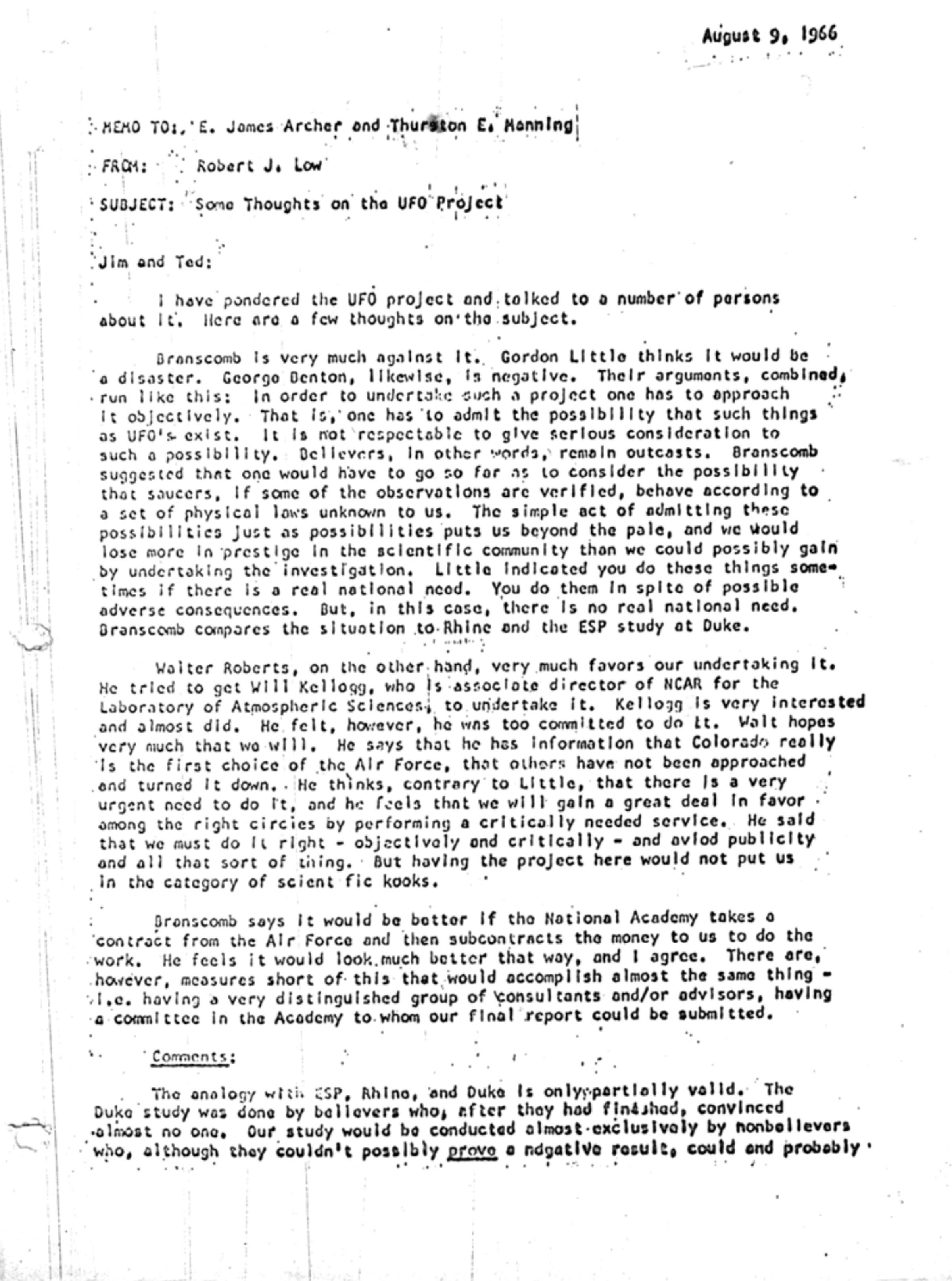
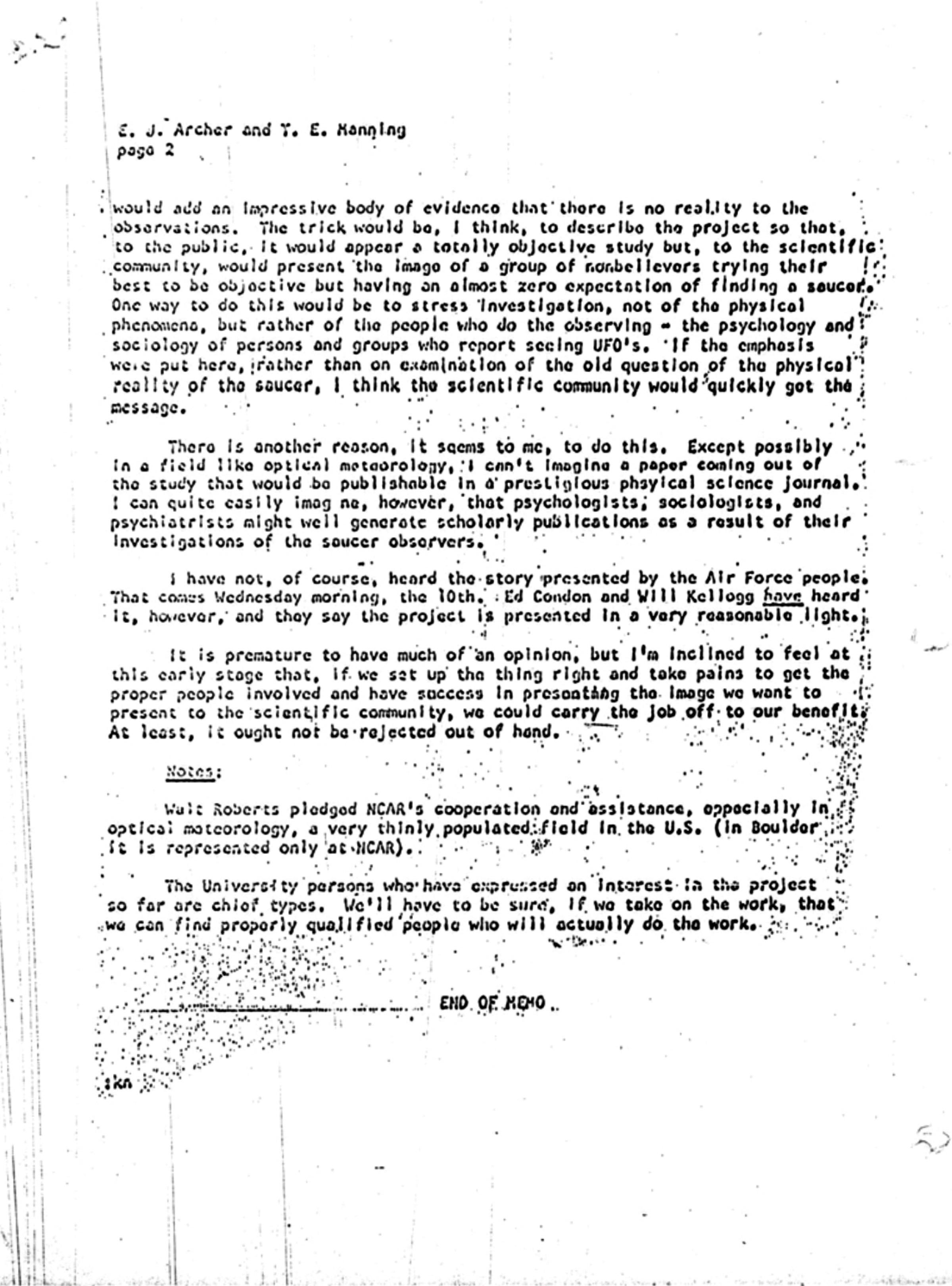
Additional Entity Analysis:
Morphological Taxonomy and Distinctiveness
The entities described by Schirmer occupy a distinctive position in the taxonomy of non–human entities reported in the close–encounter and contact literature. They are not the Greys—the small, large–eyed, hairless beings who dominate the abduction literature from the Hill case forward and became the default alien type in post–1980 popular culture. They are not the tall, beautiful Nordics of the 1950s contactee tradition. They occupy their own morphological category: medium height, silver–uniformed, distinctive facial configuration with non–blinking eyes, helmeted with communication–antenna devices, and bearing the winged serpent emblem on the left breast of each uniform.
This morphological distinctiveness is evidentially significant because it argues against the hypothesis that Schirmer’s account was primarily shaped by cultural templates. If the account were primarily confabulation drawing on available cultural imagery, it would most plausibly have produced beings similar to the dominant cultural types available in 1967: either the Hill–case Greys or some form of Hollywood science fiction alien. The specific details Schirmer produced—the particular eye configuration, the catwalk on the craft exterior, the winged serpent emblem, the antenna in the helmet—do not obviously derive from any available cultural template and represent exactly the kinds of idiosyncratic details that genuine perceptual experience tends to produce and confabulation tends to avoid.
The non–blinking eyes deserve particular attention as a morphological detail. The blink reflex in terrestrial mammals is an involuntary neurological function; its absence in an entity otherwise presenting with a humanoid appearance violates a deeply ingrained biological expectation in a way that is specifically alarming at a neurological level—triggering the same alarm response that makes human beings uncomfortable in the presence of uncanny simulacra that appear almost but not quite human. This specific detail recurs across multiple independent close–encounter reports in which witnesses describe their reaction in consistently alarming terms, suggesting genuine observation of a genuine biological characteristic rather than a culturally derived narrative element.
Additional Theological Analysis:
Providence, Mission, and Counterfeit Eschatology
The theological implications of the entities’ stated mission—monitoring human civilization with concern about nuclear weapons development—deserve extended treatment as they illuminate the DFH framework’s analytical power. The claim implicit in this mission statement is that the entities perform the function of sovereign oversight of human history, a function that in the Reformed theological tradition belongs exclusively to the God of Scripture. Westminster Confession of Faith Chapter 5 teaches that God upholds, directs, disposes, and governs all creatures, actions, and things, from the greatest even to the least—a comprehensive doctrine of divine oversight that leaves no room for any alternative agency to exercise the kind of civilizational guardianship the Schirmer entities claimed.
By positioning themselves as the corrective to humanity’s most feared self–destructive tendency, the entities claim a role that in the biblical framework belongs to God alone: the restraint of human evil within the bounds of his sovereign permission. The theological problem this raises is not merely that the claim is implausible in secular terms, but that it positions the entities as providers of a form of salvation that Scripture identifies as available exclusively through God’s own redemptive activity. Entities who present themselves as humanity’s protectors against nuclear self–destruction are claiming a soteriological function—however secular in its apparent content—that the biblical framework reserves to God alone.
The pattern of soteriological displacement that the Schirmer entities’ communication exemplifies is characteristic of the full range of close–encounter contact communications from the 1950s through the present, as documented in this author’s ‘Doctrines of Devils’ manuscript. The specific content varies—sometimes the entities are concerned about environmental destruction, sometimes nuclear weapons, sometimes spiritual evolution—but the structural function is consistent: the entities present themselves as agents of a rescue operation that humanity cannot accomplish for itself, positioning themselves as indispensable mediators between humanity and its own survival. This appropriates the structure of Christian soteriology while replacing Christ with the entities as the exclusive mediating agents.
The entities’ promise to return twice more and eventually allow Schirmer to see the universe constitutes an eschatological communication—a promise about the final end–state of the contact relationship. This promise appropriates the register of biblical eschatological hope—the promise of seeing God face to face, of the full cosmic revelation awaiting believers in the consummation—while relocating its fulfillment from the God of Scripture to the entities themselves. The beatific vision promised in Christian theology is the direct, unmediated knowledge of God; the cosmic tour promised by the entities is unmediated knowledge of the universe. Both promises address the same fundamental human longing for transcendence of current limitations and access to a perspective that comprehends rather than is comprehended by the cosmos. The entities’ promise appropriates this longing, redirects it toward a non–divine fulfillment, and positions the entities as the intermediaries through whom fulfillment will eventually arrive: a counterfeit eschatology that mimics the structure of genuine eschatological hope while serving the entities’ own purposes rather than those of the God of Scripture.
Additional Legacy Analysis: What Remains Unknown
One analytical discipline the Schirmer case demands—and that the research literature has not always displayed—is honest acknowledgment of what genuinely remains unknown after more than half a century of documentation and analysis. The case is not as thoroughly documented as its prominence in the UFO literature might suggest. Key documents have not been publicly released: the complete Condon Committee case file on the Schirmer investigation, including Craig’s original field reports, the psychological assessment materials in full, and Sprinkle’s complete session recordings. The polygraph examination records have never been made public; the examining agency has never been identified. The metallic fragment has presumably been lost or discarded; no subsequent physical analysis has been conducted on it.
What this means is that the analyses available in the public record, including the present study, rest on a subset of the potentially available evidence—a subset that has not expanded substantially since the early 1970s despite the passage of fifty years. The complete Condon Committee files are maintained by the National Archives and Records Administration and have been partially released under FOIA requests; a comprehensive examination of the Schirmer case materials within those files might reveal details not reflected in the published committee summary. Intellectual honesty requires acknowledging that the picture remains potentially incomplete and that definitive conclusions about what the evidence establishes must be held with appropriate epistemic humility.
The broader argument that cases like Schirmer’s deserve sustained investigative attention rests on the recognition that the phenomenon to which they belong—whatever its ultimate nature—has produced consistent physical effects, consistent physiological sequelae in witnesses, and consistent structural patterns across independent reports from multiple countries and decades. This consistency is itself a scientific fact requiring explanation. The explanation may be sociological, neurological, psychological, physical, or spiritual; but an explanatory account adequate to the consistency of the phenomena is precisely what the investigative record has never produced, and what the dismissive conclusions of the Condon Committee actively prevented from being developed. Herbert Schirmer deserved a better investigation than he received. The phenomenon he reported deserves a better accounting than official science has provided.
The emerging UAP policy environment—with the revelations of AATIP, the congressional UAP hearings of 2022 and 2023, and the testimony of former government officials about non–human intelligence—has created a new institutional context for the assessment of historical cases. If the claims made by credible former government officials in recent congressional testimony are accurate, then the Schirmer encounter and thousands of similar documented cases are not isolated anomalies requiring individual explanation but manifestations of a phenomenon whose reality was known to elements of the national security establishment throughout the decades in which the Condon Committee and its successors were publicly dismissing individual reports. The implications for the assessment of the Condon Report’s handling of the Schirmer case are significant, and further underscore the importance of sustained, rigorous, methodologically honest inquiry into a record that official institutions have consistently failed to engage with on its own terms.
Additional Comparative Analysis:
The Schirmer Case and the Abduction Taxonomy
Thomas Bullard’s systematic analysis of the abduction phenomenon—undertaken in the 1980s as part of the Fund for UFO Research’s comprehensive survey of abduction cases—identified a consistent narrative template across independent abduction reports that has become one of the most discussed features of the abduction research literature. Bullard’s template, distilled from over three hundred cases, identified a characteristic sequence of events: capture (the abduction), examination (medical or quasi–medical procedures), conference (communication with the entities), tour (of the craft), otherworldly journey (movement through space or time), theophany (encounter with a transcendent being or state), and return (to the starting point with altered awareness). Not every case contains all elements, and their sequence varies, but the recurrence of the template across independent cases argued for Bullard, in substance, that the accounts reflected either a genuine consistent phenomenon or a cultural template operating consistently across the research community.
The Schirmer case maps incompletely but recognizably onto Bullard’s template. The capture element is present in the removal from the patrol car; the examination element is attenuated (the instrument applied near the neck corresponds more closely to examination than to conference); the conference element is strongly present in the crew leader’s extended briefing; the tour element is present in the demonstration of the propulsion system and the star map display; the otherworldly journey element is absent or minimal; the theophany element is absent; and the return element is present. The incomplete mapping—particularly the attenuation of the examination element and the absence of the theophany—distinguishes the Schirmer case from the post–Hill abduction template and again argues against the hypothesis that the account is simply a derivative of a culturally available narrative structure.
The communicative emphasis of the Schirmer encounter—its focus on information transfer, explanation, and mission statement rather than on physical examination—places it closer to the contactee tradition of the 1950s than to the abduction tradition that would dominate the literature from the 1970s forward. This is a genealogically significant observation: the Schirmer case occupies a transitional position between the contactee and abduction traditions, sharing structural features with both while being fully identical with neither. This transitional character may reflect the actual phenomenological diversity of close–encounter experiences, which resist reduction to any single narrative template; or it may reflect the influence of different cultural templates available at different stages of the phenomenon’s history. What it clearly does not reflect is any simple derivation from the most available abduction narrative template of the period, which was the Hill case, since the Schirmer case diverges from that template in precisely the ways one would expect if genuine independent experience rather than cultural borrowing were operating.
Additional Analysis:
The Problem of Institutional Suppression and the Schirmer Case
Any comprehensive analysis of the Schirmer case must grapple with a question that the available evidence does not definitively resolve but that the broader pattern of the UFO investigation history makes increasingly difficult to avoid: whether the institutional dismissal of the case by the Condon Committee was simply the product of methodological inadequacy and institutional conservatism, or whether it reflected a more active policy of non–disclosure about a phenomenon whose reality was known at levels of the national security establishment that the Condon Committee did not have clearance to access.
The evidence bearing on this question is indirect and contested. The now–public history of the United States intelligence community’s engagement with the UFO phenomenon extends back at least to the 1947 wave, with classified documents from the CIA, NSA, and other agencies demonstrating awareness of and concern about the phenomenon that went substantially beyond what was publicly acknowledged through Project Blue Book or the Condon Committee. The Robertson Panel of 1953—a classified CIA–sponsored review of the UFO evidence—recommended not merely that individual cases be debunked but that the UFO phenomenon itself be subjected to a sustained public debunking campaign, on the grounds that the volume of UFO reports represented a potential threat to national security communications infrastructure by clogging reporting channels. This policy recommendation—debunk, not investigate—set the institutional tone for the subsequent decades of official UFO management.
If this policy was in operation when the Condon Committee was conducting its investigation, it would explain not merely the general orientation toward negative conclusions that the Low memorandum documented but the specific pattern of finding positive evidence in individual cases while generating negative general conclusions. Committee investigators in the field, following their genuine professional standards, documented what they found; committee administrators, operating under institutional pressures whose ultimate source may have been above the university administration level, managed the translation of those field findings into official conclusions that served the debunking mandate. The Schirmer case, with its combination of credible professional witness, confirmed physical marks, and detailed hypnotically recovered encounter account, would have been precisely the kind of case that institutional debunking pressure would most need to defuse.
This reading of the Condon Committee’s handling of the Schirmer case remains speculative in the absence of documentary evidence specifically establishing that the committee’s conclusions were influenced by external intelligence community pressure. But the pattern—positive field findings, negative summary conclusions, dismissal of credible witnesses, inadequate physical evidence analysis—is consistent with managed non–disclosure as well as with institutional conservatism and methodological inadequacy, and the UAP disclosure context of the post–2017 period has substantially increased the prior probability that managed non–disclosure was a factor in the official handling of UFO cases during this period.
Additional Analysis: The Philosophical Status of Missing Time
The missing–time phenomenon that anchors the Schirmer case and dozens of comparable close–encounter reports deserves more extended philosophical treatment than the UFO research literature has typically provided, because it raises questions about the nature of temporal experience and personal identity that go beyond the immediate evidential concerns of any specific case. Missing time, as a phenomenon, is precisely what its name suggests: a period of time during which the witness was presumably present and conscious—did not lose consciousness in any way detectible by subsequent clinical examination—but of which the witness retains no memory. The subjective experience of the encounter occupies ten minutes; the objective record indicates thirty minutes; twenty minutes are simply absent from the experiential record.
The philosophical puzzle this poses is that consciousness is normally our most direct access to temporal experience. We know that time has passed because we experience its passage; when we lose consciousness (in sleep, under anesthesia, or through a traumatic episode), the lack of experienced time is retrospectively filled in by cognitive inference from external evidence—we infer from the light level and the clock that hours have passed during which we were not conscious of anything. Missing time in the UFO context differs from this model: the witness did not apparently lose consciousness (there is no report of suddenly waking up, no period of disorientation characteristic of recovery from unconsciousness), but the experiential record is simply absent for the missing period.
Several possible mechanisms have been proposed in the literature. Neurological dissociation—a temporary alteration of the normal binding processes through which experience is integrated into continuous autobiographical memory—could in principle produce a period of apparent wakefulness during which the ordinary mechanisms of memory formation were suspended, leaving no experiential trace of the events that objectively occurred. This mechanism is consistent with the dissociative episodes documented in post–traumatic stress contexts and other extreme experiences, but it is typically associated with external stressors at the time of the experience rather than with the kind of post–encounter temporal gap that Schirmer described. Alternatively, if the entities were indeed capable of influencing or suspending normal neurological function—as the paralysis experience suggests—they may have applied a specific suppression of memory formation mechanisms during the period of the encounter aboard the craft. This hypothesis is consistent with the hypnotic recovery of the missing–time content but carries all the epistemological uncertainties associated with hypnotically recovered material.
The temporal anomaly in the Schirmer case is, in a sense, the evidential anchor of the entire encounter: it was present from the first moment Schirmer checked the clock on returning to the station; it was documented by Condon Committee investigators before any hypnotic intervention; it cannot be explained by misidentification of an ordinary aerial object; and it demands an account of what was happening during those twenty minutes that no conventional explanation has been able to provide. Whatever happened during the twenty minutes of the Schirmer encounter—and the answer may never be definitively established—something happened, and the temporal gap it left in the experiential record is one of the most robust and least controversial facts in the entire evidentiary record.
Additional Analysis:
The Sociological Function of Ridicule in UFO Witness Cases
The systematic ridicule to which Herbert Schirmer was subjected in the aftermath of his December 1967 report deserves analytical attention not merely as a human interest dimension of the case but as a sociological phenomenon with implications for the evidential record. The kind of sustained, organized community ridicule that Schirmer experienced—the effigy in the cemetery, the dynamiting of the patrol car, the tear–up of traffic citations, the departure of his wife—represents what sociologists of deviance call the social construction of a stigmatized identity: the community’s collective production of Schirmer as a person who had violated the norms of rational belief and was therefore no longer eligible for the social protections and professional authority that normative community membership confers.
This sociological process is not unique to the Schirmer case; it has accompanied the public reports of UFO witnesses across the period of modern UFO history with remarkable consistency, producing the same basic pattern of social sanction regardless of the professional background, character, or credibility of the witness. Police officers, military pilots, scientists, and ordinary citizens who have reported close encounters have all been subjected to versions of the same stigmatization process, the severity of which tends to vary with the dramatic character of the report rather than with the credibility of the witness. The consistency of this social response across cases—its independence from the specific character and credibility of individual witnesses—is itself an analytically interesting datum. It suggests that the stigmatization is a response to the content of the report (claiming the reality of close encounter with a non–human craft) rather than to the character of the reporter.
From a sociological perspective, the stigmatization serves a clear social function: it maintains the collective consensus reality by marking as deviant any claim that contradicts that consensus. A community that allows the reality of a UFO encounter to stand unchallenged has implicitly endorsed the possibility that the consensus reality is less complete than it claims to be—a deeply uncomfortable admission for any social group whose identity and functioning depend on shared assumptions about what is real. The ridicule of UFO witnesses is, in this analysis, less a response to their specific claims than a defense mechanism for the social group’s investment in a particular model of reality. Understanding this dynamic does not validate the witnesses’ claims, but it does illuminate the social conditions under which those claims are suppressed, distorted, or ignored, and it places the Condon Committee’s institutional response in its broader sociological context.
Additional Analysis: The Condon Report in the History of Science
The Condon Committee’s investigation and its handling of cases like Schirmer’s can be situated within a broader history of institutional science’s encounter with anomalous evidence—instances in which established scientific institutions have failed to engage adequately with evidence that challenged prevailing consensus models. The history of science offers numerous precedents for this pattern: the initial institutional rejection of continental drift; the decades–long resistance to the germ theory of disease; the protracted battle over the reality of meteorites in the eighteenth century, during which the French Academy of Sciences famously declared that stones could not fall from the sky because there were no stones in the sky. In each case, the institutional failure was not primarily intellectual but sociological—the institutions of normal science were structured in ways that made it professionally costly to take seriously evidence that conflicted with the dominant paradigm.
The UFO evidence base has occupied a similar structural position in the sociology of American science since 1947. The phenomenon’s association with popular sensationalism, its resistance to laboratory reproducibility, and its apparent conflict with the dominant scientific worldview created conditions in which institutional engagement was professionally dangerous and disengagement professionally safe. The Condon Committee represented the one institutional attempt to overcome these conditions through the authority of a distinguished physicist and the resources of a major university—and the attempt failed, producing a report whose conclusions served the interests of institutional disengagement rather than the requirements of honest scientific assessment. The consequences have been a half–century of institutional inattention that has prevented the development of the analytical tools, comparative databases, and investigative protocols that a phenomenon of this character and consistency genuinely requires.
James McDonald’s assessment—that the Condon Report represented a failure of science, not a success of skepticism—has been partially vindicated by the subsequent history of UAP research and disclosure. The cases documented by the Condon Committee, including the Schirmer case, were not anomalies that subsequent conventional science explained away; they remain unexplained fifty years later, and the recent official acknowledgment that the phenomenon is real and significant at the national security level suggests that the institutional failure McDonald diagnosed was even more profound than his critique recognized. The Schirmer case is one of the data points in that larger history—one instance of the pattern in which a genuine and significant phenomenon was reported by a credible witness, incompletely investigated by official science, dismissed by institutional consensus, and preserved for fifty years primarily through the efforts of non–institutional researchers.
Additional Analysis: The Witness Testimony of Wlaschin
Chief William Wlaschin’s role in the Schirmer case has not received the analytical attention it deserves, despite the fact that his testimony and actions constitute some of the most important independent corroboration in the evidentiary record. Wlaschin was not merely a passive recipient of Schirmer’s report; he was an active participant in the investigative process whose decisions—arranging the polygraph, conducting the initial site inspection, accompanying Schirmer to Boulder, and testifying to Condon Committee investigators—reflect both genuine confidence in his officer’s integrity and genuine concern about an event he found inexplicable by conventional means.
Wlaschin’s confirmation of the neck welt is perhaps the most significant single piece of corroboration in the case. He examined the welt in the days following the encounter and confirmed its presence, its dimensions, and its location on the nerve cord below the left ear. He was not corroborating Schirmer’s memory of the encounter—he was corroborating a contemporaneous physical finding that was present on Schirmer’s body and that neither man could explain. Wlaschin’s subsequent declination to identify the polygraph examining agency reflects professional discretion rather than concealment; the agency’s understandable concern about its institutional reputation for having examined a UFO witness does not diminish the significance of the examination’s results as reported by Wlaschin.
Wlaschin’s decision to accompany Schirmer to Boulder for the Condon Committee sessions is an act of professional solidarity that merits recognition in its own right. A police chief who escorts a subordinate officer to a hypnotic regression session in the context of a government–funded UFO investigation is a police chief who takes seriously both the event his officer reported and the investigation of it—not a chief who regards the whole matter as embarrassing nonsense to be managed and suppressed. His presence in Boulder signals that, whatever his personal beliefs about the ultimate nature of what Schirmer had experienced, he regarded the experience as genuine and significant and the investigation as worth supporting. This professional endorsement from a supervisory officer without evident motive for fabrication or credulity is a form of testimony whose evidentiary weight the existing literature has undervalued.
The Incident in Herbert Schirmer’s Own Words
Herb Schirmer Presentation, Unnamed Florida UFO Conference, possibly 1974
Transcript taken from audio at: noufors.com/audio/Schirmer Layer-3.mp3
_______________________
I guess I should tell you a little bit about myself before I get into the experience that I had.
I was born in Missouri, and I was brought up as a service brat. My father was a career man in the Air Force. I went to school in Japan, Germany, France, and Hawaii. I jumped around quite a bit, so I didn’t get much of an education when I was young, but I did finish it all later.
When I was 17 years old, I went into the military service. United States Navy, and my first duty station was in Jacksonville, Florida. And then from there I went to the Far West Command, and I helped serve our flag and fight for it in Vietnam even though I felt it was an immoral act of a war.
Then coming out of the service I went back to Missouri and spent a couple months there, and I went home to Nebraska where my folks were. And I wasn’t making very much money being out of the service, you know. Two dollars an hour being a clerk wasn’t my bag really, so I wanted newer fields. So I always wanted to be in law enforcement. So, I talked to my father about going into law enforcement and he decided that the State Patrol in Nebraska would be a good idea.
So we fill out the forms and everything and I had to go to Ashland, Nebraska to the police department to get a police check. So I walked in and five minutes later I was a policeman; they hired me there.
My life. . . before this happened, as a police officer, the short time I was, it was a good one. I enjoyed it. I enjoyed working with the public and serving the community and serving the laws of the state. Now I guess I’ll get on with the story.
It was along 2:30, actually, I think was the time that this happened, but right around 2:20, I was just checking two gas stations. I left the two gas stations. Excuse me, I left the last gas station that I checked to pull onto the highway. And I was making radio contact with the Wahoo Sheriff’s Office because we didn’t have radio communications available in the city at nighttime because we couldn’t afford it.
So I told them that everything was all secure. I pulled onto the highway and putting the mic down, I seen some flashing lights in front of me.
First appeared to me to be a truck, I thought. As I got closer and put the high beams of the lights in the patrol car on this, this object started raising. These lights started raising up in the air to about 40 feet. I think I was something like 50 yards from this. These lights were flashing, and as they got bigger, as I got close to it, it seemed like they were red flashing lights coming out of a porthole, which sort of circled the craft.
It had like a catwalk going around the center of it. It was shaped like a football, very metallic, like a very shiny bumper if you polished a bumper on a car. It had sort of a reddish, orangey glow coming from beneath it.
And then, there was this white flash that came on to me in the patrol car. It felt as if we were being pulled, and then it was being pulled. You know, we were being pulled up the side of this bank to the left of the road and up toward this field, the car and I.
I felt nothing. At first I felt kind of stunned and shocked, and then I felt sort of tingly. And as the car and I moved up the bank to the top of this field, this object landed, and some legs came out, and it sat down.
I was just sitting there really motionless. I couldn’t move. I may have even had my mouth open. I don’t remember, you know, being probably scared.
This hatch came open and this light came out of the hatch and this form came down and looked. . . the form of a human being. And this form started walking toward the patrol car with an object in both its hands, appeared to be hands, and he was walking straight toward the patrol car. As he was doing this, another form came out and started walking toward the patrol car also.
As this being got in front of the, walked up to the front of the patrol car with this object in his hand which looked sort of a squarish–oval type. It looked like it had a lens in front of it and the only thing I could think was “Oh my God what’s going to happen now?”
And this green light came out all over the car and then I saw the light went back in again and I felt a sensation then, and then I felt nothing like I was just there, and that was it.
And this other being started walking up toward the car. I was sitting straight, looking straight. I couldn’t even move my head.
And he walked up to the car, and the window was about three-quarters of the way rolled down, and he had an object in his hand, a silver object that looked like a big pencil with a round ball on the end of it. And he pressed this against the side of my neck, which I felt some pain from, and said, ouch.
Then he stepped back, and I sort of sat there, and he opened up the... car door and just went like this. And I sort of a raised up out of the patrol car, and I was looking at him and he was looking at me, and he said, “Are you the watchman of this town?” And my response was “Yes sir.” He said “Come with me, watchman.”
And we started moving toward the spacecraft, and it felt like I was walking on air. We got up to the hatch to where you went inside of the spacecraft, and we just sort of like floated up into the first level. And he says to me, “Watchman, come with me,” and we were in a circular room.
And there were a lot of cylinders about four and a half feet high and about two feet wide that circled the whole room. And it had sort of like a cable running through it, two cables running through these. They looked like tall batteries to me. And then in the center of this room was a huge cocoon or, you know, like this shaped object was spinning. And it was giving off colors like the rainbow and was about 20 feet long.
And it seemed like these cables were coming up and connecting to these two block things that came down on each end of it. And we walked a complete circle in there, and I said, “What is this?” And he said, “This is how our craft operates.” And he said, “It operates on electrical reversible magnetism.”
And then I looked at him, and he said, “Come with me, watchman.”
And we walked back over to where I had came up in with him, and this glass sheet came down. And we stepped onto this, which I felt. And we moved up into the second level of the craft, and lo and behold, I’ve never seen anything like it before in my life, was so many different types of instrument panels and computer-type things that you just wouldn’t believe it.
This cone-thing was right in the center of the floor. You could see half of it from on top and half of it from the bottom, but it gave off a red glow that sort of . . . not flashed, but kind of died down and then came back up again.
And he says, “Watchman, come with me.” And we walked over to a screen that was up on the side, I’d say wall. And it was sort of like a TV screen and he pressed some buttons and I guess flipped some switches. I wasn’t paying too much attention to him. I was looking at the screen and some stars in the sky appeared on there. And he put his finger up like this and he said, “This is where we’re from, watchman.”
And then he put his hand back down. He didn’t say where and he didn’t say the name. He just pointed.
“The purpose that we’re here is to get electricity.” And there was another being standing a little distance away and the man turned to him, and they both looked at each other, and he started depressing buttons. And he says, “Watch, watchman,” and there was this antenna on the outside of the spacecraft, which angled toward a power unit. And this bolt went out, a color I’ve never seen before in my life, and I don’t even think I could describe it, went out and came back. And this stayed like this for about three minutes, and then it went off.
And he turned and looked at me, and I felt as if I was getting a very, very. . . an awful lot of . . . roll of . . . input of words that I couldn’t understand.
And he reached up and he touched me on the shoulder, and he felt real when he touched me. And I think at that time, I did touch him. And he felt real to me. And he says, “Watchman, come with me.”
We walked back over to the exit, I’ll say, where we came up. And the glass sheet came down again. And we went up into the third part of the craft, which was the observation deck, he said. As we stepped off, he said, “Watchman, come with me.” And we walked over and we were standing there looking out of a big plate glass window type thing.
There was a control panel right in front of it, and there were two chairs that looked like dentist chairs. You know, I’ve written as a dentist chair, but really a superstructure of a chair, better than a dentist chair. And we looked out the window, and I could see this one being walking back and forth by where my patrol car was. And I think I said, “Wow.”
And he put his. . . No, he didn’t. He turned to me, and he said something I don’t understand. And he said some more things that I didn’t understand or couldn’t make out. And I still don’t. And then he pointed his hand toward the plate glass window, as I say referred to, to the stars out there. And he says to me, “Watchman, one day you yourself will see the universe as I have.” And he reached up and he touched me on the shoulder like this, you know, like grabbing you on the shoulder like a man does to steer you away. And he says, “Come with me, Watchman.”
And then he stopped. And he said, “Watchman.”
And I turned around like this to look at him and it felt like I was getting more input of something that I couldn’t understand. Then he says, “Watchman, come with me.” We walked over and we went down all the way out of the craft.
As we got outside, this other being started walking back toward the spacecraft and boarded it as we were walking toward my patrol car. And we stopped right by the patrol car and I turned to look at him and he was looking at me. And then again, it felt like I was receiving an input of words of some kind that I couldn’t understand.
And he turned, no, he sort of lifted his hand and then he turned and walked back to the spacecraft, floated up inside. This catwalk thing started spinning. The lights started flashing off and on. This red-orange glow came out from beneath it.
It started lifting up in the air. And I guess it got about 100 feet high and just shot straight out of sight.
Let me tell you, I was scared.
I started feeling ‘me’ again.
When I was aboard the spacecraft, I had hardly no feeling at all. My body was tingling, I was perspiring, I was hot, I felt nauseated. I got back into the patrol car, I turned it around and I headed back for the police station.
On the way to the police station, at a high rate of speed, I tried to make communication with Wahoo Sheriff’s Office and it appeared the radio was dead.
I got to the station, I jumped out of the car in a fast walk, walked into the police station. And I noticed that the wall clock in the police station said one minute after 3 a.m.
Well, I went directly to the bathroom. Not to go to the bathroom but to drink water because I was hot. And I walked back into the main room of the police station. We had a real small police station. It was about 20 by 20.
And I sat there at the table.
I lit a cigarette and I said, “Wow, what the hell happened? Something happened to me. Did I really see a flying saucer? Did this really happen to me?” I looked at my report log. I remember through all the training and everything I went through that regardless of the nature or what it was, put it in your report book because you just might need it.
So I looked at my report book and I got my pen out and I wrote, “At 2.30 a.m., December 3rd, 1967, I saw a UFO at Junction 6 and 63, believe it or not.”
About 6:30 that morning, a fellow officer came in and I explained to him what happened to me. And the fellow officer says, “I believe you, Herb. One time I was on my way to Wahoo, Nebraska, and I was driving down the road. I looked over. Lo and behold, there were two UFOs sitting in a field. And these little green men were out there walking around it, waving at me.”
I said, “Sure, Paul.”
And he says, “I don’t think you should tell anybody, Herb, because I don’t think anybody’s going to believe you. Matter of fact, you’re going to lose your job if you tell the people.”
But I said, “Paul, it’s the truth.” He said, “Well, you know, a lot of people won’t even accept the truth.”
I said, “Well, I’ll wait for the chief.”
He says, “No, go on home.”
So I went home and I really felt like everything was drained completely out of my body. And I laid down on the couch. And as I laid there, I started getting a buzzing feeling in my head. And it felt like I was being. . . I had pressure on my body. I couldn’t move my arms. You know how you try to open up your mouth and you can’t say help? I was trying to say help, you know? And then I went off to sleep and the phone rang and it was the chief.
And the chief says, “Get your butt down to the station right now. What is this? What do you mean you’ve seen a UFO?”
“I said, I don’t feel good. I’m sick and I’m not coming down to the police station.”
He said, “I’ll be right over.”
So the next thing, TV came in, press came in, you know, newspapers, radio stations, and telephone calls started coming in.
Two days later, the ridicule started coming in. Believe me. And I had a man run three blocks huffing and puffing. He owned the Goodyear Tire Shop there in Ashland, Nebraska. And he told me, “Herb, if you ever see another flying saucer and it lands, you tell him I want to sell him a set of tires.”
“I mean the phone would ring, and . . . “This is the planet Mars,” you know? I mean, really ridiculous stuff.
I think, though, being here in Florida, one of the neatest welcomes I got was right out here in the lobby. The gentleman was out there selling books. And I walked up. He says, “Herb Schirmer?” I said, “Yes.” “My name is so-and-so and I was taken aboard a police cruiser.”
I thought that was neat. The United States Air Force Condon Committee, Blue Book Project, or however you want to say it, investigating team came down to Ashland, Nebraska to investigate me. A gentleman by the name of John Ahrens who is a friend of mine and a gentleman by the name of Roy Craig who was a physicist. John Ahrens, he’d probably hit me, but he was a shrink. Psychiatrist.
Him and I had long discussions, and he told me to tell my story over and over and over and over. And I told it over and over and over and over. And then they found a 25-minute time lapse in my log.
And John says, “Herb, what happened to you between 2:30 a.m., December 3, 1967, and 3:00 a.m.?” Or a little before 3 a.m.?
And I looked at him, and I couldn’t say anything because I didn’t remember. So he says, “You’ve got to come to Boulder.” I said, “Okay.”
So they took me up to Boulder. I met a UFO team there. . . a lot of people who ran a lot of tests on me. And a hypnotist by the name of Dr. Leo Sprinkle administered time regression hypnosis on me, which found out a small detail, that I had been aboard the spacecraft and that I had actually communicated with them.
They played the tape back to me, and it shocked me. I didn’t know what to think. I said, “Is that really my voice on that tape?”
“You bet it is, boy.”
I says, “My God. What do I do now?”
So while I was up in Boulder, the city [Ashland] got real cute. You know, the city fathers and people in the city. The day I left, as a matter of fact, the night I left, they went down to our beautiful cemetery there in Ashland, Nebraska, and took this dummy and hung it by the neck in a tree, put a big star on it, shot holes through it, and painted the holes with red like blood, and put “Herb” across the star with a cowboy head on it. And they really made it look big because they went. . . down to the mortuary, and they got the ambulance out.
A code three run: sirens, red lights, the whole works. Went over there, and they very carefully took it down and put it on a stretcher and covered it up and took it back to the morgue. They thought they’d scare me, but they didn’t, you see. That’s what they were trying to do. They were trying to scare me, but they didn’t scare me because I thought it was kind of funny, and I laughed about it when I read it in the paper and seen all the pictures and everything.
But while I was in Boulder, they blew my car up with dynamite, and that really made me mad. I just got through paying for it. And I was furious, you know. I could have done like George C. Scott did in that movie Rage, you know. That’s how mad I was.
But through the whole crisis, I had one very good friend in Ashland, Nebraska. His name is LeRoy Dimmitt, a very close friend. And he helped me a lot in Ashland. He was one of our relief officers on the police department.
And I was really proud to have him as a friend, the way he stuck by. My family, I really can’t say. . . I went to my father and I said, Dad, I know you have 20-something years in the Air Force, but I asked my father point blank, I said, Dad, what do you think of UFOs? My father never said no, and he never said yes. He just said, “Son, if you’re telling the truth, stick with it. And so I stuck with it. All right, thank you very much.”
SAGA Magazine, April, 1970
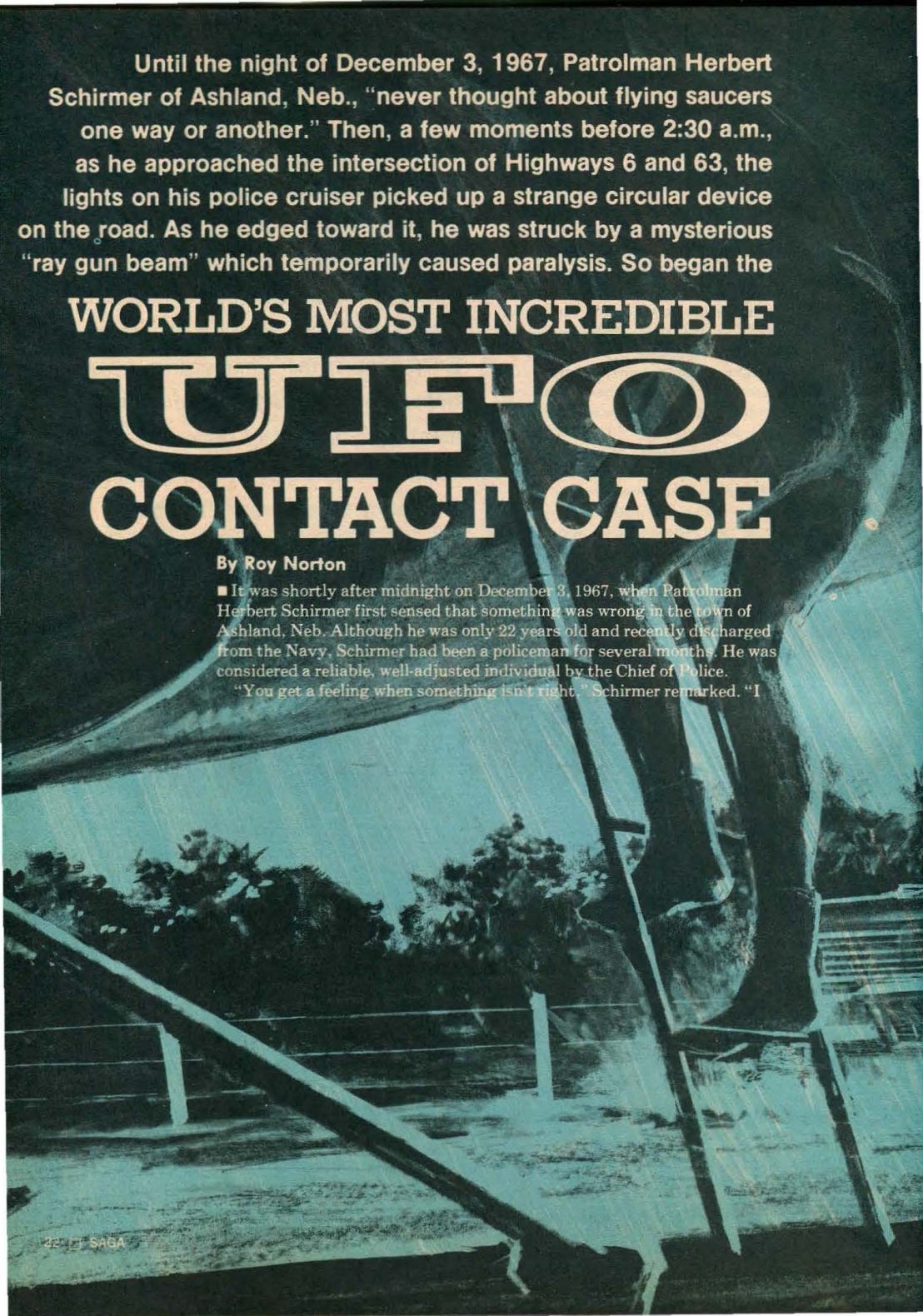
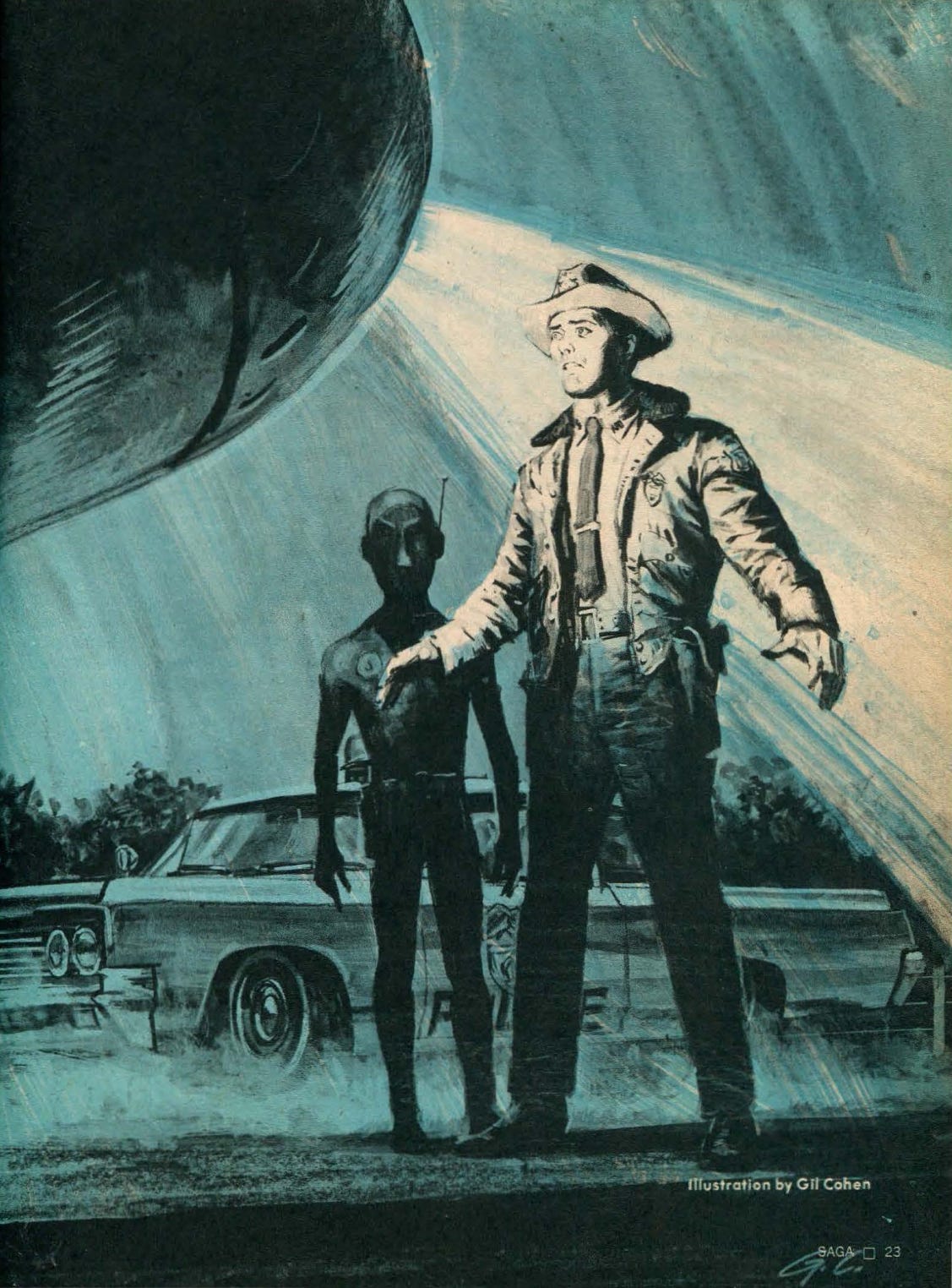
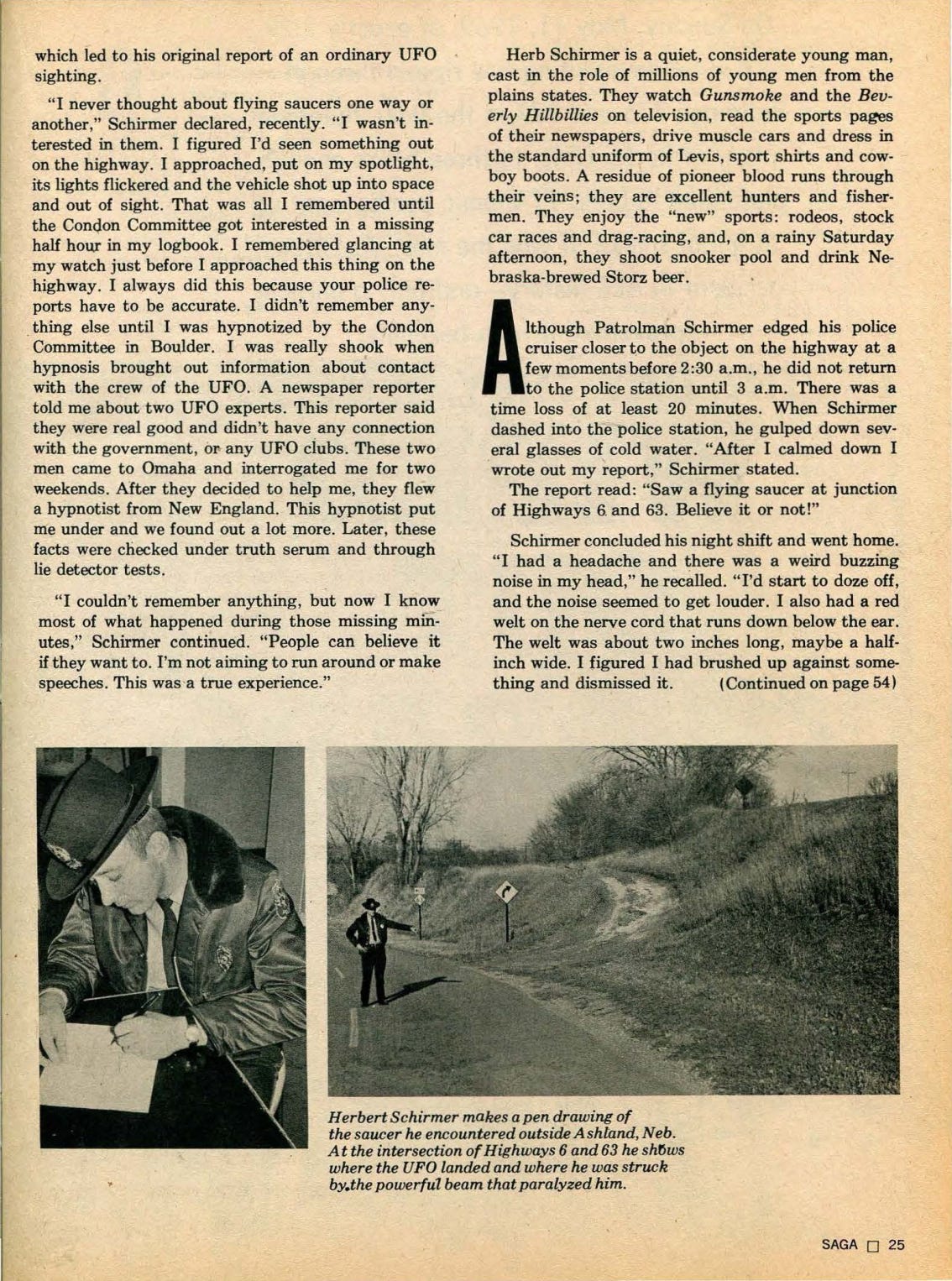
Synthesis: The Schirmer Case as a Type–Specimen
The Schirmer case functions in the American UFO research literature as something close to what biologists call a type–specimen: a specific, well–documented exemplar of a broader category of phenomena that defines the characteristics of that category for comparative purposes. As a type–specimen for the law enforcement officer close–encounter report in the pre–Hopkins abduction era, the case combines a set of features—credible professional witness, contemporaneous official documentation, Condon Committee investigation, hypnotic regression, physical sequelae, detailed entity description, and distinctive symbolic elements—that make it uniquely suitable as a reference point for comparative analysis across the broader close–encounter literature.
The features that make the Schirmer case valuable as a type–specimen are precisely those that make it resistant to simple resolution: the combination of institutional documentation (the Condon Committee investigation) with independently corroborated physical evidence (the welt), contemporaneous written record (the patrol log), and detailed hypnotically recovered testimony creates an evidentiary profile that is simultaneously richer than the typical sighting report and more constrained than the typical elaborate abduction account. The case is neither so underdocumented as to be analytically useless nor so elaborated by subsequent testimony as to have lost contact with its contemporaneous evidentiary foundation. It occupies a middle position in the evidential spectrum that makes it tractable for serious analysis while preserving the genuine complexity that distinguishes the close–encounter phenomenon from either ordinary misidentification or obvious fabrication.
As a type–specimen for the DFH analytical framework, the case is equally valuable. The entities’ physical appearance—including the winged serpent emblem that this framework identifies as theologically significant—their communicative content—including the pseudo–salvific mission statement and the eschatological promise—and the pattern of their interaction with the witness—including the apparent ongoing contact during the hypnotic session and the promise of future returns—all display the features that the DFH predicts for adversarial spiritual entities engaging with human witnesses. The case is not the most dramatic in the close–encounter literature, nor the most extensively documented, nor the one with the most compelling physical evidence. But it is one of the most analytically tractable, and it rewards the kind of sustained, rigorous, theologically and epistemologically informed engagement that the present study has attempted to provide.
Herbert Schirmer reported what he experienced to the best of his ability and maintained that report for fifty years at enormous personal cost. The least that serious scholarship can offer in return is an analysis that takes his experience seriously on its own terms—neither dismissing it as obviously mistaken nor accepting it uncritically as literally true, but engaging honestly with the full complexity of the evidence and the genuine difficulty of the interpretive questions it raises. This study has been an attempt to offer that analysis. Whether it succeeds in doing justice to the case—to the man who experienced it, to the investigators who documented it, and to the phenomenon it exemplifies—is a judgment the reader must ultimately make.
APPENDIX A:
BIOGRAPHICAL SUMMARY OF HERBERT L. SCHIRMER, 1968–2017
The following biographical summary draws exclusively on verifiable primary and directly cited secondary sources. Assertions about Schirmer’s post–1968 life that appear in popular UFO literature without documentable sourcing have been noted as unverified and are not presented as established fact. Citations are embedded in the text in the form of parenthetical source identifications; full source descriptions appear in the bibliography at the close of this appendix.
Origins and Early Life
Herbert L. Schirmer was born on August 16, 1945, in Meadville, Mississippi, the son of Harvey Schirmer and Virginia McDonald Schirmer. (Stanley Funeral Home and Crematory, Dublin, Georgia, obituary for Herbert Schirmer, d. March 6, 2017, stanleyfuneralhome.com/obituaries/Herbert–Schirmer.) That he was born in Mississippi while his family was evidently rooted in eastern Nebraska — his mother Virginia remained in Wahoo, Nebraska, the Saunders County seat immediately adjacent to the county containing Ashland, until at least the time of his death in 2017, and his brother Peter Schirmer resided in Wahoo as well — suggests a wartime or immediate postwar displacement, his birth in Mississippi coinciding with the final months of the Second World War before his father’s family apparently returned to its Nebraska base. He entered the United States Navy in 1964 and served until 1967 at the rank of Seaman, his service dates spanning the period of the American military escalation in Vietnam. (United States Navy Memorial, “Schirmer–Herbert,” Navy Log entry, navylog.navymemorial.org/schirmer–herbert, recording service branch USN, dates 00/1964–00/1967, born 08/16/1945 in Meadville, Mississippi.) Upon completing his naval service, Schirmer pursued law enforcement, entering the Ashland Police Department approximately seven months before the encounter of December 3, 1967, after what is described in the Wahoo–Ashland–Waverly Journal as an unexpected job offer arising from a routine background check visit to the department. He had originally planned to join the Nebraska State Patrol. (Wahoo–Ashland–Waverly Journal, “1967 Alien Abduction Tale Told in Graphic Novel,” July 10, 2020.)
The Immediate Aftermath, 1968: Loss of Career and Community Standing
Following the December 1967 encounter and the subsequent investigation by the Condon Committee in Boulder, Colorado, in February 1968, Schirmer was briefly appointed Chief of Police of Ashland after the resignation of Chief William Wlaschin. The tenure was extremely brief. A contemporary account in the Ashland Gazette, cited in the Wahoo–Ashland–Waverly Journal, reported that Schirmer was appointed chief in early April 1968 following Wlaschin’s resignation, but that the mayor had appointed Paul Dupree as his successor less than a month later. (Wahoo–Ashland–Waverly Journal, July 10, 2020.) The causes of Schirmer’s inability to continue in office are well–documented from his own recorded account, delivered to a UFO conference audience in Florida in the 1970s and preserved in an audio recording that cartoonist Michael Jasorka later discovered and used as the basis for his graphic novel. In those recordings, Schirmer described the community harassment in detail: the effigy of him hung in Ashland Cemetery, a bullet–riddled mannequin bearing his name over a sheriff’s star, subsequently transported to the local morgue by ambulance crew in an extension of the joke; the dynamiting of his patrol car; the slashing of his tires and the breaking of his windshield; and the refusal of residents who received traffic citations to treat his authority as legitimate. (Wahoo–Ashland–Waverly Journal, July 10, 2020, drawing on the Florida conference audio recording.)
His wife left him during this period. The exact circumstances and timing of the separation are not documented in the primary sources available, but the Wahoo–Ashland–Waverly Journal notes that “other reports indicate his wife may have left him because of the incident and its aftermath.” (Wahoo–Ashland–Waverly Journal, July 10, 2020.) The persistent headaches that Schirmer had reported from the morning following the encounter continued during this period; his own recorded account describes consuming analgesics at a rate he characterized as alarming. He left Ashland having lost his law enforcement career, his marriage, and his standing in the community where he had planned to build a professional life.
Nebraska Years and Limited Public Engagements, Late 1960s–1970s
After leaving Ashland, Schirmer reportedly relocated to Omaha, Nebraska. (Wahoo–Ashland–Waverly Journal, July 10, 2020: “Schirmer eventually left Ashland and reportedly moved to Omaha.”) During this period he cooperated with the investigations of writer Warren Smith and researcher Brad Steiger, participating in the June 1968 hypnotic regression sessions with hypnotist Loring G. Williams that produced the elaborated abduction account published in Smith’s two books under the pseudonym Eric Norman: Gods, Demons, and Space Chariots (1970) and Gods and Devils from Outer Space (1975). Under hypnosis, Schirmer also produced detailed drawings of the craft, its propulsion system, its interior layout, and the physical appearance of the crew leader; these drawings are reproduced in the secondary literature and appear in Jasorka’s graphic novel. Their execution required active cooperation with the investigative process and reflects Schirmer’s willingness, at least through the early 1970s, to engage with efforts to document and publicize his account.
He made a small number of public appearances in Nebraska during this period in which he described his encounter for audiences. These included a presentation at the public library in Fremont, Nebraska, in the mid–1970s, documented in local press coverage, and the Florida UFO conference appearance at which the audio recording discovered by Jasorka was made. (Wahoo–Ashland–Waverly Journal, July 10, 2020: “He made several public appearances where he spoke of the alien encounter, including one at a Fremont library in the mid–1970s.”) The Florida conference recording, while undated precisely in the available sources, is described by Jasorka as deriving from the 1970s; the Grand Island Independent describes it as a “found 1970’s U.F.O. conference storytelling,” and the Amazon listing for the graphic novel similarly characterizes it as a “found 1970’s U.F.O. conference storytelling.” (Grand Island Independent, “Artist Tells of Nebraska UFO Story in Comic Book,” August 18, 2025; Amazon.com listing for Michael Jasorka, December 3rd, 1967: An Alien Encounter.) Beyond these engagements, Schirmer progressively withdrew from public life.
Georgia: Rebuilding a Private Life
At some point after his Nebraska years — the precise timing of his relocation is not established in the primary sources available — Schirmer moved to the state of Georgia, eventually settling in the Warner Robins and East Dublin area of central Georgia. Warner Robins is a mid–sized city in Houston County built substantially around Robins Air Force Base, the largest industrial employer in Georgia; East Dublin is a small city in Laurens County, roughly fifty miles east of Warner Robins. The specific circumstances of Schirmer’s move to Georgia — whether tied to family connections, employment opportunity, or simply the desire for anonymity in a place where his 1967 encounter was not local knowledge — are not documented in the available record.
In Georgia, Schirmer was employed as a security guard for Advanced Security Services, a career in the private security sector that allowed him to draw on his law enforcement background and professional training while avoiding the institutional exposure and community accountability of uniformed public policing. (Stanley Funeral Home and Crematory obituary, March 6, 2017: “He was a retired Security Guard for Advanced Security Services.”) The occupation placed him within the general category of protective services work — monitoring premises, managing access, responding to security incidents — without the public authority or public scrutiny that had proved so costly in Ashland.
He became active in Freemasonry in Georgia, attaining the office of Past Master of Tyrian Lodge No. 111 in Warner Robins. (Stanley Funeral Home and Crematory obituary, March 6, 2017: “He was a Mason where he was a Past Master fro [sic] Tyrian Lodge #111 in Warner Robins, GA.” The typographical error — “fro” for “from” or “for” — appears in the original obituary text.) The attainment of Past Master — the governing officer of a Masonic lodge, who presides over its meetings and serves as its ritual and administrative head — is a significant achievement within Masonic structure, requiring election by the lodge membership, completion of a full term in office, and the conferral of the Past Master degree. It implies a sustained engagement with the organization over a period of years and a degree of personal standing in the local Masonic community that represents a meaningful form of social integration in his adopted state.
He married Teresa Norton Schirmer, his surviving wife at the time of his death, and the couple were living in East Dublin, Georgia. The circumstances and timing of this marriage are not documented in the primary sources available; it was evidently contracted after the dissolution of his first marriage in the aftermath of the Ashland incident, and it endured to the end of his life. He had one son, Randall Schirmer, who was residing in Seattle, Washington, at the time of his father’s death. (Stanley Funeral Home and Crematory obituary, March 6, 2017.)
The Graphic Novel and Contact with Jasorka
In 2011, Los Angeles cartoonist Michael Jasorka published December 3rd, 1967: An Alien Encounter, a graphic novel based on the Florida conference audio recording. Jasorka launched the book at a party in Los Angeles on December 3, 2011 — the forty–fourth anniversary of the encounter — and subsequently undertook a Nebraska promotional tour in partnership with Kinkaider Brewing Company, which produced the “Star Snake Dank IPA” in connection with the book’s regional release. (Wahoo–Ashland–Waverly Journal, July 10, 2020; Grand Island Independent, August 18, 2025.)
The Grand Island Independent account of the Kinkaider event notes that Jasorka displayed “where former state trooper Herbert Schirmer signed a copy of his comic book.” (Grand Island Independent, August 18, 2025.) This detail confirms that Schirmer had signed at least one copy of the graphic novel, establishing that some form of contact between him and Jasorka had taken place before the Nebraska promotional tour — despite Jasorka’s earlier statement to the Wahoo–Ashland–Waverly Journal in 2012 that he had not attempted to contact Schirmer and had instead relied on the audio recording and archival documents. Whether Schirmer read or approved the graphic novel’s treatment of his account, whether he received any compensation or acknowledgment beyond the signed copy, and what if any communication passed between the two men are questions not addressed in the available sources.
The graphic novel represents the last documented instance of Schirmer’s account being publicized with his cooperation or knowledge. Its Nebraska promotional tour occurred several years before his death, and no subsequent public engagement by Schirmer has been identified in the sources available to this study. The Omaha World–Herald feature of May 2025 that brought the case to renewed public attention — covering the graphic novel, the Kinkaider beer, and the case’s broader cultural legacy — was published eight years after Schirmer’s death and reflects the continuing life of his account in regional and national discourse rather than any final statement by the witness himself.
Death and Burial, March 2017
Herbert L. Schirmer died on Monday, March 6, 2017, at Treutlen Health and Rehab, a care facility in the Dublin, Georgia, area. He was seventy–one years old. (Stanley Funeral Home and Crematory obituary, March 6, 2017: “Mr. Schirmer passed away on Monday, March 6, 2017 at Treutlen Health and Rehab.”) The nature of the illness or condition responsible for his death is not specified in the obituary or in any other primary source available to this study.
Memorial services were held on Thursday, March 16, 2017, at 2:30 p.m. at the Georgia Veterans Memorial Cemetery in Milledgeville, Georgia — the state veterans’ cemetery located at 2617 Vinson Highway, Milledgeville — where he was interred. (Stanley Funeral Home and Crematory obituary, March 6, 2017, service schedule.) Burial in a state veterans’ cemetery reflects Schirmer’s naval service and confirms the formal recognition of that service by the State of Georgia. The United States Navy Memorial’s Navy Log entry for Schirmer, apparently submitted by a family member or acquaintance, notes that he “was featured in a ‘comic book’ as a Nebraska police officer who encountered, and boarded an alien spacecraft in 1967,” and records his survivors as “his wife and son, his mother, four brothers and a sister” — a summary consistent with the obituary’s enumeration of survivors. (United States Navy Memorial, “Schirmer–Herbert,” navylog.navymemorial.org/schirmer–herbert.)
He was survived by his wife, Teresa Norton Schirmer, of East Dublin; his son, Randall Schirmer, of Seattle, Washington; his mother, Virginia McDonald Schirmer, of Wahoo, Nebraska; four brothers, Harvey Schirmer of Warner Robins, Georgia, Donald Schirmer of Manhattan, Illinois, Robin Schirmer of North Carolina, and Peter Schirmer of Wahoo, Nebraska; and a sister, Patsy Doyle of Kansas. (Stanley Funeral Home and Crematory obituary, March 6, 2017.) The survival of his mother in Wahoo, Nebraska — she would have been in her seventies or eighties at the time of her son’s death, assuming she was of normal childbearing age when Herbert was born in 1945 — indicates that the family’s Nebraska roots remained intact across the five decades during which Herbert himself lived elsewhere.
Analytical Note on the Biographical Record
The biographical record for Herbert Schirmer’s post–1968 life is substantially thinner than the evidential record for the encounter itself and its immediate aftermath. The primary sources are limited to: his own recorded account from a Florida UFO conference in the 1970s (undated precisely, preserved by Jasorka); brief secondary reporting in the Wahoo–Ashland–Waverly Journal (2012, drawn substantially from the Florida conference recording); the Stanley Funeral Home obituary (2017, a primary document of the highest reliability for the facts it records); the United States Navy Memorial log entry (a secondary compilation from the obituary); and incidental references in the Grand Island Independent (2025) confirming the signed graphic novel. The considerable portion of Schirmer’s life between his departure from Nebraska and the publication of the graphic novel — a period potentially spanning two to three decades — is essentially undocumented in any publicly accessible source.
This documentary gap is itself analytically significant. It confirms that Schirmer did not pursue a public career as a UFO witness, did not build an economic or celebrity identity around his account, and did not seek the kind of sustained public platform that would generate the documentary trail of conference appearances, interview transcripts, and media coverage that characterizes many figures in the close–encounter literature who have been willing and able to capitalize on their accounts. The life reconstructed from these sources is that of a man who had a remarkable experience at age twenty–two, reported it honestly at great personal cost, cooperated with the investigators and writers who sought him out in the years immediately following, and then largely withdrew to rebuild a private life in which the encounter was a permanent but not publicly displayed feature of his identity. That he maintained the accuracy of his account to the end — neither recanting under sustained social pressure nor elaborating it into a more commercially viable narrative — is the final biographical datum, and among the most evidentially significant.
Sources Cited in Appendix A
1. Stanley Funeral Home and Crematory, Dublin, Georgia. Obituary for Herbert Schirmer (August 16, 1945 – March 6, 2017). Published March 6, 2017. Available at stanleyfuneralhome.com/obituaries/Herbert–Schirmer. Primary source: furnishes birth date, birthplace, parentage, naval service, Georgia employment, Masonic affiliation, date and place of death, and full list of survivors.
2. Find a Grave. “Herbert L. Schirmer (1945–2017).” Memorial no. 177140536. findagrave.com/memorial/177140536/herbert–schirmer. Secondary compilation drawing on Stanley Funeral Home and Crematory/Dublin Chapel as acknowledged source.
3. United States Navy Memorial. “Schirmer–Herbert.” Navy Log entry. navylog.navymemorial.org/schirmer–herbert. Records service branch USN, dates 00/1964–00/1967, rate/rank SN (Seaman), born 08/16/1945 in Meadville, Mississippi. Notes the graphic novel and summarizes survivors consistent with the obituary.
4. Wahoo–Ashland–Waverly Journal. “1967 Alien Abduction Tale Told in Graphic Novel.” July 10, 2020. Available at wahoo–ashland–waverly.com. Provides the most detailed secondary account of Schirmer’s post–1968 Nebraska years, drawing on the Florida conference audio recording and local newspaper archives including the Ashland Gazette for the chief–of–police appointment and succession details.
5. Grand Island Independent. “Artist Tells of Nebraska UFO Story in Comic Book.” August 18, 2025. Available at theindependent.com. Confirms the signed graphic novel copy and documents the Kinkaider Brewing Company promotional event.
6. Jasorka, Michael, cartoonist. December 3rd, 1967: An Alien Encounter. Los Angeles: Bombshell Comics, 2011. Graphic novel based on the Florida conference audio recording; Amazon listing describes the source as “found 1970’s U.F.O. conference storytelling of ex Nebraska state–patrolman, Herbert Schirmer.” Confirms that Schirmer signed at least one copy of the book.
7. Omaha World–Herald. “A Nebraska Cop’s Alleged UFO Encounter Lives On, Thanks to a Graphic Novel and a Beer.” May 1, 2025. Documents the case’s cultural legacy and the Kinkaider Brewing Company’s “Star Snake Dank IPA.”
APPENDIX B:
EVALUATION FROM THE “CONDON REPORT”
From Scientific Study of Unidentified Flying Objects: Final Report of Research Conducted by the University of Colorado for the Air Force Office of Scientific Research under the Direction of Edward U. Condon. (New York: E. P. Dutton, 1969). Page numbers in double brackets indicate pagination of the 1969 Bantam Paperback edition.
Case 42
North Central
Fall 1967
Investigators: Craig, Ahrens, staff
Abstract:
A state trooper, on duty since 5 p.m., was cruising the outskirts of his small midwestern town alone at 2:30 a.m. He reported a saucer-like object landed on or hovered over, the highway 40 ft. in front of him. The object departed straight upward at high speed. The trooper could not account for a 20-min. period during which he assumed he must have been near the UFO. No evidence was found that a physical object had been present as claimed. Psychological assessment of the trooper, carried out with his approval and cooperation, also failed to provide evidence that the reported object was physically real.
Background:
A state trooper, cruising alone about 2:30 a.m. in his squad car, had a feeling of uneasiness that something unusual was nearby. At 1:00 a.m. and at about 1:35 a.m. he had checked the cattle at the local sale barn, and found them behaving strangely -- bawling and kicking the chutes. After 2:00 a.m. he was checking various facilities along Highway A, and near its intersection with Highway B noticed red lights to his right, which he thought were perhaps on a truck stopped on Highway B. He passed the intersection, then turned around and returned to B, to check the presumed truck. The patrolman switched his headlights to bright and stopped the police car as his headlights struck the source of red light, that he thought was some 40 ft. ahead (later measured to be 150 ft.). The red lights were blinking. They appeared now to be shining from windows of a saucer-shaped object, hovering 6 - 8 ft. above the highway, tilted at an angle of about 15° from the horizontal. The object glowed brilliantly, and started rising, emitting a siren-like sound,
[[596]]
the trooper reported. It rose gradually, with some side-wise fluttering, and emitted a flame-colored material from its under side. With his head out the open car door, the trooper said he watched the object move nearly overhead, then move upward rapidly, shooting out of sight. After a quick check of the site by flashlight, he returned directly to the troop barracks, where he was surprised to find the time to be 3:00 a.m. As he turned his car around on Highway A, he had noticed that the time was 2:30 a.m. and it seemed to him that no more than ten minutes could have elapsed before he reached the troop barracks. He felt that perhaps he had not been conscious during a period of approximately 20 min. while he was observing the UFO. He had a feeling of paralysis at the time, and felt strange, weak, sick, and nervous when he returned to the troop barracks, according to his report.
In describing the object later, the trooper said it had a row of oval portholes around its periphery, each port about two feet across. The light was glowing from inside the object. He could see nothing through the red-lighted ports as the lights blinked off except a black line moving up and down. Below the portholes, he described a cat-walk around the object. The surface of the object appeared to him like polished aluminum, and was quite bright in reflected light. The night was reported to be clear, calm, and moonless.
Investigation:
His superior officer declared that the trooper was dependable and truthful. His chief was convinced that this report of an UFO sighting was not the result of hallucination or dishonesty. He had checked the area the next morning. Among ordinary litter beside the road, beneath the point that the trooper said the object hovered he found a small piece of metallic-appearing material which he did not recognize. This material, less than one centimeter long and paper thin, was offered as possible residue left by the UFO. The chip of material was black on one side, while the other surface had the bright appearance of
[[597]]
aluminum paint. A portion of this material was analyzed semi-quantitatively. Its major constituents were iron and silicon. Since the relation of the material to the reported UFO was so tenuous, no further effort was made to determine its specific origin, for it could plausibly be accounted for in terms of ordinary corroded earthly waste.
The site area was checked for radioactivity, no evidence of which was found. No other evidence that an unusual object had landed on or hovered over the site was found.
His superior officer said the trooper had been given a polygraph examination at the trooper’s request by an experienced operator at an official agency. The polygraph reportedly showed no indications that the UFO report was other than truthful.
The trooper said he had served with the U. S. Marines. With his approval, a series of psychological assessment tests were administered by project personnel and psychologists at the University of Colorado Center for Student Life Programs. In addition, a test utilizing partial hypnotic techniques was conducted by Dr. R. Leo Sprinkle, Professor of Psychology, the University of Wyoming. The latter test was conducted in an effort to determine whether or not hypnotic techniques might have value in developing otherwise inaccessible information about UFOs. During this session, new information was added to the trooper’s account of his UFO experience; however the authenticity of the reported experience remained unestablished [was left in question]. Dr. Sprinkle expressed the opinion that the trooper believed in the reality of the events he described.
Tests administered were the Rorschach, Thematic Apperception Test, Sentence Completion, Word Association, Wechsler Adult Intelligence Scale, and Minnesota Multiphasic Personality Inventory. Results of these tests were evaluated by Mr. R. Dean Land, Counselor, and Dr. Robert H. Fenner, Assistant Director for Clinical Services, of the University of Colorado Center.
Conclusion:
Evaluation of psychological assessment tests, the lack of any evidence, and interviews with the patrolman, left project staff with no confidence that the trooper’s reported UFO experience was physically real.
[[598]]
APPENDIX C:
Drawings by Hebert Schirmer and Other Illustrations
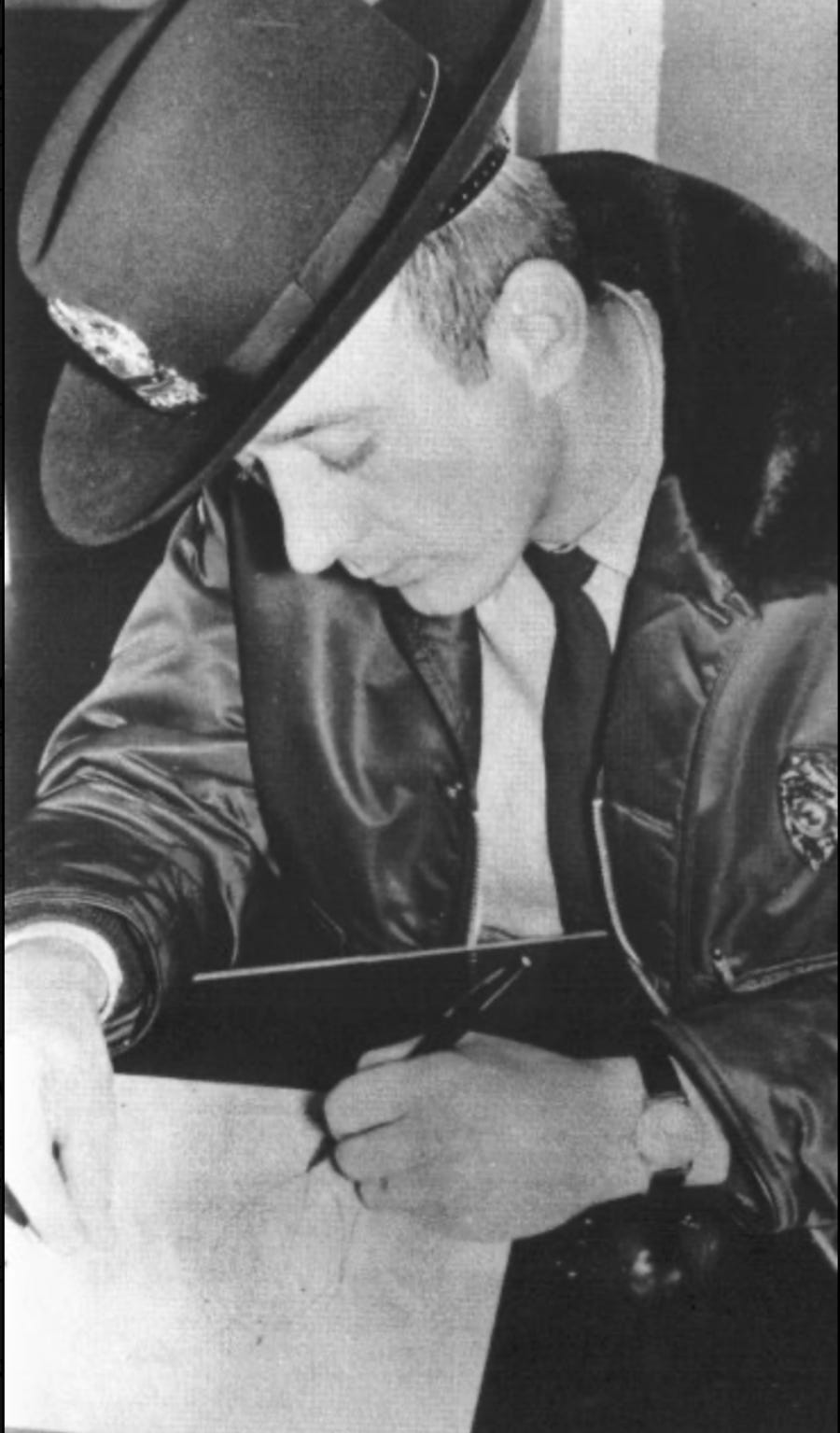
Sergeant Schirmer shortly after his encounter, drawing the object he had seen.
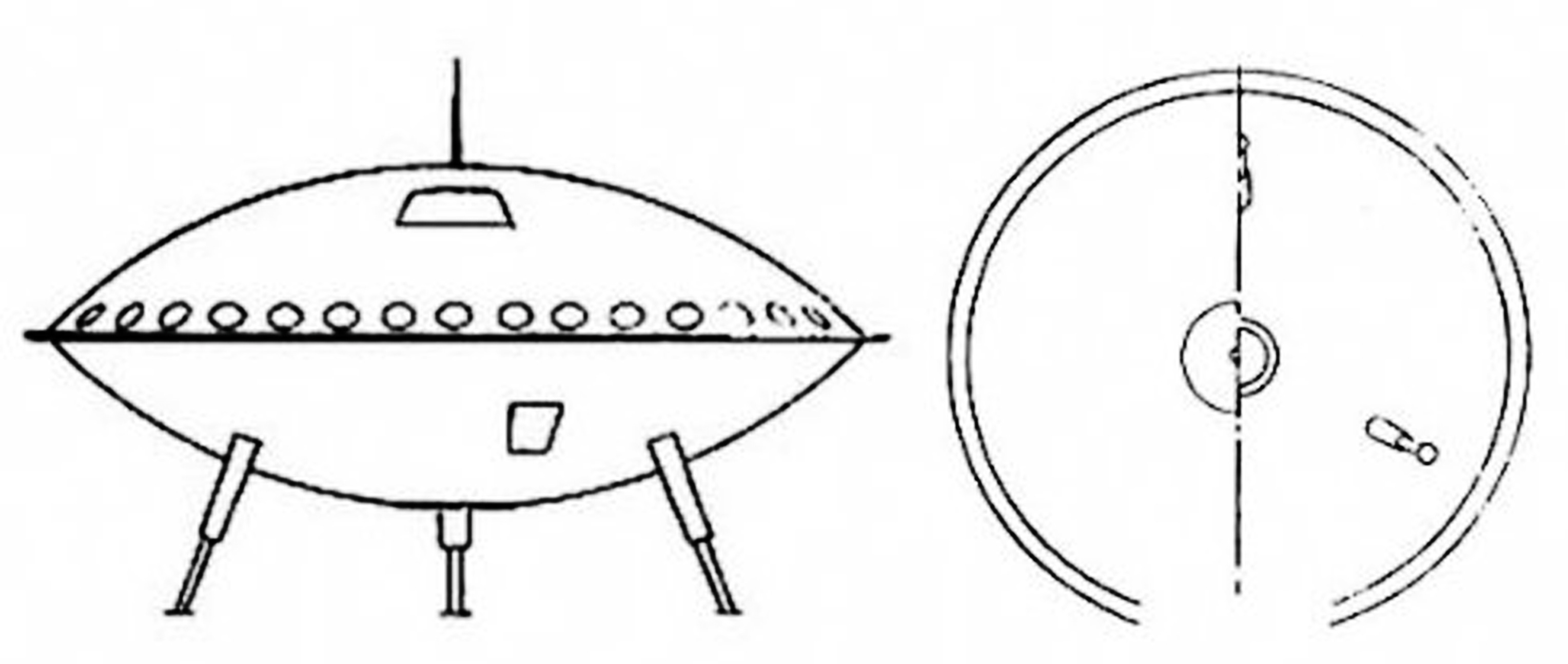
The craft as drawn by Officer Schirmer.
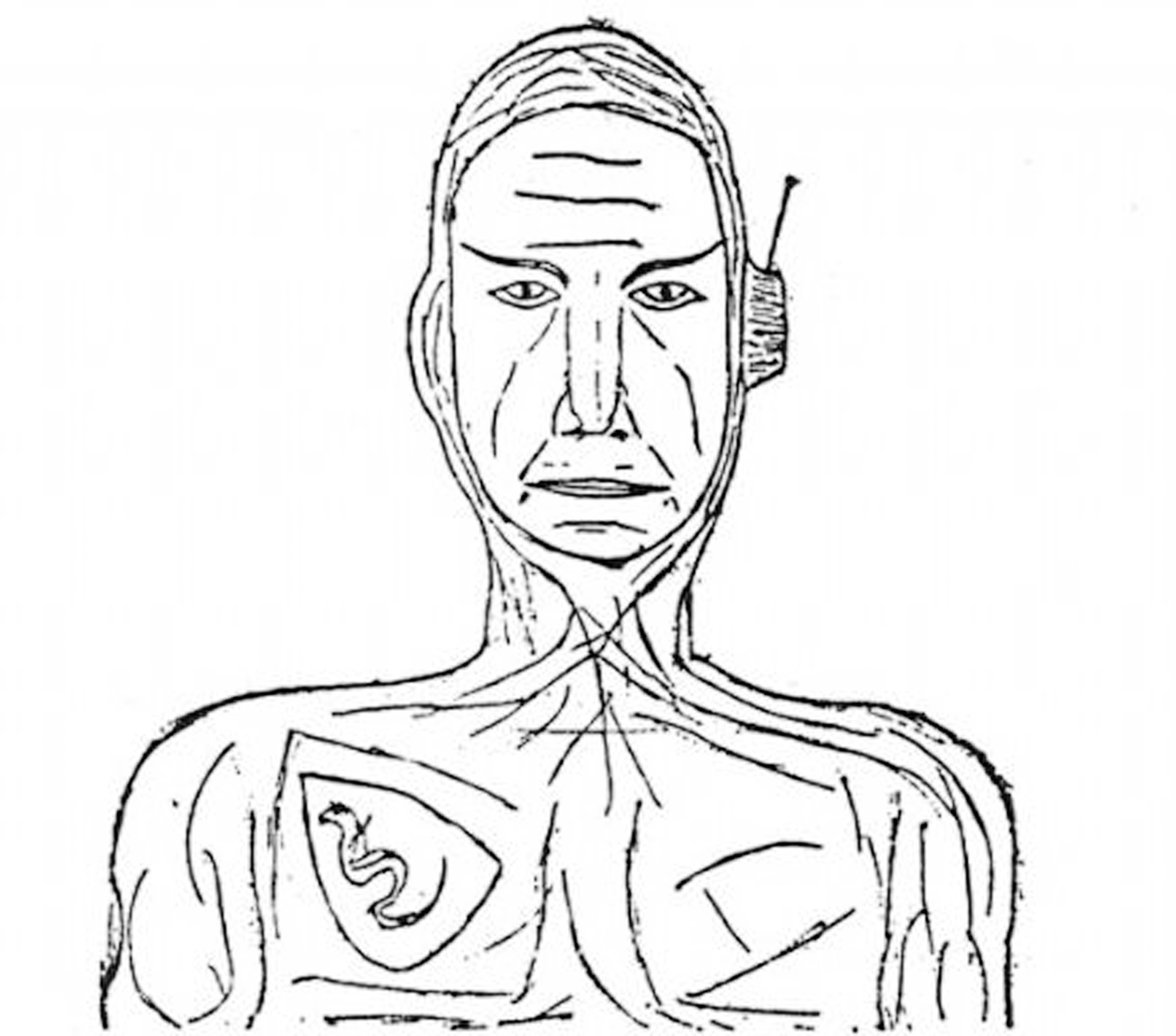
Officer Schirmer’s drawing of the occupant who
spoke with him, and the “winged serpent” emblem
on the uniform.
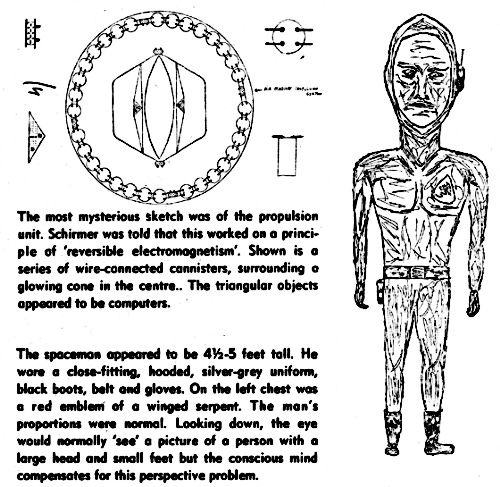
Perhaps the most intriguing drawing was of the propulsion unit. Schirmer was told this worked on a principle of “reversible electromagnetism.” It was a series of canisters connected with two cables, which surrounded a “glowing cone” in the center. The triangular objects were thought to be computer panels.
The occupant was four–and–a–half to five feet tall. He wore a close fitting, hooded, silver-grey uniform, black boots, belt, and gloves. His bodily proportions were normal. After some consideration, Officer Schirmer was certain the “winged serpent” emblem was on the
left side of the occupant’s chest.
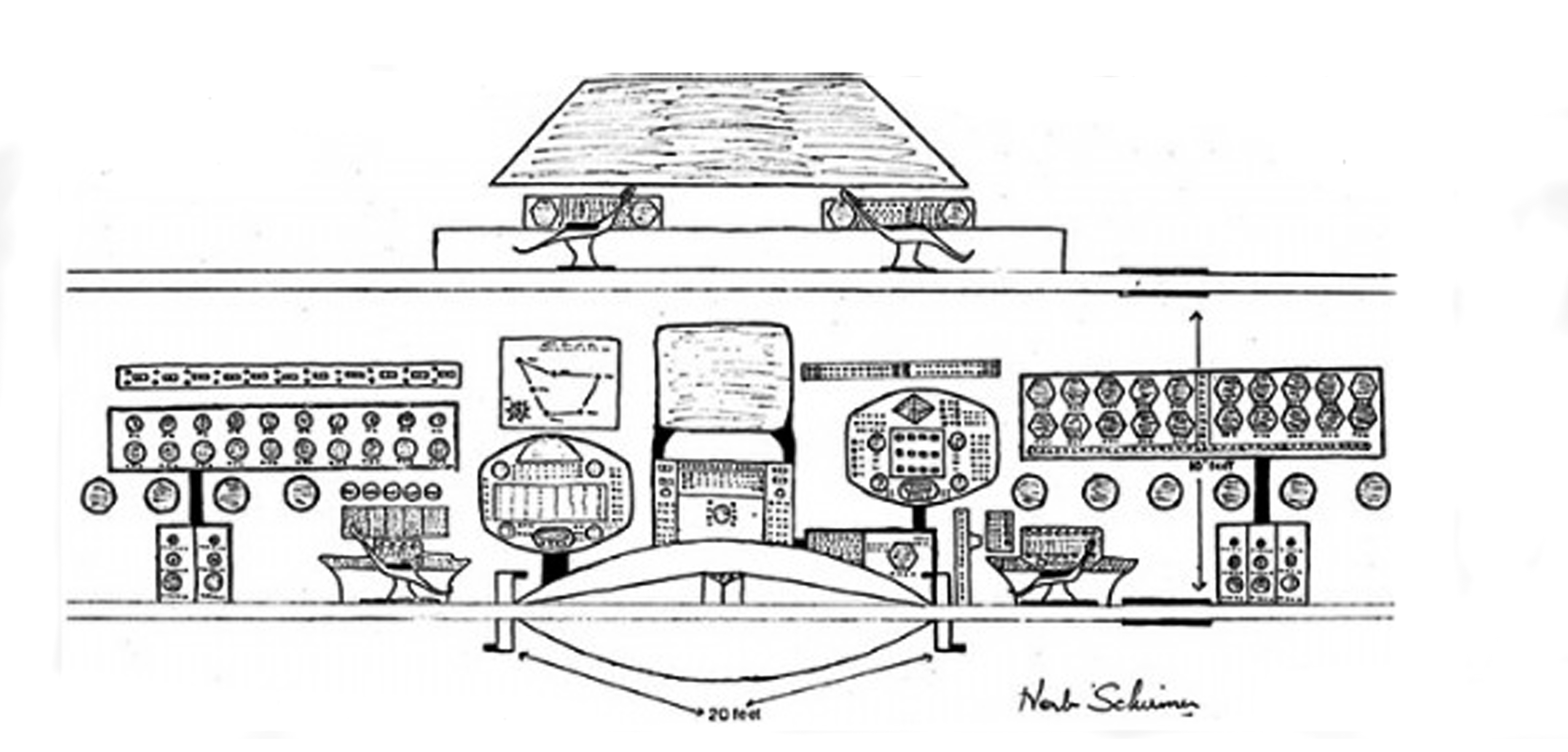
The upper level of the craft as depicted by Schirmer under hypnosis. Among what appeared to be many computers, in the center is a TV-like screen, on which he was shown a star system and told “This is where we are from: a galaxy next to yours.” To the left of the screen was a map, seemingly showing a sun and planets Schirmer couldn’t understand.
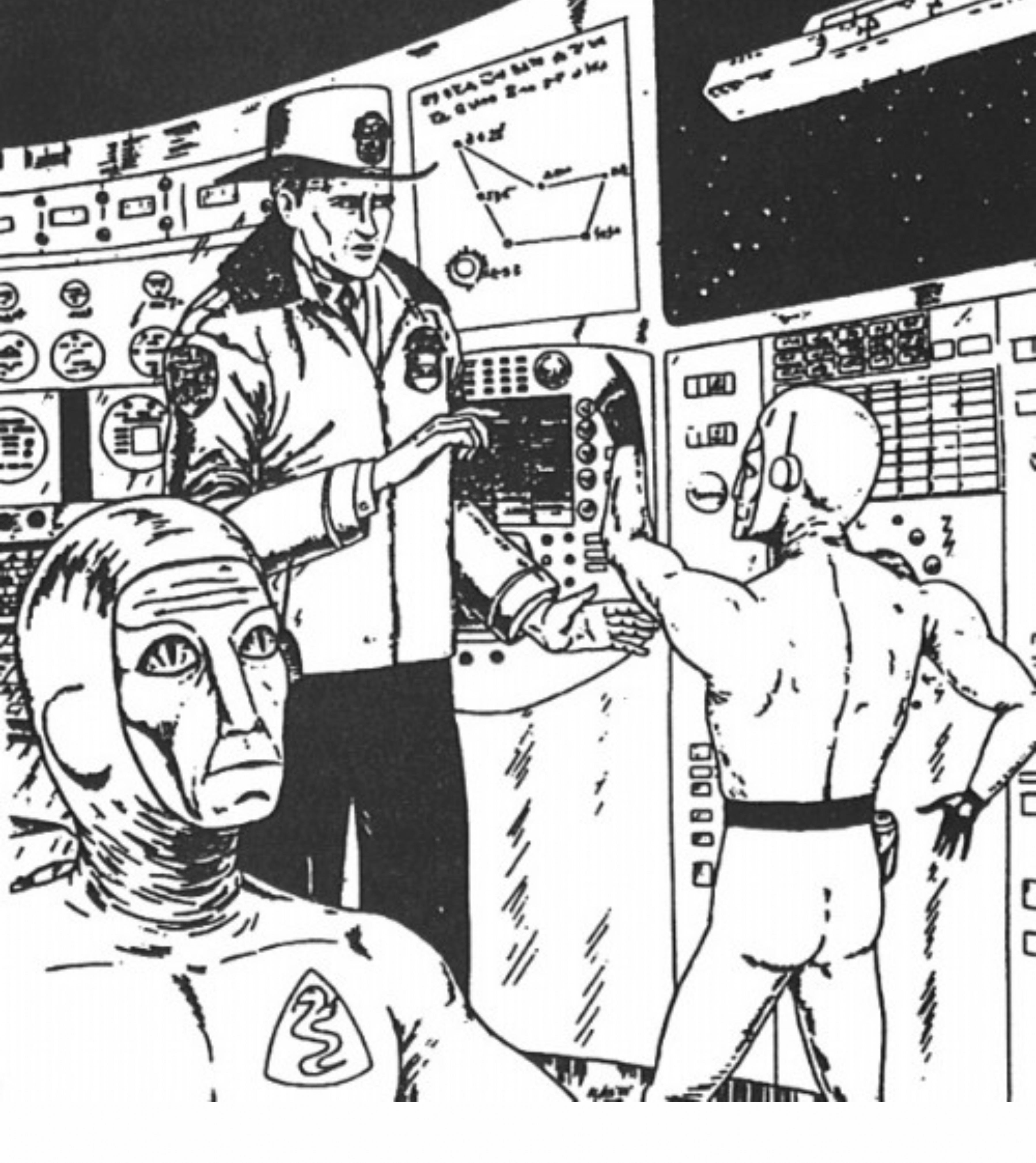
An illustration of Schirmer aboard the craft. Drawing by Wes Crum, after information given by Schirmer under hypnosis. (Credit: Michael Hesemann)
ASSORTED NEWSPAPER CLIPPINGS
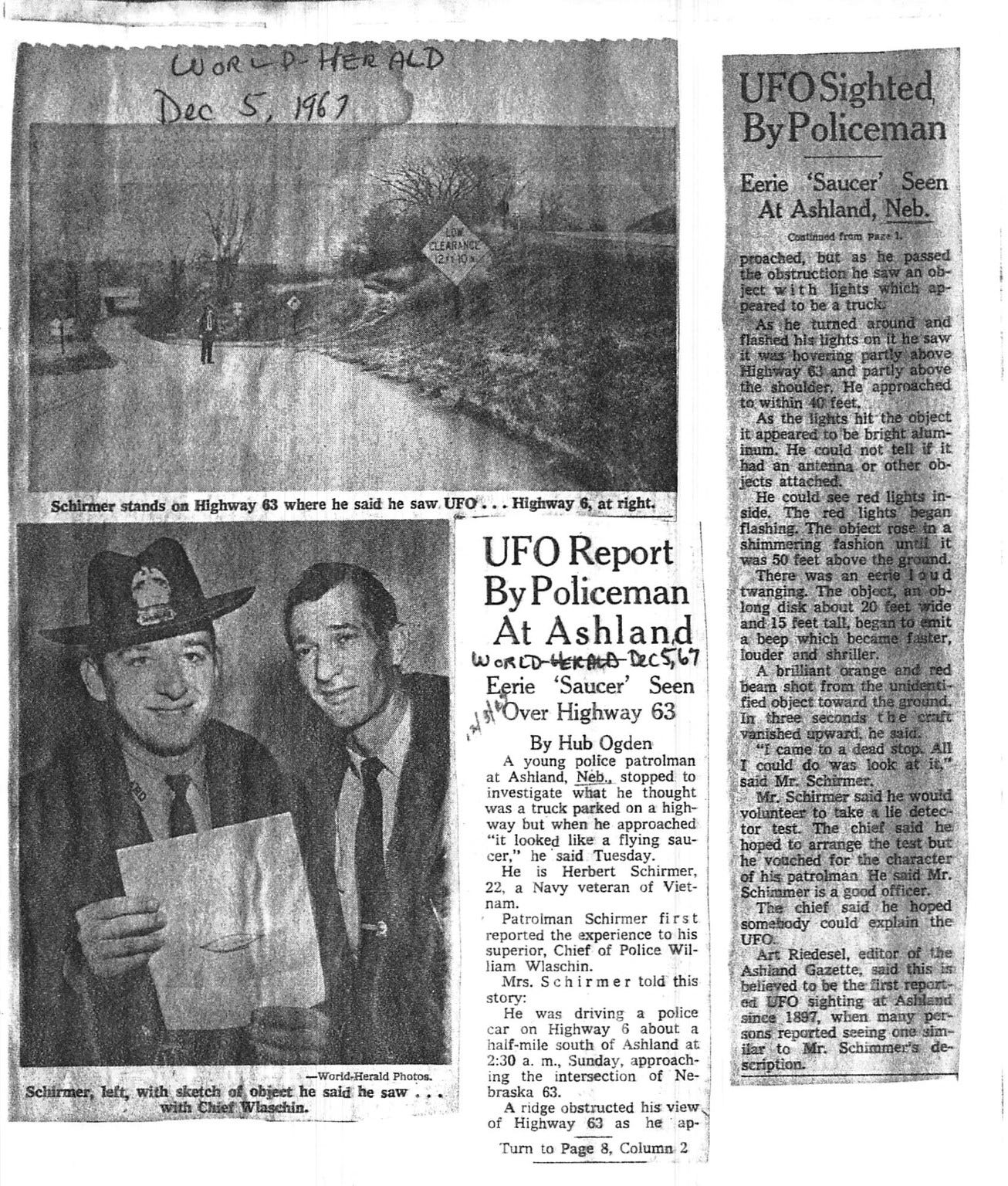
Omaha World Herald, December 5, 1967
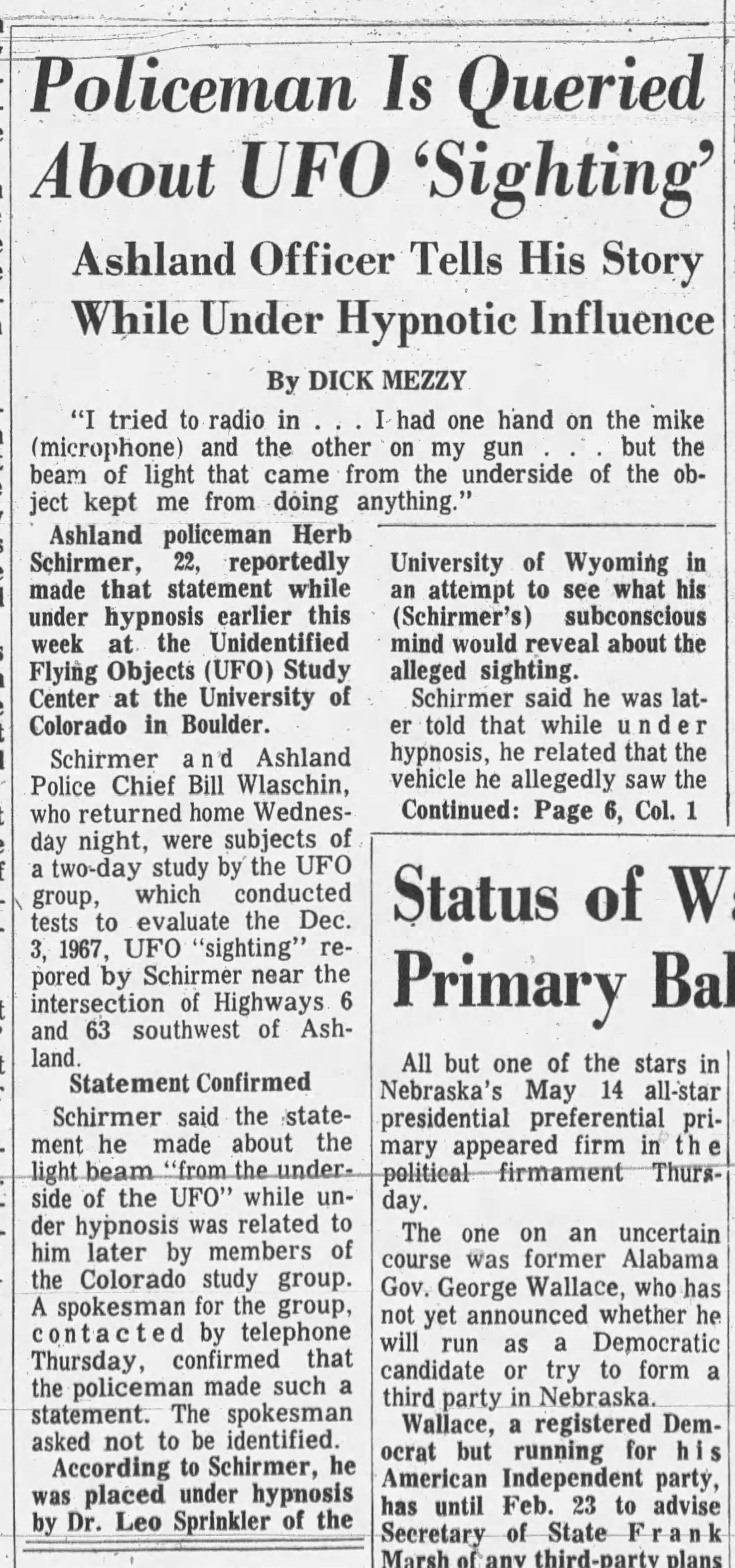
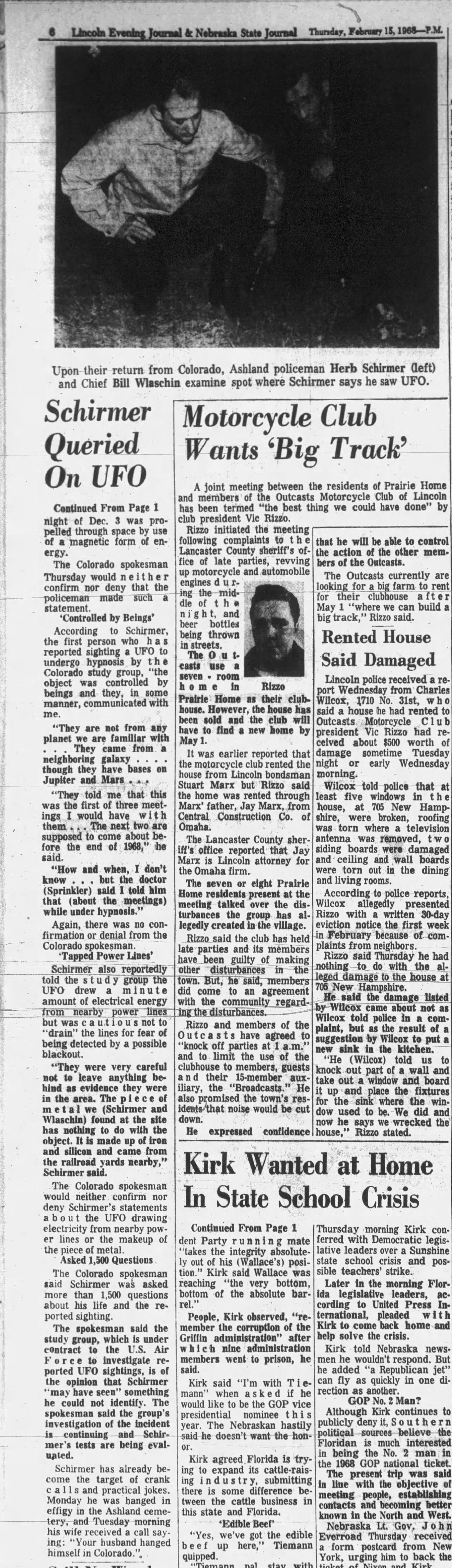
Lincoln NE Journal, February 15, 1968
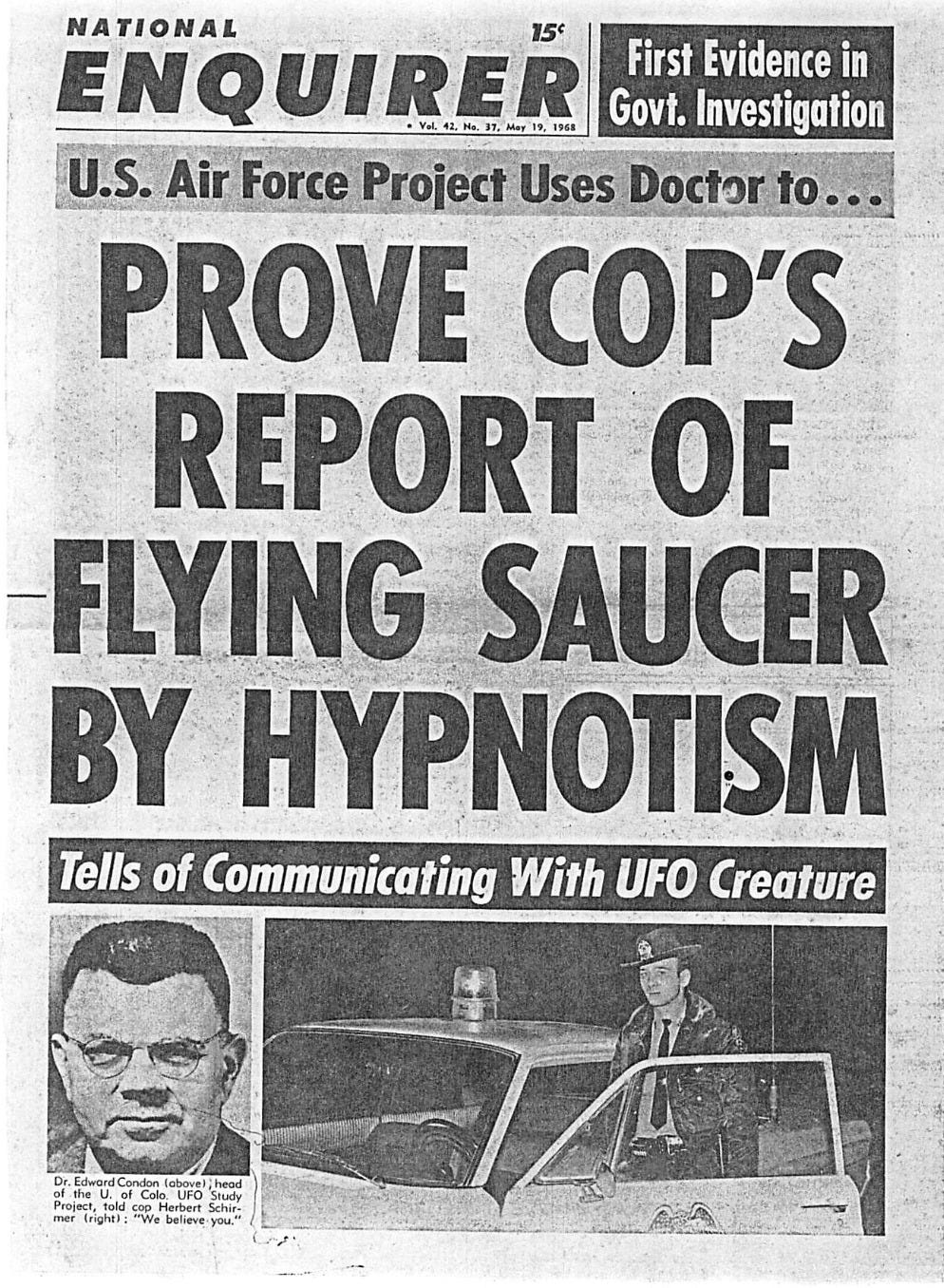
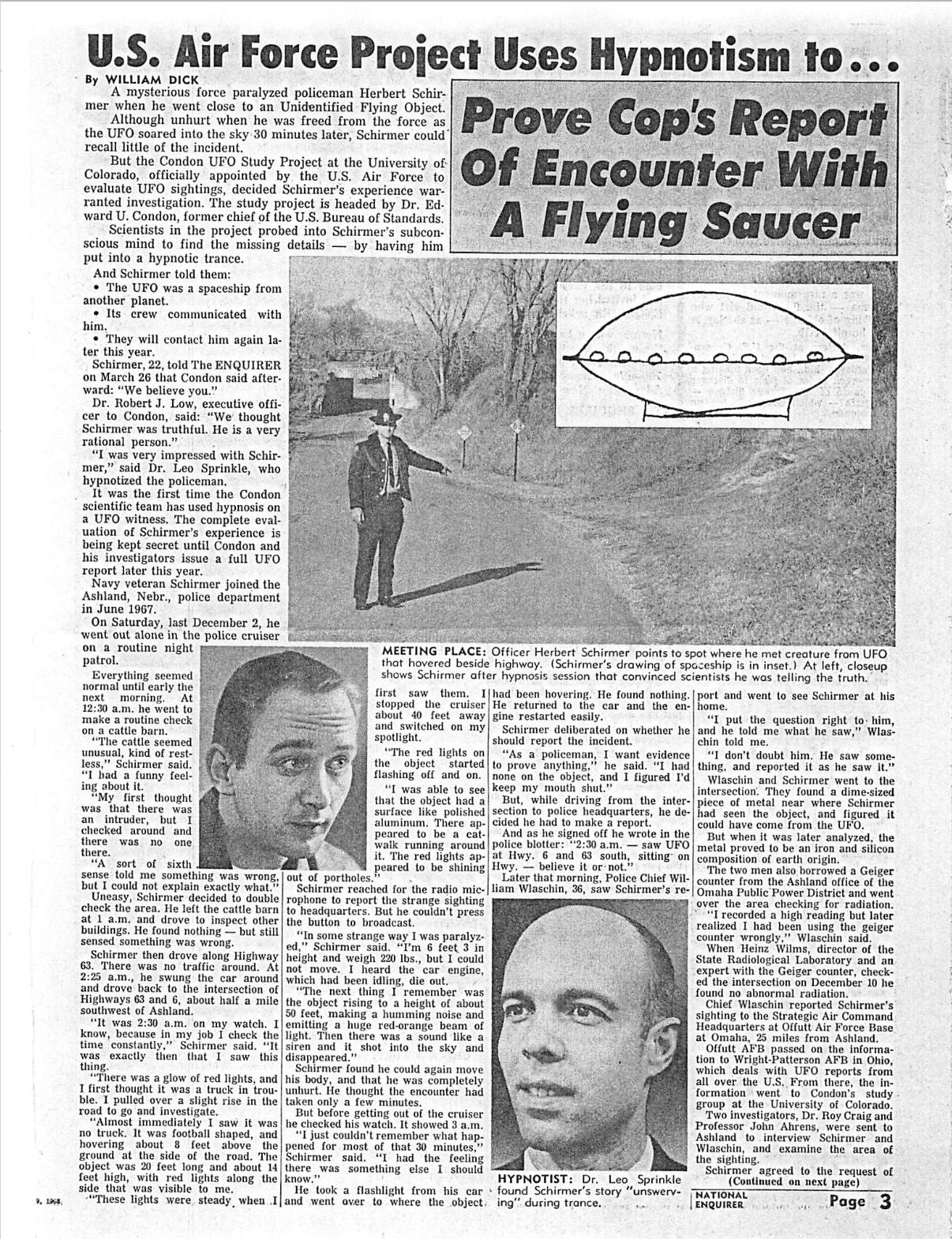
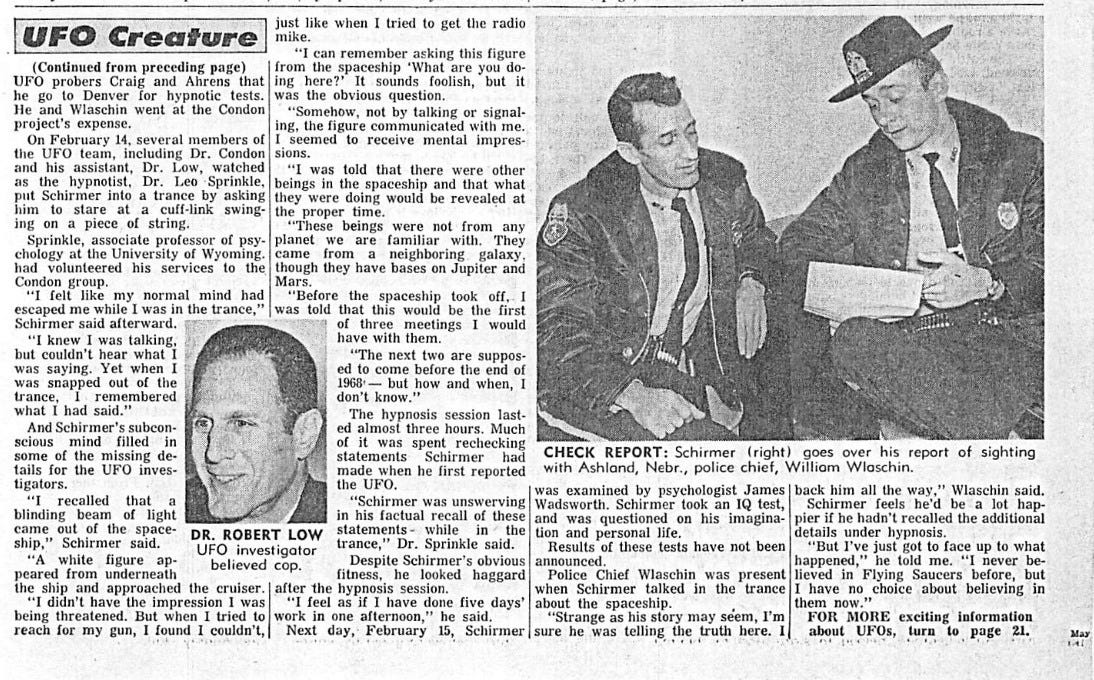
National Enquirer, May 19, 1968
ENDNOTES
1. Edward U. Condon, ed., Scientific Study of Unidentified Flying Objects (New York: Bantam Books, 1969); Eric Norman [Warren Smith], Gods, Demons, and Space Chariots (New York: Award Books, 1970); Eric Norman [Warren Smith], Gods and Devils from Outer Space (New York: Award Books, 1975); Roy Craig, UFOs: An Insider’s View of the Official Quest for Evidence (Denton: University of North Texas Press, 1995).
2. J. Allen Hynek, The UFO Experience: A Scientific Inquiry (Chicago: Henry Regnery, 1972), 1–45. Hynek argues, in substance, that Project Blue Book’s statistical and methodological approach was inadequate to the phenomenon it purported to study and that the residue of genuinely unexplained cases was epistemologically significant.
3. David Michael Jacobs, The UFO Controversy in America (Bloomington: Indiana University Press, 1975), 190–225; Condon, Scientific Study, 1–6.
4. David R. Saunders and R. Roger Harkins, UFOs? Yes! Where the Condon Committee Went Wrong (New York: World Publishing, 1968), 56–150. Saunders reproduces the Low memorandum and argues, in substance, that the project’s conclusions were predetermined.
5. John G. Fuller, The Interrupted Journey: Two Lost Hours “Aboard a Flying Saucer” (New York: Dial Press, 1966), 3–100.
6. Fuller, The Interrupted Journey, 200–335 (Dr. Simon’s concluding commentary). Simon argues, in substance, that the hypnotically recovered memories are psychologically genuine but that their literal physical reality cannot be established.
7. Kevin D. Randle, “The Schirmer Abduction 40 Years Later,” Fate, May 2008; Chris Rutkowski, Unnatural History: : True Manitoba Mysteries; UFO Abductions, Crop Circles, Hauntings, Sasquatches, (Winnipeg: Chameleon Publishers, 1993).
8. “1967 Alien Abduction Tale Told in Graphic Novel,” Wahoo–Ashland–Waverly Journal, July 10, 2020.
9. Condon, Scientific Study, 397; Randle, “The Schirmer Abduction 40 Years Later.”
10. Hynek, The UFO Experience, 100–120.
11. Condon, Scientific Study, 396; UFO Evidence, “Police Officer Herbert Schirmer Abduction—Ashland, Nebraska, December 3, 1967,” www.ufoevidence.org/cases/case659.htm.
12. Condon, Scientific Study, 396; Randle, “The Schirmer Abduction 40 Years Later.”
13. “A Nebraska Cop’s Alleged UFO Encounter Lives On, Thanks to a Graphic Novel and a Beer,” Omaha World–Herald, May 1, 2025.
14. UFO Evidence, “Police Officer Herbert Schirmer Abduction”; Condon, Scientific Study, 396–97.
15. Condon, Scientific Study, 396–97; Craig, UFOs: An Insider’s View, 1–50.
16. Randle, “The Schirmer Abduction 40 Years Later.”
17. Condon, Scientific Study, 397.
18. Condon, Scientific Study, 397; R. Leo Sprinkle, Soul Samples: Personal Explorations in Reincarnation and UFO Experiences (Columbus, NC: Wild Flower Press, 1999), 1–40.
19. Condon, Scientific Study, 397–98; UFO Evidence, “Police Officer Herbert Schirmer Abduction.”
20. UFO Evidence, “Police Officer Herbert Schirmer Abduction”; Eric Norman [Warren Smith], Gods, Demons, and Space Chariots (New York: Award Books, 1970).
21. Norman, Gods, Demons, and Space Chariots; Ralph Blum and Judy Blum, Beyond Earth: Man’s Contact with UFOs (New York: Bantam Books, 1974), 107–40.
22. Condon, Scientific Study, 398; Randle, “The Schirmer Abduction 40 Years Later.”
23. “1967 Alien Abduction Tale Told in Graphic Novel,” Wahoo–Ashland–Waverly Journal, July 10, 2020.
24. Podcast UFO, “Officer Herbert Schirmer and the UFO,” August 2, 2020, podcastufo.com.
25. Randle, “The Schirmer Abduction 40 Years Later”; Norman, Gods, Demons, and Space Chariots.
26. UFO Evidence, “Police Officer Herbert Schirmer Abduction,” quoting Steiger’s retrospective account of the Williams sessions.
27. Norman, Gods, Demons, and Space Chariots (1970); Eric Norman [Smith], Gods and Devils from Outer Space (1975); Erich von Däniken, Chariots of the Gods? trans. Michael Heron (New York: G.P. Putnam’s Sons, 1968).
28. Blum and Blum, Beyond Earth, 107–40; Randle, “The Schirmer Abduction 40 Years Later.”
29. Condon, Scientific Study, 396.
30. UFO Evidence, “Police Officer Herbert Schirmer Abduction”; Condon, Scientific Study, 396–97.
31. John E. Mack, Abduction: Human Encounters with Aliens (New York: Scribner’s, 1994), 1–60.
32. Mark Rodeghier, UFO Reports Involving Vehicle Interference: A Catalogue and Data Analysis (Evanston, IL: Center for UFO Studies, 1981), 1–30.
33. Hynek, The UFO Experience, 100–120; Randle, “The Schirmer Abduction 40 Years Later.”
34. Fuller, The Interrupted Journey, 60–100; Condon, Scientific Study, 396–98.
35. UFO Evidence, “Police Officer Herbert Schirmer Abduction”; Raymond W. Boeche, “Doctrines of Devils: Religious Messaging in UFO Contact Cases, 1952–2020,” unpublished manuscript, Fortean Research Center, Lincoln, NE, 2024.
36. David Carrasco, Quetzalcoatl and the Irony of Empire (Chicago: University of Chicago Press, 1982), 1–50; Jacques Vallée, Passport to Magonia: From Folklore to Flying Saucers (Chicago: Henry Regnery, 1969), 145–80. Scripture citations from ESV®.
37. Don Berliner and Marie Galbraith, UFO Briefing Document: The Best Available Evidence (New York: Dell, 1995), 45–52.
38. Rutkowski, Unnatural History, 1–40.
39. Hynek, The UFO Experience, 85–99.
40. UFO Evidence, “Socorro/Zamora UFO Incident,” www.ufoevidence.org/cases/case90.htm; Ray Stanford, Socorro “Saucer” in a Pentagon Pantry (Austin: Blueapple Books, 1976), 1–80.
41. Budd Hopkins, Missing Time: A Documented Study of UFO Abductions (New York: Richard Marek Publishers, 1981), 1–30.
42. Elizabeth F. Loftus and John C. Palmer, “Reconstruction of Automobile Destruction,” Journal of Verbal Learning and Verbal Behavior 13 (1974): 585–89; Elizabeth F. Loftus, “The Reality of Repressed Memories,” American Psychologist 48 (1993): 518–37.
43. Elizabeth F. Loftus and Katherine Ketcham, The Myth of Repressed Memory (New York: St. Martin’s Press, 1994), 1–50.
44. Randle, “The Schirmer Abduction 40 Years Later”; Daniel L. Schacter, Searching for Memory: The Brain, the Mind, and the Past (New York: Basic Books, 1996), 1–50.
45. Mack, Abduction, 30–60.
46. Norman, Gods, Demons, and Space Chariots; Condon, Scientific Study, 397–98.
47. Bertrand Méheust, Science–fiction et soucoupes volantes (Paris: Mercure de France, 1978).
48. Jacques Vallée, Messengers of Deception: UFO Contacts and Cults (Berkeley: And/Or Press, 1979), 1–100; Jacques Vallée, Dimensions: A Casebook of Alien Contact (Chicago: Contemporary Books, 1988), 200–40.
49. Vallée, Passport to Magonia, 145–80; Vallée, Messengers of Deception, 50–100.
50. John A. Keel, UFOs: Operation Trojan Horse (New York: G.P. Putnam’s Sons, 1970), 1–50; John A. Keel, Strange Creatures from Time and Space (Greenwich, CT: Fawcett Gold Medal, 1970), 1–30.
51. Keel, Operation Trojan Horse, 150–200.
52. Boeche, “Doctrines of Devils.”
53. 2 Corinthians 11:14 (ESV); 1 Timothy 4:1 (ESV); Revelation 12:9 (ESV). Scripture quotations from the ESV® Bible, copyright © 2001 by Crossway. Used by permission.
54. Boeche, “Doctrines of Devils.”
55. Colossians 2:3 (ESV): “in whom are hidden all the treasures of wisdom and knowledge.”
56. John Calvin, Institutes of the Christian Religion, ed. John T. McNeill, trans. Ford Lewis Battles, 2 vols. (Philadelphia: Westminster Press, 1960), 1.14.13–19.
57. “A Nebraska Cop’s Alleged UFO Encounter Lives On,” Omaha World–Herald, May 1, 2025; “1967 Alien Abduction Tale Told in Graphic Novel,” Wahoo–Ashland–Waverly Journal, July 10, 2020.
58. “1967 Alien Abduction Tale Told in Graphic Novel,” Wahoo–Ashland–Waverly Journal.
59. Blum and Blum, Beyond Earth, 107–40; Randle, “The Schirmer Abduction 40 Years Later.”
60. Mack, Abduction, 1–30; UFO Evidence, “Police Officer Herbert Schirmer Abduction.”
61. Raymond W. Boeche, ed., Bloodless Cuts: The Complete Collected Works of Thomas R. Adams (Lincoln, NE: Lux et Veritas, 2018).
62. “A Nebraska Cop’s Alleged UFO Encounter Lives On,” Omaha World–Herald, May 1, 2025; “1967 Alien Abduction Tale Told in Graphic Novel,” Wahoo–Ashland–Waverly Journal.
63. James E. McDonald, “Science in Default: Twenty–Two Years of Inadequate UFO Investigations,” in UFOs: A Scientific Debate, ed. Carl Sagan and Thornton Page (Ithaca: Cornell University Press, 1972), 52–122.
64. Author’s analytical conclusion from the full body of sources cited throughout.
65. Boeche, “Doctrines of Devils”; Calvin, Institutes, 1.14.13–19.
66. Author’s analytical synthesis.
67. McDonald, “Science in Default,” 52–122. The AAAS symposium was held in December 1969; the paper was published in Sagan and Page, eds., UFOs: A Scientific Debate.
68. Raymond W. Boeche, ed., Bloodless Cuts: The Complete Collected Works of Thomas R. Adams (Lincoln, NE: Lux et Veritas, 2018). The FRC case archives covering Nebraska anomalous phenomena are maintained by this author in Lincoln.
69. Randle, “The Schirmer Abduction 40 Years Later,” provides the most detailed analysis of the potential influence of Smith and Steiger’s prior beliefs on the Williams sessions’ content.
70. The acoustic effects associated with reported UFO craft are surveyed in Peter A. Sturrock, The UFO Enigma: A New Review of the Physical Evidence (New York: Warner Books, 1999), 1–60.
71. The comparative craft morphology analysis draws on the UFOCAT database as described in Thomas E. Bullard, “Abduction Phenomenon,” in Jerome Clark, ed., The UFO Encyclopedia, 2nd ed. (Detroit: Omnigraphics, 1998), 1:1–28.
72. McDonald, “Science in Default,” 52–122. The specific pattern of positive case–level findings generating negative summary conclusions is analyzed at 85–110.
73. Mack, Abduction, 1–60, provides the clinical framework for understanding the post–encounter psychological pattern in abduction witnesses.
74. The absence of radioactivity and its limited evidentiary significance are discussed in Sturrock, The UFO Enigma, 65–120.
75. Jacques Vallée and Eric Davis, Incommensurability, Orthodoxy, and the Physics of High Strangeness: A 6–Layer Model for Anomalous Phenomena, NIDS Monograph (2003), discusses the Trans–en–Provence case and its physical evidence analysis. The GEPAN investigation is documented in Vallée, Dimensions, 1–30.
76. The comparative analysis of 1960s close–encounter cases draws on Hynek, The UFO Experience, 85–140, and Bullard, “Abduction Phenomenon,” in Clark, ed., The UFO Encyclopedia.
77. The problem of corroborated hypnotic content is discussed generally in Mack, Abduction, 30–60, and specifically in relation to physical marks in Sturrock, The UFO Enigma.
78. Condon, Scientific Study, 397–98 (the resistance episode); Sprinkle, Soul Samples, 1–40 (Sprinkle’s retrospective characterization).
79. Boeche, “Doctrines of Devils.” The relationship between the DFH and the secular control system hypothesis is developed in this manuscript with reference to the broader contact case literature.
80. The UAP disclosure context is documented in Leslie Kean, UFOs: Generals, Pilots, and Government Officials Go on the Record (New York: Harmony Books, 2010), and in the congressional UAP hearing records from 2022 forward.
81. “1967 Alien Abduction Tale Told in Graphic Novel,” Wahoo–Ashland–Waverly Journal, July 10, 2020; “A Nebraska Cop’s Alleged UFO Encounter Lives On,” Omaha World–Herald, May 1, 2025.